cornwallguide.html
Introductory Guide
Recovered from Oliver's original site crawl. Rendered as plain text so compromised live-site markup is not carried into the mirror.
Oliver's Cornwall - Introductory Guide
Oliver's Cornwall An Introductory Sightseeing Guide
Antony House Ken-Caro Garden St. Mawes Castle
Text and images should align.
To view this page at its best, adjust your zoom so the page uses full screen width
This is a brief introduction to most of the subjects covered in these pages - homes, gardens, castles, museums, art galleries, churches and other holy places, towns, villages and antiquities. A miscellanea page covers those subjects that seem not to fit elsewhere. For detailed reviews go to my Cornwall Reviews pages - index below. For opening information try Hudson's annual guide.
Oliver's Cornwall underwent some major changes during 2010 and 2011. I realised that increasingly visitors are coming to the site looking for walks. I have, therefore, created a new page - Oliver's Cornwall Walking Pages . This links to individual pages including Cornish Coast Path, Inland Trails, Coast-to-Coast Trails, Coastal Round Walks and Bodmin Moor Walking.
INTRODUCTORY GUIDE CONTENTS
Homes Gardens Castles Museums & Galleries Holy Sites & Churches Antiquities Towns & Villages Walking Pages
CORNWALL REVIEWS INDEX and SITE CONTENTS
Introductory Guide What's New? Oliver's Cornwall Walking Pages Homes Gardens Museums & Galleries Countryside
Holy Sites & Churches Antiquities Castles Towns & Villages Miscellanea Home Page Contact Me
© Copyright Oliver Howes 2016 Page updated 20 November 2020
Homes
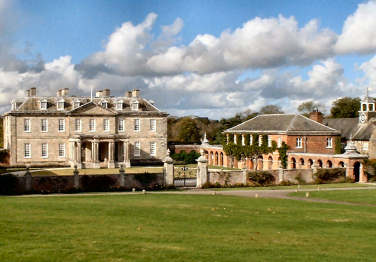
Cornwall may not have the many great aristocratic mansions of English counties such as Yorkshire and Derbyshire or of the Scottish Borders. It can, however, boast a wide variety of somewhat smaller homes open to the public. Of the eleven which open regularly, four are still private homes, six are in the care of the National Trust, the other, Mount Edgcumbe on Plymouth Sound opposite Plymouth, is managed by Plymouth City Council. They are nicely spread across the whole of Cornwall, from Mount Edgcumbe in the south east to St. Michael's Mount in the far west. The range is from amazing medieval St. Michael's Mount, Tudor Godolphin and Cotehele, through Georgian Antony and Pencarrow, to vast part Tudor, part Edwardian Lanhydrock. Our favourites are Antony for its sheer elegance and woodland garden, Cotehele for its antiquity, gardens and location, Pencarrow for its family's determination to keep it going and Trewithen for its charming guided tour. Private homes all have obligatory guided tours, National Trust homes are self-guide with docents in each room, Mount Edgcumbe is also self-guide. All have gardens open. Entry charges are still mostly a great deal more reasonable than they are at many homes in England and Scotland.
Georgian Antony House in far south-east Click here to go to detailed reviews of Cornwall's Homes
Return to top of page
Go to Home Page for general index of detailed reviews
Gardens
Nowhere in the British Isles will you find such a concentration of gardens open to the public. Most, when they think of Cornish gardens, will think of the spring gardens. Indeed, Argyll notwithstanding, Cornwall has the finest collection of spring gardens anywhere on these islands. But there is so much more than just that and some of the all-season and summer gardens are truly outstanding. Altogether Cornwall's regular opening gardens number more than forty ; many others open occasionally for such worthy charities as the NGS and RNLI.
Spring Gardens - our favourites include the National Trust's Glendurgan and Trengwainton, and private Caerhays, Trewidden, Tregothnan and Trebah. All are on or near the south coast.
Summer Gardens - our especial favourites are Ken-Caro, Marsh Villa and Trist House. Most of the private gardens tend to be quiet.
All Season Gardens - we particularly like Heligan, Pinetum Park , Trevarno, Trelissick and Cotehele. And we enjoy walking the Lanhydrock Estate.
Other Gardens - several are attached to nurseries ; most disappoint.
Village Gardens - we try to visit villages on charity days, when many villagers open their gardens. Our especial favourites so far have been Porthscatho and St. Tudy. We have also enjoyed Warleggan.
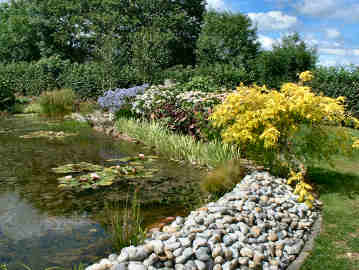
Click here to go to detailed reviews of Cornwall's Gardens The lower pond at Ken-Caro near Liskeard
Return to top of page
Go to Home Page for general index of detailed reviews
Castles
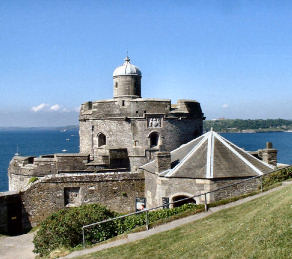
Cornwall has substantantially less (and less substantial) fortifications than England, Scotland and Wales. You would certainly come to Cornwall to visit homes, gardens, mine ruins and antiquities - and, of course, for the superb walking on the coast and the moors. It is unlikely that you would come here solely to visit castles. Nonetheless, if you are in Cornwall, some of the castles may be worth including in your itinerary. Most castles are in the care of English Heritage but Pengersick is in private hands and Castle-an-Dinas (castle in name only) is on open land. Oldest of all is Castle-an-Dinas, a massive iron-age hill fort nesar. St. Columb. Perhaps it should be under antiquities : I have included it for its name and views. Tintagel is probably next oldest if the Arthurian legends are to be believed. Norman and medieval castles are now no more than ruins ; of these ruins Launceston is most easily accessible, Restormel most romantic. The rump of Pengersick is still lived in. Henry VIII's coastal artillery forts still stand complete : Pendennis and St. Mawes were even manned in the two world wars. Views from both are superb, particularly from St. Mawes Castle which takes in the full sweep of Falmouth Bay. There are also some Tudor fortifications on the Fowey estuary, at Readymoney Cove and across the river at Polruan.
St. Mawes Castle looks across to Falmouth Click here for detailed reviews of Cornwall's Castles
Return to top of page
Go to Home Page for general index of detailed reviews
Museums and Art Galleries
Cornwall has no major international museums as do London, Edinburgh, Glasgow and elsewhere. What it does have, however, is three important histories - maritime, industrial and artistic - and these contribute Cornwall's most entertaining museums and galleries. Many towns also have small local museums.
Industrial - Major tin and copper mining areas were in West Penwith, around Camborne and St. Agnes and on Bodmin Moor. Important museums are Cornish Mines and Engines at Pool and Levant Mine and Geevor Mine in West Penwith. You should also seek out mine remains, such as Wheal Coates, in all these areas. You will also find Wheal Martyn china clay museum near St. Austell, a submarine cable museum at Porthcurno and a small Marconi Centre on the Lizard.
Maritime - With such a maritime history it surprises that there is only one major museum, the National Maritime in Falmouth. The Shipwreck, Rescue and Heritage Centre in the charming Georgian port village of Charlestown is also worth seeing and there are tall ships moored there, too. And the fishing harbours at Newlyn, Looe and Padstow are all well worth seeing.
Art Galleries - Important galleries are Penlee House in Penzance, the Tate and the Barbara Hepworth collection in St. Ives, Falmouth Gallery and the Royal Cornwall Museum in Truro. The number one place for artists studios and galleries is St. Ives ; colonies, too, in St. Just-in-Penwith and St. Agnes.
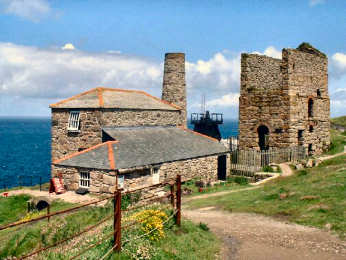
C lick here for full reviews of Cornwall's Museums & Galleries Levant Mine Museum in West Penwith
Return to top of page
Go to Home Page for general index of detailed reviews
Holy Sites and Churches
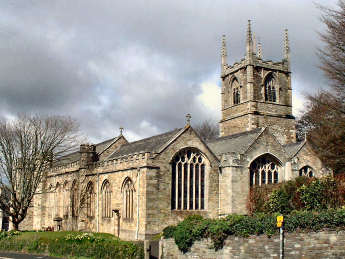
With the fall of the Roman Empire, the spread of pagan tribes from east and north meant that Christianity was virtually extinguished through Europe. The exception was Ireland and it was from there that the religion spread back through Europe. The major route was through Wales, Cornwall and Brittany. That probably explains why Cornwall has so many saints' names in towns and villages and why so many churches are dedicated to saints unheard of otherwise - the itinerant holy men founding small communities on their way to continental Europe - and why there are so many holy wells and Cornish (Celtic) crosses to be found. Though not the earliest of Cornish saints, Petroc is looked on as father of the Cornish Church ; Piran, slightly earlier than Petroc, also has great importance as patron saint of tin miners. There are few churches of great size or great significance. Even Truro cathedral is of fairly small scale and St. Petroc's in Bodmin is probably the grandest parish church. St. German's in the far south-east is an exception, its size explained by its having once been a major monastic church and, for a while, the seat of a bishop. Our favourites include St. Winwaloe and St. Just-in-Roseland for their locations and St. Neot for its medieval glass. A feature that we particularly enjoy in many Cornish rural churches is their striking ancient carved bench ends.
St. Petroc's Church in Bodmin, Cornwall's largest
Click here for reviews of Cornwall's Holy Sites and Churches
Return to top of page
Go to Home Page for general index of detailed reviews
Antiquities
Nowhere in mainland Britain will you find a greater concentration of antiquities than in Cornwall. In this broad category I include not only the prehistoric but also all the lost settlements high on the moors in the two major areas where you find antiquities - West Penwith and Bodmin Moor. So my period covers neolithic and bronze age barrows, stone circles and quoits (dolmens), iron age hill forts and promontory forts (cliff castles), several iron age villages, and early Christian remains such as inscribed stones, holy wells and Cornish crosses. Not everything that you might classify as an antiquity is on my antiquities page. So you should also look on my Holy Sites and Churches page for some early Christian sites and on my Miscellanea page for items on Cornish crosses and boundary stones. You will also find a lot of photos of these and other antiquities amongst my walks in West Penwith (found on my Countryside pages), my walks on Bodmin Moor and my walks on various trails ( Inland Trails page). What appears on the Antiquities page is what I consider to be the major sites. In the index to that page I have indicated those that are easy of access. Many of the best need stout walking boots, the ability to read a map and use a GPS and sometimes a fair degree of stamina.
Click here - full reviews of Cornwall's Antiquities Chysauster Iron Age village in West Penwith
Return to top of page
Go to Home Page for general index of detailed reviews
Towns and Villages
It would be easy to think that all the significant towns and villages are on the coast. It quite surprised me to realise that a third of those I describe here are actually inland, if only a little way. There is quite a cross section - from well known resorts like St. Ives, Penzance and Newquay, run-down towns like Bude, Hayle and Portreath, tiny harbours like Port Quin and Penberth and minute settlements like St. Winnow, through lovely fishing villages and quiet inland villages, to towns as diverse as Launceston with its impressive church and ruined castle, the charming little planned town of Lostwithiel, and even one city, Cornwall's capital Truro. Choosing favourites from such a diverse range, and from the almost fifty I describe, is difficult. If pressed, I think I would opt for St. Ives for its higgledy-piggeldy streets, its artists colony and its sheer charm ; Newlyn for its busy fish harbour and interesting back streets ; Penberth Cove for its careful conservation by the National Trust ; Lostwithiel for its medieval planned layout, its antique shops and its pubs, restaurants and cafés ; St. Just in Penwith for its mining history and art galleries ; Zennor for is rugged rural charm and coastline ; St. Winnow for the walk there from Lerryn ; and St. Mawgan for its church, pub, Japanese garden - and the walk there from Mawgan Porth.
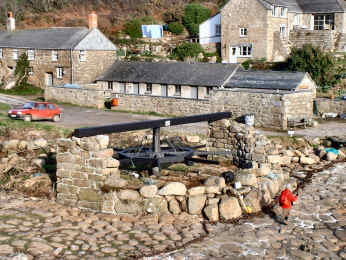
The boat winch at Penberth Cove (NT)
Click here for full reviews of Cornwall's Towns and Villages
Return to top of page
Go to Home Page for general index of detailed reviews
Oliver's Cornwall Walking Pages
This is what we love most about Cornwall, the glorious landscapes of open moorland, secret valleys, soaring cliffs - and over 300 miles of unbeatable coast path hiking trail. We hope you will enjoy our descriptions of our favourite countryside and walks - and will try some of them for yourselves. Now that I am revising this site, I have divided my new Walking Pages section into five parts. These are the Cornish Coast Path, Coastal Round Walks, Trails, and Country and Moorland Walking, the latter mostly on Bodmin Moor. Every walk that I describe I have walked at least once, usually several times. For my new pages, I am now including full walk directions and GPS data. As I revise existing pages I shall, in some instances, include GPS data where it may be helpful. Cornwall's coast and country are so glorious that it is truly difficult to choose favourites. Probably I would settle for the north coast between Pentire Point and Port Isaac, the north coast of West Penwith, the high moorland of West Penwith and of Bodmin Moor, and the creeks on the River Fal.
In 2010 I undertook a serious revision of this site. Major feature of that revision is a new empasis on walks. There are completely new pages for the Cornish Coast Path, Round Walks from the Coast Path, Round Walks on Bodmin Moor and other Inland Round Walks. These pages, along with my Trail pages, can now be found through Oliver's Cornwall Walking Pages .
Discover Bodmin Moor on Visit Cornwall
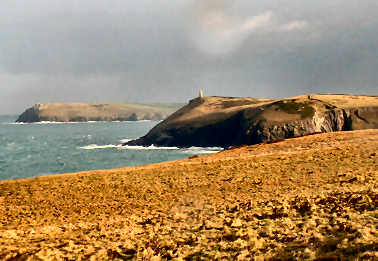
Now go to Oliver's Cornwall Walking Pages Stepper and Pentire Points near Padstow
Return to top of page
Go to Home Page for general index of detailed reviews
CORNWALL REVIEWS INDEX and SITE CONTENTS
Introductory Guide What's New? Oliver's Cornwall Walking Pages Homes Gardens Museums & Galleries Countryside
Holy Sites & Churches Antiquities Castles Towns & Villages Miscellanea Home Page Contact Me
© Copyright Oliver Howes 2016 Page updated 20 November 2020
Recovered photographs