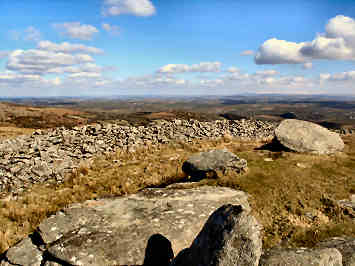
Stowe's Hill near Minions
The most concentrated group of interest on Bodmin Moor is on the south-eastern edge of the moor at Minions. A short walk north from the western car park will bring you to The Hurlers and Pipers, ancient standing stones. Legend has it that the three stone circles of the Hurlers are teams of sportsmen, turned to stone for playing hurling on a Sunday; the nearby two Pipers standing stones provided the musical accompaniment. A longer walk to the north leads to a fascinating area at Stowe's Hill. Here, south of the summit, is Daniel Gumb’s Cave where a simple stone-worker, self-taught mathematician, carved a Euclid theorem on a rock. Climb to the top of the hill, around 1300 feet above sea level, one of the moor's highest points, and you will find the quite amazing Cheesewring, a natural granite outcrop, precariously poised above a quarry. Beyond is a massive stone-walled pound, possibly bronze age, and beyond that a larger walled enclosure. Views over the moor are glorious; to the north you are looking to the high tors of Brown Willy and Rough Tor, to the south you can see the sea as far as Dodman Point, to the east you see Dartmoor. South of the hill, beyond a massive deep ditch, is first a degraded cairn and then the famous Rillaton bronze age barrow. The cist, where the gold Rillaton Cup (original in the British Museum, copy in Royal Cornwall Museum) was discovered, is visible on the barrow's east side.
Stowe's Hill, the prehistoric pound wall
Simple Stowe's Hill round walk see below
STOWE'S HIIL ROUND WALK FROM MINIONS - about 3 miles
Just to the west of the western car park at Minions a track leads north-west to the Pipers standing stones. From here go east to the Hurlers stone circles then roughly north-east to a low hill. Here is Rillaton bronze age barrow, just to its north a degraded cairn. Now head roughly north-west, directly towards the summit of Stowe's Hill. After crossing a massive embanked ditch (I don't know its purpose) you can see Daniel Gumb's cave ahead. From the cave, climb Stowe's Hill to the Cheesewring to explore the amazing rock formations within the bronze age walled pound and enjoy the wonderful views. If you then descend the hill by the same route, past the massive ditch, you can turn east on a track to cross the former tramway to Cheesewring quarry and follow the left-hand hedge down to another tramway. Turn right on this to return to the eastern car park in Minions village. Another mineral tramway leaves Minions heading south for Crow's Nest.
More in Antiquities
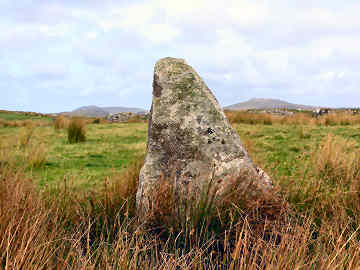
Stripple Stones
I sought out Cornwall's largest - and most unusual - stone circle during a walk in September 2006 that took in King Arthur's Hall, Garrow Tor and Hawk's Tor. The Stripple Stones is a most unusual site because it is Cornwall's only stone circle standing within a henge (circular bank and ditch) - if there were other such henges they have degraded so much as to be unidentifiable these days. The henge is about 225 feet in diameter but now quite shallow and degraded. It seems that no one can agree about how many standing stones there originally were in the circle. Estimates vary from 15 to 28. Only four stand now and the central longstone lies flat. It would be good to see the site cleared and the lost stones re-erected - if they could all be found. Pity is that the location is quite difficult to access so that is unlikely to happen. Location is on the lower southern slopes of Hawk's Tor. It lies on private land but it is to be assumed that the farmer doesn't mind if enthusiasts use his unlocked gates. I was able to approach it from De Lank water works, climbing access land over Carkees Tor and skirting Shallow Water Common before heading south to pass the east side of Hawk's Tor. A fascinating spot and well worth the fairly moderate effort involved in geting to it.
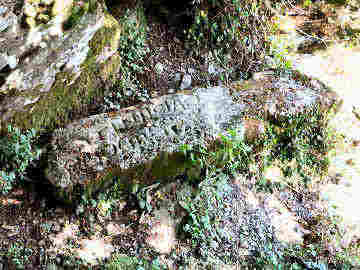
The Arthur Stone at Slaughterbridge, the legendary Camlann
Arthur Stone at Slaughterbridge, the legendary Camlann
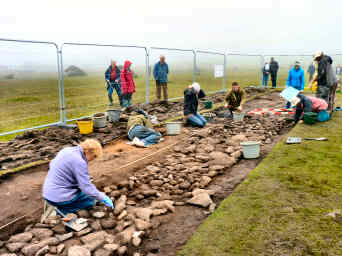
The Crystal Pavement at the Hurlers
Crystal Pavement at the Hurlers