Creed House Garden
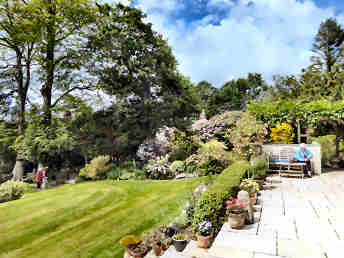
This must surely be Cornwall's most self-effacing garden. Although open to booked groups and occasionally for charity, you will find little mention of it in the usual sources. And there are none of the usual signs pointing to the garden, not even to the hamlet of Creed. An ill signed turning, about a third of the way up Grampound's main street, is actually Creed Lane. A mile down that you turn left just after the church and turn in the first gate on the left. It is worth doing so, as we found in Aigust 2006. The Croggons came to Creed House, the former Rectory, in 1974. The garden had been neglected for years and it was some while before they discovered extra buildings hidden under brambles and bindweed. Since then they have been steadily planting and improving and are now clearing some additional woodland. There are fine specimen trees - both young and old, several small ponds, a stream garden, a bog garden, shrub and herbaceous borders and a couple of lawns. Behind the stable yard is a walled garden with colourful planting around a lawn. The overall effect is very tranquil. Whilst here do take a look at the light and airy church, nestling below the garden, where my father's cousin Bertie was rector for several years before becoming rector at St. Just in Roseland. We visited Creed again in June 2016, found the garden colourful and well tended and enjoyed tea and cakes on the terrace.
1 mile south of Grampound by unsigned lane
We enjoyed tea on the terrace
More in Gardens
Enys Garden near Penryn
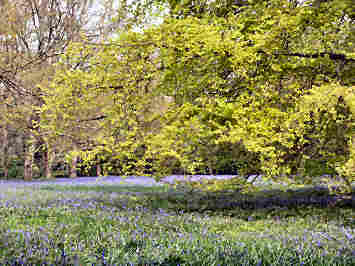
In the same family since Norman times, and reputedly the first Cornish garden to receive public attention, Enys seems to be spoken of with something like awe. Garden writer Timothy Mowle refers to it as 'a sleeping beauty of a garden'. Douglas Ellory Pett, Cornish garden expert, has a brief description in his Cornwall Gardens Guide. So, learning that a Trust had been formed to restore Enys and had applied for Heritage Lottery funding for that purpose, and that it was open a couple of days a week from March to October (and on the first Sunday of each month), we thought that, despite references to 'the first stages of romantic decay', it could be worth visiting. We did so on the first Sunday of May 2006. So did about a thousand others. We are sorry to say that we were very disappointed. We should have guessed, when we passed the gloomy-looking four-square Regency house, looking for all the world like a run-down Anglo-Irish home, that little had been done to the garden except the clearance of a few paths. We would have been right. Nowhere looked as if any effort had yet been made and few rhodos, azaleas or magnolias were in bloom. The guide leaflet was misleading and most people were losing their way in woodland that should have been marked off-limits. The lakes that Pett refers to were not accessible. Frankly, nothing was worth seeing except the wonderful blankets of bluebells in Parc Lye.
Glendurgan and Trebah revisited 2014
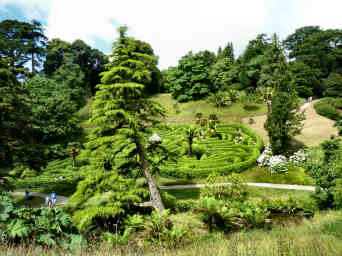
Living, as we do, 40 miles or so from Mawnan Smith, it is not often that we get to see the Helford River ravine gardens. However, a free pass to Trebah encouraged us that way and National Trust membership added Glendurgan. We had expected to prefer Glendurgan to Trebah and were surprised that it didn’t work that way. In the event we found Glendurgan a little colourless and short on views while Trebah seemed full of colour with many delightful views. Glendurgan’s prime feature must be its impressive and well-kept maze, best seen from the high path on the east side of the ravine. Trebah’s is the view north up the ravine from the beach end of the garden, looking across a small lake and past massed hydrangeas in the valley and mature trees on the slopes up to the house. In both gardens we set out on the high western path and returned first on the high eastern path and then on the low central path. In Glendurgan this allows you to see the Schoolroom Summerhouse, in Trebah you get to see the impressive new stone amphitheatre, built in 2014 and already the venue of the Miracle Theatre’s production of ‘The Tempest’. We concluded that the essential difference between the two gardens is that Glendurgan is presented ‘take it ot leave it’ while Trebah is very much a commercial enterprise with shop, plant centre and a good large restaurant/caf�. As members we would like to prefer Glendurgan but have to plump for Trebah.
Glendurgan Garden
Cornwall's south coast is full of sub-tropical valley and ravine gardens, many created by the Falmouth Quaker ship-owning Fox family. Glendurgan was the work of Alfred Fox, nearby Trebah of Charles. Glendurgan's 40 acres run down a valley to the tiny hamlet of Durgan (you can rent a National Trust cottage there) on the Helford River. Specimen trees and tree ferns are quite superb. In spring daffodils, primroses and bluebells provide good early colour; they are followed rapidly by giant magnolias, camellias and rhododendrons. Hydrangeas, other shrubs and wild flowers provide summer colour. There is a large maze of low laurel hedges. As ever with the National Trust, maintenance is immaculate. For a pub lunch try the Red Lion at Mawnan Smith or (at quiet times) the Ferryboat Inn at Helford Passage. Our preference was the Red Lion but the Ferryboat, after a change of hands, is now quite classy. Glendurgan has an alfresco tea shop and ample parking. The garden is signed from Mawnan Smith village, as is adjacent Trebah. If you are a spring garden enthusiast, perhaps you will make a day of the two. If you are interested in following up the Fox Quaker association try the charming Come-to-Good Meeting House near the National Trust's Trellisick Garden. Glendurgan revisited 2014