Trebah and Glendurgan revisited 2014
revisited 2014
Living, as we do, 40 miles or so from Mawnan Smith, it is not often that we get to see the Helford River ravine gardens. However, a free pass to Trebah encouraged us that way and National Trust membership added Glendurgan. We had expected to prefer Glendurgan to Trebah and were surprised that it didn’t work that way. In the event we found Glendurgan a little colourless and short on views while Trebah seemed full of colour with many delightful views. Glendurgan’s prime feature must be its impressive and well-kept maze, best seen from the high path on the east side of the ravine. Trebah’s is the view north up the ravine from the beach end of the garden, looking across a small lake and past massed hydrangeas in the valley and mature trees on the slopes up to the house. In both gardens we set out on the high western path and returned first on the high eastern path and then on the low central path. In Glendurgan this allows you to see the Schoolroom Summerhouse, in Trebah you get to see the impressive new stone amphitheatre, built in 2014 and already the venue of the Miracle Theatre’s production of ‘The Tempest’. We concluded that the essential difference between the two gardens is that Glendurgan is presented ‘take it ot leave it’ while Trebah is very much a commercial enterprise with shop, plant centre and a good large restaurant/caf�. As members we would like to prefer Glendurgan but have to plump for Trebah.
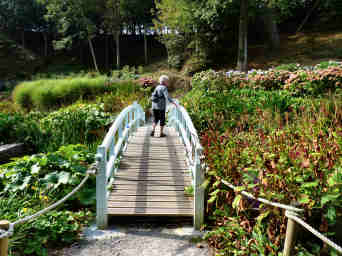
The Monet bridge near the foot of the garden
On this 2014 visit we spotted for the first time, on the right only a little way inside the garden, a serpentine (we think) sculpture of an Austin Healey sports car. This commemorates Cornishman Donald Healey, racing driver and designer of the Austin Healey, who started restoration of the garden while the family lived there from 1961 to 1971.
More in Gardens
Trebah Garden
The renowned Fox family had a hand in the creation of many of Cornwall's finest gardens. Trebah, created by Charles Fox during the 1820s and 30s, is a casual and colourful semi-wild 'ravine' garden of some 25 acres, dropping 200 feet down a sheltered valley to a private beach on the broad estuary of the peaceful Helford River. After some 50 years of neglect, the Hibbert family began restoring Trebah in 1980. It is a garden of many parts and really merits the best part of a morning or afternoon to do it full justice. An impressive Visitor Centre - with shop, caf� and art gallery - is in the form of a tea planter's bungalow. Trebah’s essence is of Cornish Spring Garden - magnolias, camellias, azaleas and giant rhodos - but it is much more. Central in the ravine, a stream garden meanders through ponds and water gardens to the beach on the Helford River; around it are first bamboos, tree ferns and Chusan palms, later a sea of hydrangeas, brilliant in summer. High paths along the ravine offer glorious viewpoints and superb overviews. There is ample car parking. The National Trust's enjoyable and contrasting Glendurgan is very close by. For American interest at Trebah see the box below.
Trebartha Estate
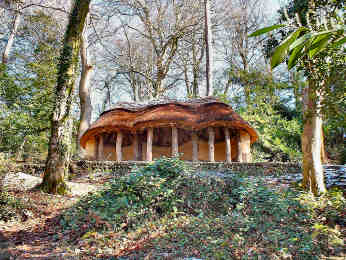
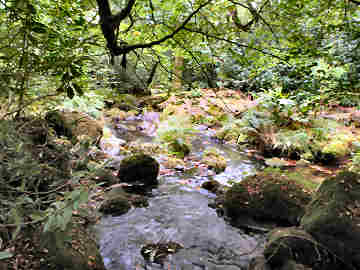
We already knew the area where the Trebartha Estate is, to the south-east of Bodmin Moor. Some years ago we had walked from North Hill, taking in Hawke's Tor and Trewortha Tor. In winter 2006 I had passed through, and admired, Trebartha village, whilst walking the Copper Trail. So, when we heard that Trebartha's landscape garden was to be open for charity one day in September 2006, we jumped at the chance of a visit. Trebartha Hall was built by the Spoures around 1500, destroyed by fire and rebuilt in 1720. Trebartha then passed to the Rodds. After use in the 2nd World War as a military hospital, the hall was almost derelict and new owners, the Lathams, demolished it to build a modern house. Near the car park is a fenced-off well, inside the fencing several old crosses and a direction stone. A path then leads along the River Lynher, past the Swan Pool and into fine mature woodland where a stream casacades down the hillside. Approached separately from the car park, a series of medieval fish ponds form another garden, the pools gradually being restored and planted. We found Trebartha enchanting though not outstanding and we enjoyed the home-made tea and cakes served in the old laundry. We returned in May 2007 to enjoy the spring shrubs.
Tregothnan, a great estate on the River Fal
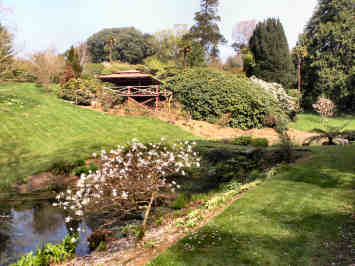
The Boscawens acquired the estate in 1335 when John of Boscawen Ros in West Penwith married the Tregothnan heiress. The original manor house here, probably built by him, was severely slighted by Parliamentary forces in the English Civil War but had been rebuilt by 1652. What you see now is a result of an 1820s remodelling by William Wilkins. The upper part of the 100 acre garden is fairly level and geometrical. To see the very best, though, you need to head for the far corner to access the wilder sloping garden below. Throughout there are fine rhodos, camellias, azaleas and magnolias. You will also find a tree fern avenue, a series of ponds below a tea-house, a young Australian 'dinosaur tree', South American and South African collections, Cornish palms, hebes and masses of primroses. This is not a perfect place - restoration and replanting is under way - but it is sheer delight. We visited in April 2006.