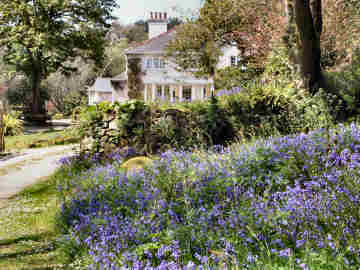
Trewoofe Orchard in the Lamorna Valley
Orchard in the Lamorna Valley
In May 2008 we had a busy gardens day. There are three gardens in the Lamorna Valley - Chygurno, Trewoofe House and Trewoofe Orchard - and, since we would be passing it on the way to Lamorna, we decided to include Trereife as well. Of the four, Trewoofe Orchard was the undoubted star, Chygurno the most remarkable, Trewoofe House pleasant but not outstanding, and Trereife a waste of time (with one honourable exception, the cafe). A great bonus was that bluebells were everywhere.
Like Trewoofe House, Trewoofe Orchard had its origins in the Lamorna artistic colony. The attractive house, approached by a driveway through woodland, was built in 1912 by philosopher Alfred Sidgewick and his novelist wife Cecily Ullman, both part of the colony's social circle. One of the garden's great attractions is its division into two by a stream. On the house side of the stream are island beds, several levels of borders and some spring shrubs. Along the stream are a waterfall, a pond and ferns, bamboos and arum lilies. On the far side of the stream is beech and oak woodland, paths meandering through it. At the time of our visit the woodland was blanketed with bluebells. We had a long chat with owner Mrs. Waterson which made our delight with this, our favourite garden of the day, even greater.
On B3515 Newlyn-Lamora, opposite Lamorna turn
Bluebells on approach to Trewoofe Orchard
More in Gardens
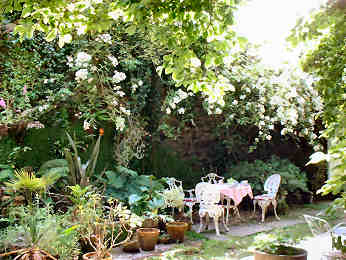
Trist House Garden at Veryan
Trist House was built around 1830 by Samuel Trist, vicar of Veryan and son of the man who built the village's famed 'round houses'. Much of Samuel's garden had been lost when Graham and Brenda Salmon bought the house in 1994. They have restored some features - including Italianate terraces and a giant rockery - and added many more. For a garden that, at the time of our visit, was mostly only ten years old it seemed remarkably mature. Amongst the delights are a rose pergola, a hydrangea walk, wisteria beds, a dell garden, a wild rose garden - and the view from the house over the Italianate terraces to a luxuriantly planted border. Do be sure to include the part of the garden across the drive or you will miss some of these features and the large rockeries which were under restoration at the time of our visit in June 2004. Excellent cream teas are served in a charming courtyard behind the house. There is only a small amount of parking but it rarely gets busy and, if it does, there is space to park in the village and walk up.
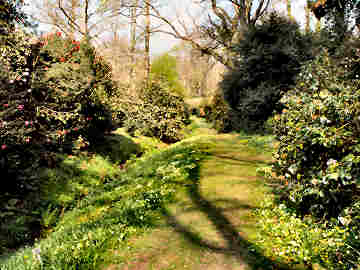
Antony Woodland Garden
We had been round Antony Woodland Garden previously but I got few photos then. On this occasion, in April 2007, I took plenty of photos, so I felt it was time for a report. Antony House and its garden are in the care of the National Trust. The Woodland Garden remains in the ownership of the Pole-Carew family but is free to members of the NT when the house is open. If you go to Antony, on the Rame Peninsula, to visit house, garden and woodland garden you would do well to allow most of a day; the full circuit of the woodland garden is the better part of five miles and there is a lot to linger over. The woodland garden has its own car park, close to the warden's lodge. The western part of the garden has the major spring interest: hundreds of superb camellias, abundant magnolias, azaleas and rhododendrons, lovely mature woodland with carpets of primroses and bluebells. For part of the way the path follows the River Lynher with views to Ince Castle and Anthony Passage. Sculpture is dotted around and you see a Georgian bath house. The eastern part overlooks the Lynher and the Hamoaze with views to Trematon Castle and the Tamar Bridges. Just off the path is an ancient dovecot. A lovely place for a fairly serious walk. And, if you are visiting the house, its more formal garden is a delight, too.
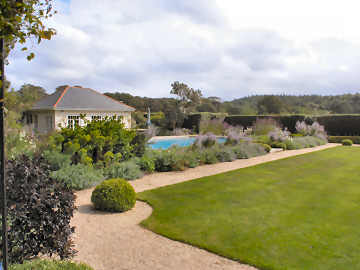
Bonython Garden
The Bonythons are one of those ancient Cornish families that seem to have disappeared off the Cornish map. They had been at Bonython on the Lizard since the 10th century or earlier and their estate stretched across the Lizard from Poldhu Cove in the west to the Helford River in the north-east. In 1585 one Captain Bonython commanded one of Ralegh's ships that founded the colony at Roanoke; Bonythons settled in America and more made their names in Australia. In the 19th century the estate was acquired by the Lyles and in 1999 by the Nathans. Bonython is a double case of restoration. The handsome Georgian house, of silvery granite, was restored by Robert Lyle in the late 20th century; the continuing garden project is the work of Mrs. Nathan. Bonython, which we visited in September 2006, is very much a summer garden. An avenue of luxuriant hydrangeas leads towards the house. A walled garden is divided in two, the upper part with herbaceous borders, the lower with vegetables and flowers for cutting. Lawns lead to a series of lakes, one sparsely planted, one under development, the middle one richly planted with South African grasses, betraying the owners' origin. Summer 2006 had been very dry so the lakes were weedy and we did not see the garden at its best; we will revisit in high summer.