Buryan, St. Buriana
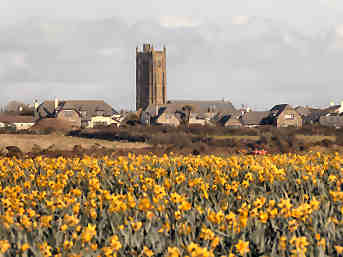
I visited Buryan in mid-February 2018 on an outing which also included St. Levan, the church high above the cliffs of Porth Chapel. Buryan is a substantial village with a store and a pub, the St. Buryan Inn, where I enjoyed a coffee on my visit. The church stands within a raised circular enclosure, usually signifying a pre-Christian site. Legends surrounding the founder of the original church on this site tell us that the 6th century saint was buried here after perishing while kidnapped by a local king, despite the attempts by St. Piran, patron saint of Cornwall's tin miners, to save her. I was there not only to look inside the church but also to photograph the two Cornish crosses, both up on substantial plinths, one inside the churchyard, one outside. A third stands at the roadside to the south of the village. On the way into the church, note the wooden porch ceiling, very typically Cornish. Unusually for Cornwall, St. Buriana's is mostly of one period, the Perpendicular Gothic. Its impressive scale is due to its origins as a collegiate church, founded by English King Athelstan in the 10th century, refounded in 1238 by Bishop Brewer of Exeter. The church is similar in plan to St. Petroc's in Bodmin, with nave, two aisles and a tower with stair turret. The interior is high, spacious and light. Roofs are Cornish wagon roofs. The superb restored elaborately carved rood screen stretches the full width of the church. Furnishing includes a fine 16th century font, a 20th century altar and reredos by E H Sedding. A litany desk is fashioned from medieval bench ends. Unusually there are misericords in the choir. A 13th century monument to Clarice de Bolleit bears an inscription in Norman French. Stained glass is by Alexander Gibbs and Ward & Hughes. A superb church, not to be missed.
St. Buryan Church & Daffs
Cornish Cross
The Central Screen
Photographs
More in Churches & Holy Sites

Caerhays
It seems quite odd that St. Michaels Caerhays Church should be all of a mile (by road) from Caerhays Castle, on whose estate it stands. However, the part Norman church long predates the early 19th century 'Castle', a Gothick mansion, overlooking the sea, begun in 1808 by John Nash for John Bettesworth-Trevanion. The church consists of three-stage crenellated tower, nave, truncated south aisle and north transept. Pevsner thinks the 16th century south aisle was probably built as a chantry chapel for the Trevanions of Caerhays Castle in the early 16th century. St. Michael was restored in 1864 and again in 1883 by the ubiquitous J P St. Aubyn. Almost all the stained glass windows were designed by Revd. William Willimott, rector here from 1852 to 1878. He also designed the attractive mosaic reredos, the parclose screens and probably the commandment tablets. The circular font, decorated with foliage, is Norman. The pulpit is simple Victorian dark oak on a light stone plinth. Monuments are a 1769 one of William Trevanion and a 1819 one of Charlotte Trevanion, which Pevsner finds the most attractive item in the church. A life-size statue in naval uniform is of Captain George Bettesworth, related to the Bettesworth-Trevanions of Caerhays Castle, who died in 1808. There are a couple of attractive early bench ends; I wonder what happened to the rest?
Calstock, St. Andrews
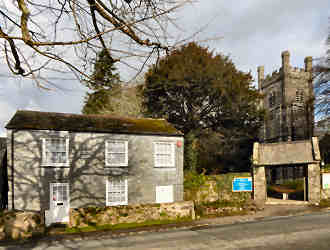
I revisited Calstock in early February 2018, after seeing St. Dominica's Church. I had hoped to look inside St. Andrew's Church, half a mile up the hill from Calstock itself; sadly, like too many Cornish churches, it was locked though I now understand that was exceptional and that the church is normally open daily from 10 to 4. I was back at St. Andrew's church on a bright, sunny Saturday towards the end of April 2018. I saw the wall paintings, high on the nave arcade but, sadly, did not get to see inside the locked Edgcumbe Chapel; so comments on it here are from Pevsner. Though the church was consecrated in 1290, nothing visible is of that date. However, much is of the 15th century but was subject to a major restoration by St. Aubyn in 1886-8; he was responsible for the wagon roofs, tiled floors, pews, pulpit and font. There is the usual plaque of the Royal Arms on one wall but, unusually, those of George IV. Remains of a wall painting over the arches of the nave arcade were uncovered in 1867, sadly so deteriorated that only the most romantic would detect St. George on his horse. Rood stairs and loft opening are still in place but the rood screen is long gone. On an interior wall of the tower is a Bell-ringers board, reminiscent of that in St. Endellion church. Below the pulpit are two brass plaques, commemorating the children of Sir Salusbury Trelawney and Sir William Lewis Salusbury Trelawney. The Edgcumbe Chapel is accessed through a door in the north wall of the Sanctuary. It is normally kept locked, the caretaker has the key; it contains monuments commemorating Piers Edgcumbe, died 1666, and Jemima Countess of Sandwich, wife of the first Earl who was responsible for bringing Charles II from Holland at the Restoration in 1660. In the extensive graveyard are a number of attractive monuments; When i was here in February there was a good display of daffs. In late April there were swathes of primroses and some early bluebells. See my Towns and Villages page for more on Calstock village.
Camborne, St. Meriadoc
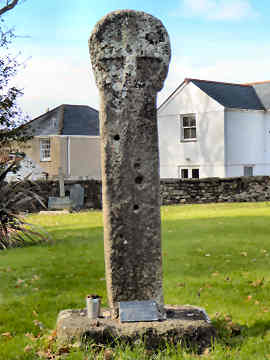
In early November 2018 I did a round of some of the churches in Camborne, Pool and Redruth (CPR). All that I tried to visit were closed: The main church, St. Meriadoc on Church Street, St. Stephen in Treleigh, St. Andrew in Clinton Road, Redruth and St. John's, Trevenson in Pool. I had already visited St. Euny in Redruth Churchtown and posted a description of it. I had, in fact, previously been in St. Meriadoc back in 2016 when there was a Christmas Tree Festival. So I feel able to post a description now. The church, very much in the centre of town, dates mostly from the 15th and 16th centuries but was restored and enlarged during the latter part of the 19th century by J P St. Aubyn (who else!). It consists of nave and two similar aisles. The chancel, surprisingly, was only added in the mid-16th century, unusually late for Cornwall; its side walls are made up of early 17th century carved bench ends. The mid-16th century pulpit carries the Tudor coat of arms. The arch-braced collar-truss roofs have been restored. The altar slab is most unusual being 10th century and originally in Chapel Ia in Troon. The tripartite reredos is of fine Sienna marble. Stained glass is mostly of the 20th century. There is a fine collection of monuments to local families including the Pendarves. In the churchyard are a regular Cornish Cross and a wheel-head cross. Built into the exterior east wall of the south aisle is a cross head and inside the south door is a cross slab. By the western wall of the churchyard are three small iron commemorative crosses and a memorial plaque to the towns greatest son, Richard Trevithick. Later, I was able to make an appointment to see and photograph insie the church in November 2018.