Egloskerry, St. Keria's Church
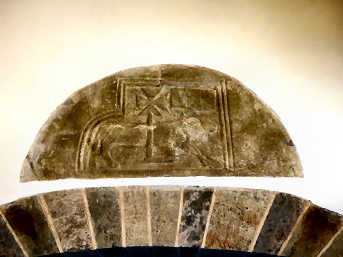
I chose an interesting day, at the end of August 2018, to visit Egloskerry's church. When I had been there in July the church was still being restored following a fire which, happily, mostly did only smoke damage. By happy coincidence my August visit coincided with Egloskerry's "Church Mouse" day. In addition to my usual photos of the interior of the church itself, I also took some thirty or more photos of mouse tableaux, most really quite amusing. I think my favourites were two life-size (human life-size, that is) tableaux, one of a mouse-vicar in his pulpit, the other of a bride and groom. I gathered from the small attribution cards by each tableau that most of the village must have contributed to the show. As to the church itself, the first thing to note is the height of the churchyard above the road, almost certainly suggested an Iron Age lann. The church's origins are in Norman times, evidenced by the north wall and south transept. An unusual feature, and probably of that date, is the tympanum over the blocked north door with a dragon snapping its own tail. The nave has a most attractive wagon roof with carved, but not painted, ceiling bosses. The simple font has cable decoration round the rim. The church was heavily restored in 1887 and stained glass dates from that time.
Egloskerry Tympanum
Egloskerry Church
Mouse Couple
Photographs
More in Churches & Holy Sites
Eval
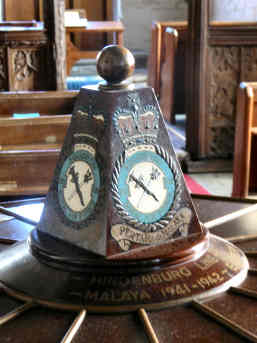
St. Uvulus church stands quite isolated, on the fringe of a former Bomber Command airfield and not far from the sea. Normally there would also be at least a small churchtown but this was demolished when the airfield was constructed. The settlement of St. Eval is some distance away and consists of military housing and, of all things, underground bunkers. The exterior of the church is quite conventional. A prominent three-stage tower once acted as a landmark before Trevose Head lighthouse was constructed; it is banded with local blue Catacleuse stone, which makes it unusual and striking. The same stone is also used to good effect in window surrounds and in the porch. The exterior may be conventional, the interior is less so, thanks to its connections with the RAF. Conventional features in the interior are the plain Norman cup-shaped front, with its RAF cover, the octagonal pulpit of 1688, the base of a rood screen with traceried panels, and a good set of carved bench ends with, in some instances, original bench backs. The pulpit of 1688 is finely carved but on an overly plain base. The south aisle arcading is in an odd mix of styles and includes a 15th century carved capital in Catacleuse stone. Modern stained glass (1989) by Crear McCartney commemorates the RAF; striking colours set off an RAF symbol surrounded by a crown of thorns. Two walls carry carved and painted RAF badges. In the Lady Chapel a stained glass windows bears RAF symbolism. While in the Lady Chapel, do look up, otherwise you will miss a fine collection of carved ceiling bosses. One wall carries painted Royal Arms but without the clear indication of which king. Outside, before entering the churchyard gate, do note the WWII was memorial.
Feock, Saint Feoc's Church
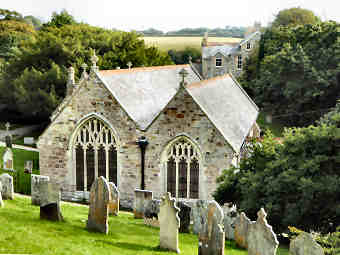
I had previously been in Feock on a couple of occasions. In July 2007 I took a couple of church exterior photos, one of the Cornish Cross and several photos of nearby Loe Beach and Pill Creek. In September 2016 I took a lot of photos of the village and of the exterior of the church, the steeply sloping graveyard, the detached bell tower, the two lych gates and the Cornish Cross near the porch. However, on neither occasion did I venture inside the church. I eventually did so in late July 2018, on an outing that also including Kea and Old Kea. As for Feock church, once inside the porch the first thing you notice is that there is a kind of small inner porch with glass doors leading into the church proper. The church, originally dating from the mid 13th century, was enlarged in 1840 then much rebuilt from 1875 by the inevitable J P St. Aubyn. The first thing you notice when you enter is a reproduction 1576 map of Cornwall, hanging on the north wall. Most striking feature of the interior of the church, however, is St. Aubyn's chancel with its series of entertainingly painted roof beams. To be fair that is essentially colourful entertainment. What are truly important are the font, the pulpit and the very Victorian reredos. There is some good stained glass, the east window unexpectedly by William de Morgan, better known as a tile designer. Perhaps the most impressive piece of furnishing is the pulpit, made of four 16th century Flemish Renaissance panels bearing biblical scenes. But my personal favourite is the late Norman font of blue Catacleuse stone and finely decorated with symmetrical and floral designs.
Flushing, St. Peter's
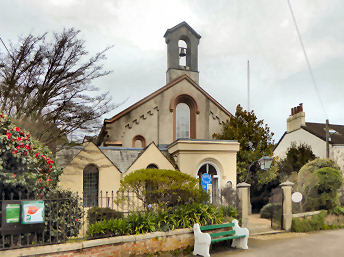
In March 2017 I visited Mylor Churchtown, where I had not previously been inside the church, so steeply and beautifully situated above the marina. On the way there I had been first to St. Gluvias at Penryn, which was closed, and St. Peter's at Flushing. St. Peter's is situated at the top of the hill down to the water. Opposite, from the top of a steep drive down to a house called Little Flushing, there is a good view down to the water and across to Falmouth. This Anglican church is highly unusual for Cornwall, dating from 1842, a time when so many Methodist churches were beng built. The interior (photo below right) is also unusual, with its queen-post roof and a model yacht - appropriate for Flushing - suspended from it. You might think there had been an older church on this site, witness the unexpected presence of a Cornish Cross in the churchyard. However, the cross was found in a farm building at Porloe in 1891 and moved to this churchyard.