Falmouth, King Charles the Martyr Church
King Charles the Martyr Church - Images to followProbably the only ancient building on the whole length of Market Street, Church Street and the first part of Arwennack Street, the Church of King Charles the Martyr was completed in 1663 by Falmouth man Sir Peter Killiigrew, soon after the Restoration, and commemorates the new King's executed father. The tiny west tower was added around 1684 with the top stage and pinnacles being added in 1800. You will see no other church interior in Cornwall like this one. The late 17th century interior has been modified several times, most notably by E H Sedding in 1898. The original length and width of the nave was 66 feet, oddly the length of a cricket wicket. It is separated into nave and aisles by tall granite columns with plaster Ionic capitals. The windows hark back to an earlier age: two tiers of Cornish Perpendicular. The chancel, originally of 1684, was replaced in 1813, lengthening the church by about one-third. The Venetian East window has full Ionic details. Pevsner believes that Galleries inserted in 1686, 1695 and 1702 somewhat spoil the former simplicity of the interior. In the late 19th century Sedding added side chapels to the chancel and and a south organ chamber. He removed the north and south galleries and rebuilt the west gallery. He also completely re-roofed and re-ceiled the church. The north porch is by William White. The PULPIT incorporates 16th and 17th century German carvings. The central part of the base of the SCREEN is from St. Paul, Penzance where it served as a communion rail. The CREDENCE TABLE dates from 1759 and bears the Killigrew arms. The hexagonal FONT bears similar carved detail to this. There is a good collection of stained glass; most interesting is that in the south aisle designed by C. Archley with interesting Cornish iconography and inscription. An interesting collection of monuments includes a standing mourning woman by an urn, against a dark obelisk.
Falmouth,
More in Churches & Holy Sites
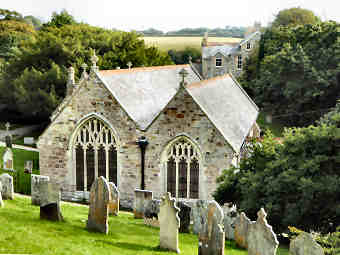
Feock, Saint Feoc's Church
I had previously been in Feock on a couple of occasions. In July 2007 I took a couple of church exterior photos, one of the Cornish Cross and several photos of nearby Loe Beach and Pill Creek. In September 2016 I took a lot of photos of the village and of the exterior of the church, the steeply sloping graveyard, the detached bell tower, the two lych gates and the Cornish Cross near the porch. However, on neither occasion did I venture inside the church. I eventually did so in late July 2018, on an outing that also including Kea and Old Kea. As for Feock church, once inside the porch the first thing you notice is that there is a kind of small inner porch with glass doors leading into the church proper. The church, originally dating from the mid 13th century, was enlarged in 1840 then much rebuilt from 1875 by the inevitable J P St. Aubyn. The first thing you notice when you enter is a reproduction 1576 map of Cornwall, hanging on the north wall. Most striking feature of the interior of the church, however, is St. Aubyn's chancel with its series of entertainingly painted roof beams. To be fair that is essentially colourful entertainment. What are truly important are the font, the pulpit and the very Victorian reredos. There is some good stained glass, the east window unexpectedly by William de Morgan, better known as a tile designer. Perhaps the most impressive piece of furnishing is the pulpit, made of four 16th century Flemish Renaissance panels bearing biblical scenes. But my personal favourite is the late Norman font of blue Catacleuse stone and finely decorated with symmetrical and floral designs.
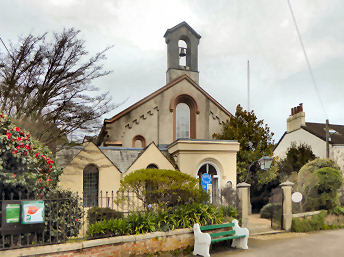
Flushing, St. Peter's
In March 2017 I visited Mylor Churchtown, where I had not previously been inside the church, so steeply and beautifully situated above the marina. On the way there I had been first to St. Gluvias at Penryn, which was closed, and St. Peter's at Flushing. St. Peter's is situated at the top of the hill down to the water. Opposite, from the top of a steep drive down to a house called Little Flushing, there is a good view down to the water and across to Falmouth. This Anglican church is highly unusual for Cornwall, dating from 1842, a time when so many Methodist churches were beng built. The interior (photo below right) is also unusual, with its queen-post roof and a model yacht - appropriate for Flushing - suspended from it. You might think there had been an older church on this site, witness the unexpected presence of a Cornish Cross in the churchyard. However, the cross was found in a farm building at Porloe in 1891 and moved to this churchyard.
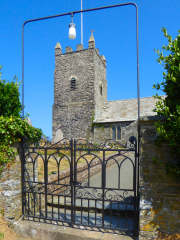
Forrabury near Boscastle, St. Symphorian's Church
I first encountered St. Symphorian's church - the same dedication as that in Veryan - in the course of the same round walk during which I first saw Minster Church. That was in January 2008. I didn't go inside it then; my interest then was only in photographing its Cornish Cross, situated to the south of the churchyard. However, I eventually revisited St. Symphorian's in July 2018 and took some interior photographs. Before going in the church I walked through the gate in the top left-hand corner of the churchyard. You should make a point of doing this for the views. Most striking is the view to the Coastguard look-out on Willapark, the headland to the south of Boscastle. Sitting just inland from Willapark and lying between the church and that headland is the high ground of Forrabury Stitches. The Stitches are evidence of a medieval way of farming. This series of fields is divided into 42 "stitch-meal" plots of farmland, a method of crop rotation that dates back to Celtic times still exists and is one of the best three surviving examples of stitches being farmed in Britain today. The church of Saint Symphorian was subject of a major restoration in 1868, resulting in an additional north aisle with heavy classical columns. The Pulpit, Credence Table and Altar all incorporate old bench ends. The pulpit is of geometrical design and features a terrier and two rabbits in a barrow, an ape on a stool, and two swans. One wonders what other treasures existed on old bench ends, sold off to local farms and houses. A priest's chair is of unusually elaborate design. The cup-shaped font is Norman with criss-cross diagonal decoration.