Grampound, St. Naunter's Church
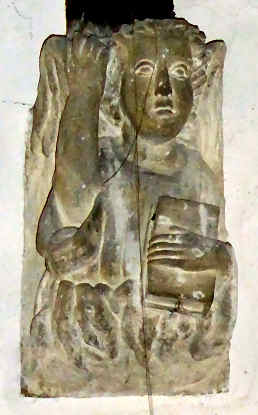
There are two Grampounds, Grampound Road on a north-south country lane and Grampound village on the A390, halfway between Truro and St. Austell. At first sight it appears to be a one street village, climbing a gentle hill from the infant River Fal. However, there is more development along side streets than on the main road itself. Near the river crossing is the Primary School, behind it a Community Centre, Village Shop and Playing Field. Opposite, Mill Lane leads to the disused Town Mill, once operated by a leat off the River Fal. On the main toad, halfway up the hill is the Dolphin Inn, where I have stopped for coffee. Just past the pub is the present focal point of the village, the village hall and church, outside them the remains of a tall (presumably) market cross, its head missing. The village hall is handsome small building with a slate hung clock tower. The adjacent church is surprisingly small. Built in 1421 as a chapel of ease to the far larger and more important St. Crida's in nearby Creed, St. Naunter's was in ruins by around 1820. It was rebuilt in 1869 and has an unexpectedly lofty interior and good 19th century fixtures and fittings. The chancel is most attractive with intricate reredos and colourful altar cloth. Roof corbels are angel figures. There is some pleasant stained glass. More images of St. Naunter's Grampound
Carved Angel
Grampound Church and Town Hall
Grampound Pulpit
More Images of St. Naunter's Church
Photographs
More in Churches & Holy Sites
Gulval, St. Gulval's Church
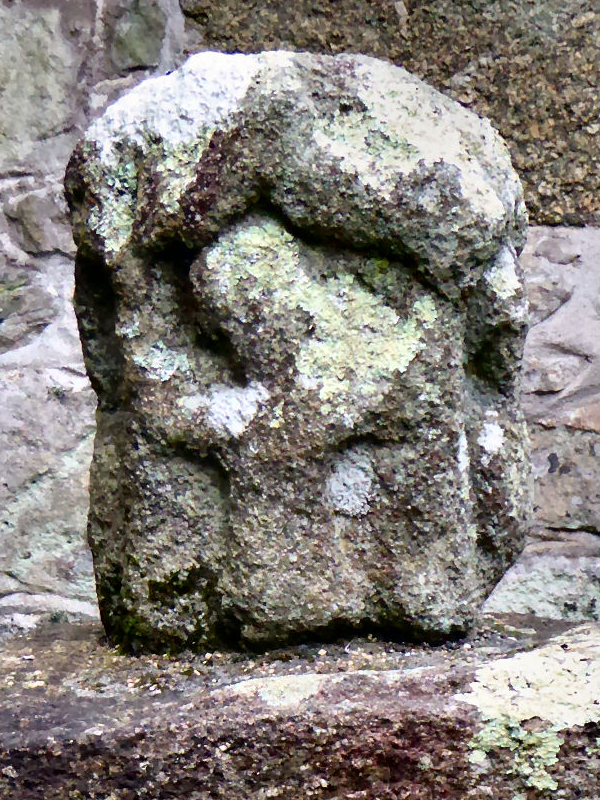
On the same late December 2018 day that I visited St. Elwyn's Church in Hayle I took the opportunity to re-visit St. Gulval's Church in Gulval, just north-east of Penzance. To my surprise the church was firmly locked; it had been open when I was there on New Year's Eve in 2016. So at least I have some interior photos from that 2016 visit, which I can use in this entry. The church is approached from two directions; from the east by a broad flight of steps; from the south by a lych gate, bearing a couple of increasingly illegible inscriptions. The first thing to note, before entering the church is the collection of artefacts just to the left of the porch. There you will find an inscribed stone, an upside-down cross shaft and an eroded lantern cross-head. The oldest unaltered part of the church is the three stage tower of 1440. The body of the church was originally of the 13th century but much altered and restored in Victorian times by J P St. Aubyn; it consists of nave, south aisle and north transept. The ceilings are conventional, except for the chancel's which is both elaborately and colourfully panelled. Beyond a relatively crude chancel screen an unusual wooden altar bears the arms of, presumably, the Kymiels and the St. Aubyns, as also does the font. Stained glass is Victorian. The pulpit is of carved wood on a marble base, behind it carved panelling. Bench ends include both old and new.
Gwennap Pit
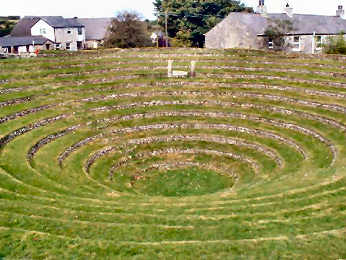
John Wesley first came to Cornwall in 1743 and one of the first areas he visited was the copper belt to the south of Camborne and Redruth. One of the first places he preached was the busy complex of mines at Gwennap, an area he returned to time and again over the years. When Wesley came to the area in September the weather was particularly stormy and, for protection from the wind and so the crowd could hear him, he preached in a natural amphitheatre created by a mine-shaft collapse. He returned there 17 times, preaching to crowds claimed to be as large as 30,000. In 1806 local mine captains rebuilt the pit with its present 13 concentric rings of turfed seating. In 1836 Busveal chapel was built close by. In the 1980s sculptor Guy Sanders created the series of commemorative panels. A small visitor centre is open from Whitsun to September. A service is held every Whit Monday. Gwennap Pit is not an easy place to find but the effort is worth it for the special atmosphere. From A30 at Scorrier east of Redruth take B3298 south, turn right into St. Day centre, then west. Not far from Gwennap Pit is Carharrack Museum of Cornish Methodism in Carharrack's Methodist Church. It has a small collection of Wesleyana and artefacts of Cornish Methodist history and is open by appointment only with Mr Barrie S May - 01209 820381.
Gwennap, St. Wennapa's Church
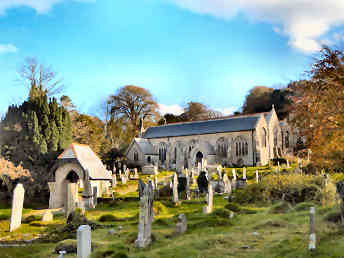
You might expect Gwennap Church and Gwennap Pit to be located adjacent to one another. You would be wrong: The pit, a collapsed mine shaft where John Wesley is claimed to have preached to 30,000, is in Busveal village. Gwennap village is a couple of miles away to the south-east, a little way off the Redruth to Falmouth road. I had been to Gwennap previously, in November 2015, but had been unable to gain access to the interior of the church. I revisited in August 2018 and was delighted to find the church open. I parked in the large car park outside the gate to the graveyard and walked up to the church. It is a surprisingly long way and, oddly, you go through a lych gate halfway up the slope. St. Wenappa's is thought to be of Norman origin but what you see now is largely 15th century but incorporating some 13th century parts. Like so many Cornish churches it was heavily restored in the late 19th century by J P St. Aubyn. To the right of the porch is a small Cornish Cross. Inside, the church consists of nave and north and south aisles. There is a variety of stained glass, some box pews, and an attractive modern font, perhaps of Elvan stone, on a simple Norman base. There are some interesting monuments: a slate tablet over the north door is by Neville Northey Burnard of Altarnun; and there are some good monuments of the 1840s to the Williams family. Above the church, to its north-east, is a remarkable detached bell-tower, rebuilt in the 15th century and possibly of Norman origin. When I was there in August 2018, parked in the car park by the entrance was an open-topped "wedding car", a Nissan Figaro of 1970, complete with its ribbons.