Gwithian
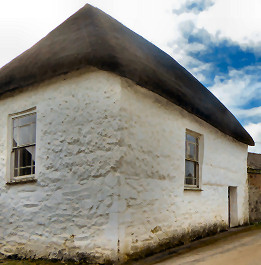
I revisited Gwithian on a sunny Saturday in Aporil 2017, a day when I also visited Gwinear and Phillack. I was pleased to find all open. This, though medieval in appearance is later in date. Nor is it Gwithian's original church. As with St.Piran's church on Piran Sands, there was an early Christian Oratory in the dunes. This was excavated in the 19th century but again left to nature and has disappeared beneath the sand. The present church was built in 1866 and incorporates parts of the earlier structure. There is an unusual square font, on pillars of blue (perhaps Catacleuse) stone, with carvings of a snake, a rosette and a cross inset. There is little else of special note but there is a very fine collection of embroidered kneelers. Just up the road is the last remaining thatched chapel in Cornwall. A deed of 1771 names John Wesley as 'Protector of the Religious Society.'. The present chapel built in 1810. The Society ceased in 1995, but the chapel was rescued from dereliction in 1999 and reopened for worship. There is a display of documents and photographs. The chapel is open Easter to October; occasional Sunday evening services are held.
Thatched Methodist Chapel
Gwithian Church
Cornish Cross
Photographs
More in Churches & Holy Sites
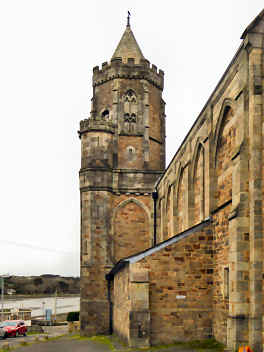
Hayle, St. Elwyn's Church
On the same late December 2018 day that I was unable to re-visit the interior of Gulval Church I was able to see the interior of St. Elwyn's in Hayle. The church stands in an elevated position above Hayle Terrace, the main road through Hayle. It was one of the last works of J H Sedding, completed in 1888. Pevsner says "its strong verticality and satisfying massing bestow an architectural benediction on the whole town". Because it is surrounded by other buildings, the most satisfying overall view is to be had from the other side of Copperhouse Pool. The stone comes in a variety of colours and shades of brown and green. A hexagonal tower at the north-east corner terminates in a stubby spire and features a tall stair turret. Inside, with its nave and two aisles, has a lofty and spacious feeling. A little surprisingly, much interior stonework has been painted white but that does rather add to the feeling of spaciousness. The chancel is striking for its fenestration: two pairs of three lights topped by a large roundel. Alongside it, on its north side, stairs lead up to an open musicians gallery, overlooking the chancel. The altar is cloth covered, behind it a colourful but primitive reredos. The font is in the Norman style and of Polyphant stone. There is a god variety of stained glass, some in lancets, some rectangular.
Helland, St. Helena's Church
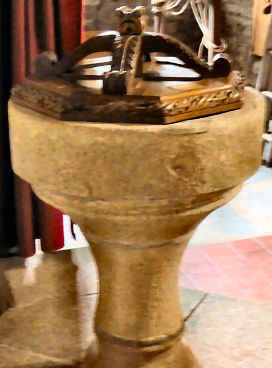
On the day in January 2018 when I revisited Blisland Church I also saw inside Helland Church for the first time; normally the church is locked but I was able to borrow the key. The church was originally cruciform, a south aisle added in the 16th century and a north transept in the 17th century. However, it was substantially rebuilt, like so many Cornish churches, by J P St. Aubyn in the late 19th century. Before entering the church, do look back at charming Churchtown Cottages, alongside which is an attractive, but roofless, lych gate, unusually with a pair of white-painted metal gates. The church consists of tower, nave, south aisle and a north transept. I assume that this was always a relatively poor parish as there is not much inside of much interest. The font has a 13th century bowl on a later stem. There are fragments of medieval glass in the east window of the south aisle. Of more interest, really, is early 15th century Helland Bridge over the River Allen, some attractive buildings nearby, including the old Mill House, and Paul Jackson's Pottery in Riversmead on the south-east side of the bridge
Helston, St. Michael's Church
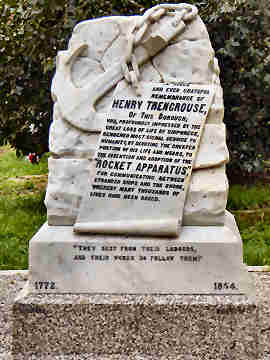
I had seen St. Michael's Church previously, but only to photograph the exterior, so my visit to view the interior in January 2019 was my first. St. Michael's is highly unusual for a Cornish church, not medieval but largely Georgian. The reason for this was not a matter of taste but was the result of lightning which in 1727 virtually destroyed the whole church, leaving only a 15th century gable cross intact. Rebuilding was completed in 1761 by architect Thomas Edwards, who was also responsible for a couple of great country houses, Trelowarren and Trewithen. Restoration and extension of the Edwards church which was completed in 1838 by George Wightwick included the chancel, north chapel and south porch. Pevsner describes the result as "a typical classical mid-Georgian town church" and, while it is so different from the usual medieval Cornish church, I enjoyed it for what it is. There are two entrances to the churchyard: the one nearest the (often inadequate) parking offers an easy but roundabout route to the church entrance; the other, up steep steps from Church Street, takes you more directly to the porch, unusually shaped, two storey in height with a large window in the upper storey. The generous proportions of the porch are echoed inside the rectangular aisleless nave with its high strap-work ceiling. At the west end is a gallery with bench seating. Stained glass in the East window of the chancel depicts the annual Helston Floral Dance. Priest's Chair and Litany Desk are of elaborately carved (I presume) light oak. In the North Chapel are 1602 brasses to the Bougins family. An unusual font, on a elaborate base, is of Beer stone with a Serpentine shaft. A marble memorial commemorates George Simon Borlase, probably of the famouse West Penwith family. Over the south door is a Transfiguration of painted enamel. In the churchyard, near the porch, is a new marble memorial to local man Henry Trengrouse who invented the "Rocket" life-saving apparatus, precursor of the breeches buoy. There are unusual churchyard memorials of cast iron (one commemorates just "Harry") and, on a Penberthy grave, a stone Cornish Cross has been fixed.