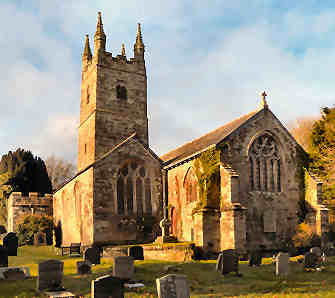
Jacobstow, St. James Church
Towards the end of January 2019 I headed to the far North of Cornwall to visit a trio of churches new to me - St. James Jacobstow, St. Marwenne Marhamchurch and St. Andrew Stratton. First port of call was Jacobstow, where Frankie Franklyn had kindly arranged for the church to be open. I had been to Jacobstow previously, in May 2017, but had taken few photos then. This time I must have photographed just about everything in and out of the church, delightfully situated in a hollow in its own little Churchtown. When I was there snowdrops proliferated in the south-east corner of the churchyard and daffodils were almost ready to bloom. The striking late 15th century three stage tower has octagonal turrets and crocketed pinnacles. You enter the south porch to be greeted by a slate floor and a substantial door with en empty statue niche above it. The body of the church is probably late 14th or early 15th century and consists of nave and north and south aisles. The chancel was rebuilt in 1886 by Otho Peter of Launceston and complements the light and dignified interior. The nave ceiling is of closely spaced curved wooden rafters; the aisle ceilings are of the Cornish wagon type. In the quire simple wooden benches face each other across a tiled floor. The chancel floor is tiled, patterned and colourful. There are two altars; the High Altar is an Elizabethan communion table, the chancel chapel has a stone table with consecration crosses. Either side of the chancel east window are paintings, probably of the late 19th or early 20th century. On the east wall of the chancel is a good slate memorial to Susannah and Mary Clerk. The north door dates from the 15th century. The font is Norman and is a good example of the Altarnun type with a face at each corner. The pulpit stands on a white stone base and is made up from 16th century bench ends. A list of rectors begins in 1270.
Jacobstow Church, morning sunlight
Jacobstow Porch
Jacobstow elaborate carved Pulpit
Photographs
More in Churches & Holy Sites
Juliot
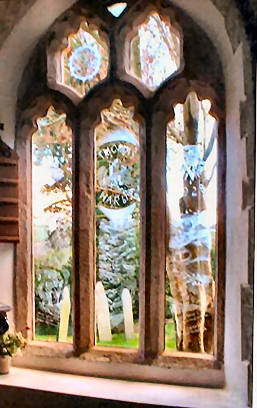
Hannett near Boscastle, St. Juliot Church
Julitta
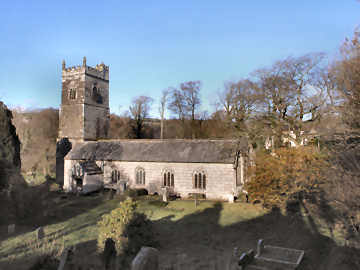
Lanteglos-by-Camelford. St. Julitta,
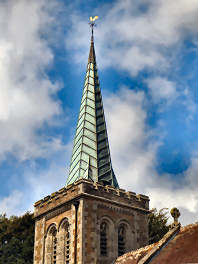
Kea, All Hallows Church
All Hallows Kea stands in a wooded part of the Killiow estate, like Old Kea not far from Playing Place but on the other side of the A39 Truro to Falmouth Road and signed from it, as is Old Kea. This is a very un-Cornish looking church, completed in 1897 by architect G H Fellowes Prynne. The impression is very much of an Arts and Crafts church, albeit in the Perpendicular Gothic style. Stone used is a creamy Killas with block size varying. Unexpectedly the porch is timber framed on a stone plinth. The equally unexpected hexagonal spire is particularly striking. When I was at All Hallows, on the last Saturday of July 2018, the church was being prepared for a wedding but I was in time for a good look round and, as always, many photographs. I was pleased that the sun was shining so I was able to get some worthwhile exterior photos. The interior (I quote Pevsner) "is especially handsome, of generous and spacious proportions with a wide nave, narrow north and south aisles with lean-to roofs and walls .... of dressed killas stone, red Paignton sandstone and yellow Ham Hill stone." The Norman font is notable, the four shafts topped by heads and the sides decorated with the tree of life, a cross and a heraldic lion passant. The altar has paintings by Prynne of angels, seraphim and the Lamb of God. Fine stained glass in the Chancel window is to a Prynne design. A Poor Box dates from 1739.