Kilkhampton
On the final Saturday in January 2019 I visited yet two more churches in the far north of Cornwall, St. James in Kilkhampton and St. Marwenna's in Morwenstow. I had previously been through Kilkhampton on many occasions and had visited the church briefly in 2016. On this occasion I spent some time in the church and took a good number of photos. I have little to add to the above piece about the church but I did note particularly the impressive full width rood screen, complete with rood, and the unusual stone altar with linenfold panelling behind and a gilded reredos above. There is a large plasterwork Royal Arms; confusingly Pevsner says it is the arms of Charles I but there is a "G" in the top left corner, suggesting George I. Attractive stained glass windows in the north aisle are late nineteenth century, mostly by Clayton and Bell; below one is a figure of a horseman.
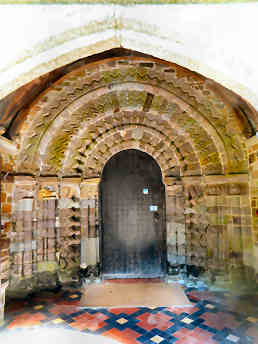
The superb Norman Porch
Central Screen & Rood
A few of the 157 medieval bench ends
Photographs
More in Churches & Holy Sites
Ladock, Church of St. Ladoca
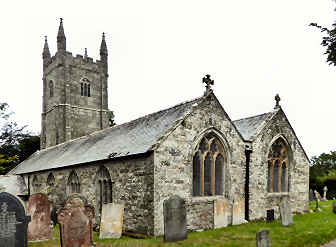
Driving through Ladock on the way to Truro you see only part of it, a village hall, the Falmouth Arms pub and a tiny post office and shop on a large car park. Pevsner devotes more than a page to St. Ladoca's church, up a steep path from the main part of the village on the former A39, and part of a small group including Ladock House (the former rectory) and the School. Just inside the churchyard is a tall War Memorial to your left. Ahead of you is the porch, to its left a tall three stage tower. The door from the porch into the church is quite striking, its four-centred arch surround set into rough stonework. Over the door is a primitive face. Inside the church consists of nave and south aisle. Both have conventional Cornish wagon roofs. The church was restored 1864 by G F Street; he embellished the chancel with an elaborate roof and an east window with shafts of polished serpentine. The altar has three painted panels. A parclose screen is very Gothic. The font is of sharply carved blue Catacleuse stone. The rood screen survives across nave and aisle. There are no medieval bench ends in place but a few were used to make up the lectern. The stained glass is some of the finest in Cornwall after St. Neot and is the best of Morris & Co's work in Cornwall.
Landewednack Church near Lizard Town
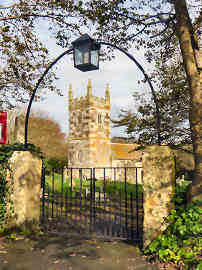
Landewednack Church Cove, which OS103 abbreviates to Church Cove, even though the cove is another half-mile down hill to the east, is just to the east of Lizard Town. I shall call it Landewednack; its church is St. Winwaloe's. And Church Cove is not to be confused with Gunwalloe Church Cove on the Lizard's west coast. Here the buildings in the cove make a delightful grouping: the old Fish Cellars, an attached Roundhouse, the former Winch House and the old Lifeboat House. It must have been difficult enough to launch cove boats from here, the lifeboat must have been almost impossible. All these buildings are now holiday or second homes. Up the hill is the village and church. The village is attractive with several thatched cottages and a barn with an octagonal extension. As at Gunwalloe, the church is dedicated to St. Winwaloe. He was also known as Wednack and a church at Towednack near St. Ives is also dedicated to him, as is one at Poundstock near Bude. Seen from the upper entrance gate the tiny church, with its variegated stone is most attractive. As at Cury, the possibly 13th century church porch is remarkable, like a small chapel with an elaborate doorway. Inside are attractive barrel-vaulted ceilings, a font and lectern both using serpentine stone, a badly worn carving of two men holding a shield, colourful organ pipes, a probable cross base built into a wall, a priest's chair tucked into a squint, and a 15th century font, its donor's name inscribed on it.
Landrake, St. Michaels Church
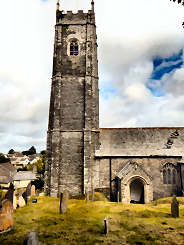
As you head towards Saltash and Devon along the A38 the elegant 100 foot tower of Landrake church appears on a hill straight ahead of you; however, you have to continue and turn right into the village further on. Parking is not easy but you should be able to find a space near the church. St. Michael's is built of the local greenish Tarten Down stone. As with so many Cornish churches, construction was of many periods, mainly 14th to 16th century. The oldest part is the largely Norman south doorway. A major restoration took place in 1877. Ceilings are striking, all in the Cornish "wagon" style. Between the south transept and the chancel, note a squint and the remains of rood stairs. The Norman font is of the Altarnun type, faces on the four corners and rosettes between. Stained glass in the chancel is by Jones and Willis and Fouracre and Watson. A small inset brass of 1509 commemorates Edward Courtenay, related to the Earls of Devon. There are several slate wall memorials; finest is to Nicholas Mills and his wife. The attractive carved pulpit is of a white stone. An elaborate reredos bears saintly figures. A squint to the chancel also has part of the staircase that led up to the now vanished rood.