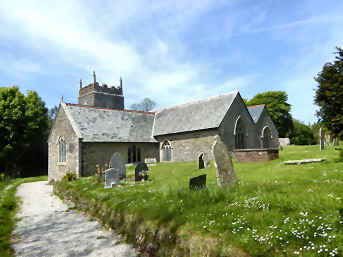
Lanihorne, St. Rumon's Church
Towards the end of September 2017 I headed down to the Roseland to pay visits to three churches, at Philleigh, Ruan Lanihorne and Lamorran. My memories of Ruan Lanihorne [not to be confused with Ruan High Lanes on the St. Mawes road, or with the many Ruans on the Lizard] are of an early meeting there with Jane and of lunching there with her at the attractive and excellent King's Head. On this occasion I just had a coffee in the King's Head before taking a look at the church. Almost opposite the pub, and a bit below, is St. Rumon's church, mostly 14th century, with a tower of the late 17th century. Pevsner suggests that the font is 14th century, its cover made of wall plates of a previous roof. The pulpit is made of old bench ends and dates from around 1530. A monument of a praying priest is 13th century. Two wall-mounted boards carry the Ten Commandments. Where the ceiling springs from the nave wall there are several painted shields, one noting the restoration of 1866, others with unfamiliar coats of arms. When I was there a tapestry was on display, depicting "Historical Ruan." I was there again in mid-May 2019, taking the opportunity for a visit while Jane was lunching at the Roseland Inn at Phllleigh with her old school friends. It was the first time I had been inside the church and I had two surprises: the first to see such a collection of painted shields around the church at wall plate height, the second to discover later that Pevsner makes no mention of them.
Ruan Lanihorne Church
The squint
13th century carved stone priest
Ruan
Photographs
More in Churches & Holy Sites
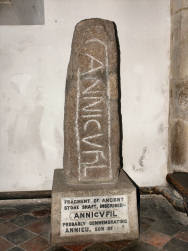
Lanivet Church near Bodmin
I found Lanivet church when walking the Saints Way. Its dedication is odd. The church's own guide leaflet suggests the dedication is to St. Nivet, daughter of Welsh King Brychan, or to St. Nevet, a Breton. On the other hand the Church of England officially declares it dedicated to St. Ia, who gave her name to St. Ives. Sadly the church is also a something of a disappointment; a handsome, typically Cornish, 15th century church in the Decorated style, ruined by over improvement by the Victorians, who scraped many frescoes and removed original stained glass. The reason to visit Lanivet church is the wonderful collection of stonework dotted around inside and out. By the porch is a 10th century 'hogback' tomb slab. Behind the church are a 13th century four-hole Cornish cross and a 10th century wheel cross. Inside the church are some fascinating memorials. One from the 5th or 6th century commemorates 'Annicu'. A portrait tomb slab in the vestry to a Courtney (perhaps related to the Earls of Devon) dates from 1560; another Courtney was added to it in 1632, surely not the brother the guide leaflet claims. A nearby tomb slab features gilded angels. Pulpit and reredos are both Victorian but attractive. St. Benet's Abbey
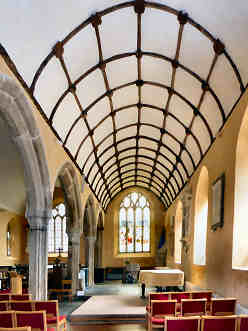
Lanlivery, St. Bryvyta's Church
I was first in Lanlivery in 2006 when I passed through when walking the Saints Way from Padstow to Fowey. On that occasion I was walking a section, linking the two southbound routes, between Lanlivery and Luxulyan. I stopped for food at the Crown Inn. On that occasion I did not visit St. Bryvyta's church though I did photograph St. Bryvyta's Holy Well by Churchtown Farm. In mid-August 2018 I decided to do a little research to the west of Lostwithiel and visited the churches in both Luxulyan and Lanlivery. I started in the latter with a coffee in the Crown Inn then walked across the road to take a look inside the church of St. Bryvyta (or Brevita or Brivet). As you approach, the first thing you notice about the church is its tower, almost 100 feet tall. Consisting of Nave, Chancel, South Aisle, Porch and Tower, St. Bryvyta's is mostly of the 15th century but incorporates some 13th century work. Noteworthy features inside include wagon roofs, several good 17th and 18th century monuments, several fragments of blue medieval glass in the east window, an octagonal font with simple decoration, an ancient carved slate tomb slab. The wooden pulpit stands on a granite base and bears carved coats of arms. A wall tablet remembers Thomas Hawkey who died in the United States in 1873. In the porch a tablet commemorates Charlotte Atherton, wife of Robert Atherton, vicar of Ratcliffe. Why is a vicar of a Leicestershire or Nottinghamshire village associated with a rural Cornwall church? In the churchyard are a table tomb and several slate gravestones. When I was there, in the quire was an exhibition of wood carvings. The pub opposite, the Crown, is a nice place but menu and prices are more restaurant than pub.
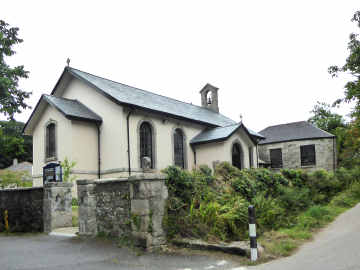
Lanner, Christchurch
I was passing through Lanner on my way to Gwennap when, on a whim, I followed a sign pointing right to "churches." I had no great expectations but was pleasantly surprised, after passing a Methodist Chapel, to find white-painted Christchurch towards the top of the hill, next to it a parish hall. In the churchyard in front of the church what took my eye was the unexpected pair of Cornish Crosses. The church itself dates from 1840 and is by the well known early Victorian architect George Wightwick. Inside the church is well proportioned with a shallow chancel and a 3-bay aisle, a later addition of 1883. The only old thing of notice inside the church is an delightful font with an angelic figure on each face. To my surprise, Pevsner says that this 19th century font was originally in St. Dunstan's, Fleet Street in London.