Martin-in-Meneage
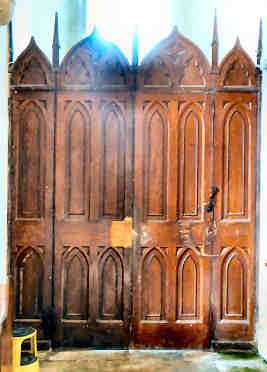
On a sunny Saturday in late February I headed down to the Lizard peninsula to take a close look at a couple of churches, that of St. Mawgan in Mawgan-in-Meneage and that of St. Martin-in-Meneage. St. Martin's church is south of the village but at St. Martin I had a pleasant surprise: I knew that, remotely situated, the church would be locked and I was just planning on exterior photos. However, while I was sitting there enjoying my soup and sandwich before leaving, who should arrive but a lady churchwarden, so I was able to take my photographs inside as well. The tower is original, of the 15th century, but the rest of the church was rebuilt after a fire in 1830; note the use of serpentine blocks in the external walls. As the church is essentially a simple rectangle it feels more like a Methodist chapel of the period. Entrance is through an unusual blue door in the tower. One font is perhaps the oldest thing about St. Martins, while the other is Norman with corner shafts and foliate decoration. Pews are simple unornamented benches, relieved by a few colourful kneelers. There are a couple of attractive hangings, one of the Lord's Prayer, the other a pictorial of the village by local schoolchildren. In the churchyard I noticed a white camellia and a sundial minus its gnomon.
St. Martin Tower Door
St. Martin Old Font
St. Martin Hanging
St.
Photographs
More in Churches & Holy Sites
Maryfield
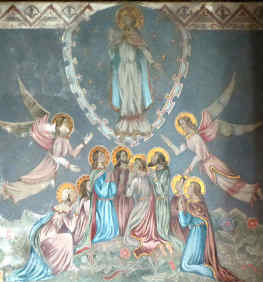
On a sunny Saturday in mid-August, I decided to look at a few places on the Torpoint peninsula - Antony, Sheviock, St. John for their churches, and Torpoint itself for its location n the water and for its harbour. In the event I was distinctly unimpressed with Torpoint, though I enjoyed the view across to Devonport Dockyard, and I was unable to gain entry to the little church at St. John. However the churches at Antony and Sheviock certainly made up for that. Despite Pevsner, there is really no such village as Antony, only the park, garden and great house. The church, along with a few other buildings, is actually in Maryfield and lies just to the east of Antony Park. Parts of the church date from its dedication in 1259, other old parts are the 14th century tower and the 15th century aisles. Like so many Cornish churches, St. James was heavily restored in the mid 19th centrury and the overall impression you get reflects that. There is some good stained glass but the feature that strikes you most strongly is the colourful decoration of the arches and arcade, with figures of saints and angels in a very striking frescoe. The reredos in he chancel is full of coloured marble and the altar when I saw it was decorated with flowers is small brass pots. The pulpit is striking, carrying four carved panels of the Evangelists. There are some fine monuments to the Carew family of nearby Antony House.

Mawes
There is really no parking here so you will need to park in town - quay or main car park - and walk up very steep Church Hill to visit St. Mawes Church. This small church was built in the early 19th century (and rebuilt in 1881) as a chapel of ease to the main church in St. Just in Roseland. It is in the Early English style and is topped by a slate-hung bell-cote. Inside, the roof is arch-braced, springing from granite corbels. Grisaille stained glass is by Powell and Sons and F W Skeat; two other stained glass windows illustrate the story of St. Maw. The unusual font is hexagonal with quatrefoil carving. Four steps lead up to a pulpit of only two sides. There are some attractive kneelers. One gets the impression that, despite the wealth of St. Mawes village, this is a poor church of but minor importance.
Mawgan-in-Meneage, St. Mawgan's Church
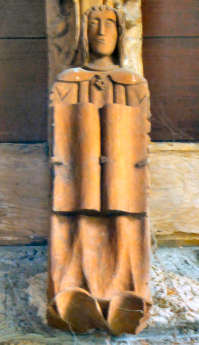
On a sunny Saturday in late February I headed down to the Lizard peninsula to take a close look at a couple of churches, that of St. Mawgan in Mawgan-in-Meneage and that of St. Martin-in-Meneage. The Daffodil Festival had been held over for an extra week at St. Mawgan; delightful as it was I had hoped for a clear un-daffodilled view of the interior of the church, so I shall have to visit again at a later date. At St. Martin I had a pleasant surprise: I had assumed that, remotely situated, the church would be locked and I was just planning on exterior photos. However, while I was eating my soup and sandwich before leaving, who should arrive but a lady churchwarden, so I was able to take my photographs inside as well. (See separate entry) St.Mawgan's church is in a fairly isolated position away from the main part of the village. The extensive graveyard, raised as it is, suggests a lann and includes an impressive raised chest tomb. The three-stage tower is of the 15th century but the body of the church is mostly 13th century and consists of nave, north aisle and north and south transepts, the latter linked to the chancel by a squint. There are Cornish wagon roofs to porch, nave, north transept and north aisle, the latter richly carved. There are two fonts in the south transept, one circular, the other hexagonal. In the south transept is a fine recessed tomb with the marble figures of Sir Roger Carminow and his wife. There are several good monuments to members of the Vyell family, also memorialised at St. Breock. In the north aisle the wagon roof is supported by angels and has a variety of carved bosses. The lectern is a delight, of red and green serpentine, found only on the Lizard. Stained glass is Victorian.