Michaelstow, St. Michael's Church
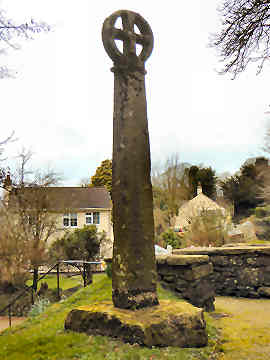
On the same Saturday in mid-February that I re-visited St. Endelienta's church, I also visited St. Michael's at Michaelstow. I had been there before but only to photograph the Cornish Cross and Holy Well in the churchyard. On this occasion I was there to see the inside of the church, which consists of nave, north and south aisles, tower and porch and dates in part from the 13th century. You approach St. Michael's up steep steps from an ample parking area, through either side of a double lych gate and past a very tall Cornish wheel cross. Off to your right is an uncared for Holy Well. You enter the porch to a handsome door surround and a roof with carved bosses on the timbers. Inside, nave and aisles have standard Cornish wagon roofs. The plain 15th century font stands on a Norman base. The exceptionally good benches and bench ends were rescued from St. Tudy church. The pulpit, with Gothic carving, stands on a stone base. The Royal Arms are of 1727 and are presumably of George II. There are fragments of medieval stained glass, some good Arts and Crafts glass and a banner of St. Michael. Slate monuments stand against the west wall, one obscured by a radiator. A small stone cross stands on a window sill.
Michaelstow Cornish Cross
Michaelstow Altar and Reredos
Carved Bench End
Photographs
More in Churches & Holy Sites
Minster near Boscastle
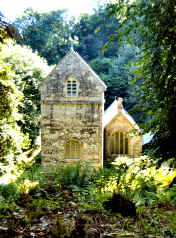
I first encountered Minster Church quite unexpectedly. I had parked in Boscastle and was walking up the Valency Valley, following the river on my right. After about a mile I saw a bridge over the river and a path heading up through dense woodland. I decided to see where it went and, after a few hundred steep yards through Peters Wood, found myself emerging through a gate on to a lane with Minster Church tucked below me. At that time I didn't look into the church as I had decided to follow the lane to Forrabury church, across the Stitches, an ancient systerm of small fields, and back to Boscastle on the Coast Path. However, I mreturned later for a look inside the church. The exterior of the church, tucked into the hillside below its graveyard, is unusual in one particular: its tower which boasts a saddleback roof. Such roofs were common in Anglo-Saxon times, suggesting that this church might be older than we think. In fact Pevsner thinks there may have been a small very early monastery here. As so often with Cornish churches, restoration was carried out in the second half of the 19th century by J P St. Aubyn. Inside, there are two 13th century windows, a simple Norman font, a good collection of slate memorial slabs, a rood over the chancel entrance, a fairly plain oak pulpit, a carved and pierced lectern, remnants of an elaborately carved screen, some elaborate marble wall memorials, a 1602 memorial brass to Hender Robarts, and a collection of flower patterned kneelers.
More Advent Church
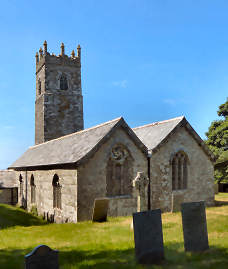
Advent Church
More Looe, St. Martin and Morval
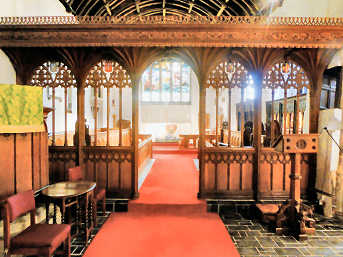
The town of Looe has no Anglican church of its own. Instead there are two a little way north of the town, St. Martin about a quarter miles north, Morval a mile or so further. St. Martin church is dedicated to St. Keyne and St. Martin. The south gate is simple but attractive. The doorway from the porch is late Norman zig-zag. The church is probably 13th century and the tower 14th and 15th. Inside, the unusual font is decorated with a tree of life. Altar rails are probably early 17th century as is the parclose screen. Monuments include a tomb chest of 1590 and a wall tablet of 1667 to Walter Langdon and his wife. There are some carved bench ends, probably Victorian; original bench ends seem to have been used in making one screen, another elaborate carved screen is presumably Victorian. There is some William Morris glass. In the graveyard is a Cornish Cross of dubious authenticity. Morval church is dedicated to St. Wenna. Seen from the road it is low but most attractive, standing, as does the house, in a small landscape park and with rhododendrons in the churchyard. Inside is an octagonal 13th century font, a seventeenth century alms box and a 1637 monument to Walter Coode.