Morwenstow, St. John the Baptist and St. Morwenna
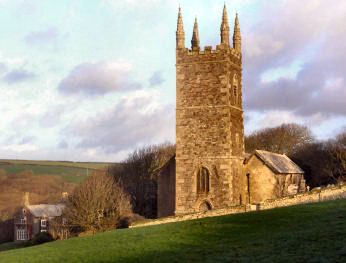
Morwenstow's church, dedicated to St. John the Baptist and to its putative founder St. Morwenna, possibly a daughter of Welsh King Brychan, is unusual in more ways than one. It must be just about Cornwall's least accessible church, a full five miles from the nearest road of any significance and in the county's most northerly parish. Of Norman origin (though there must have been an earlier church here), although restored in Victorian times, it retains a fair amount of Norman work, notably in the porch and the north arcade. And finally, for 40 years from 1834, it had as its vicar the remarkable Robert Stephen Hawker, poet and free spirit, who was responsible for much of the restoration of the church and who chose to bury shipwrecked sailors, of whom there were many in these dangerous seas, in his churchyard rather than, as was the custom at that time, on the shore where they were washed up. Hawker also wrote the Cornish anthem, Trelawny, Song of the Western Men. Worth noting inside the church are the unusual and very early Norman font, the screen and rood which Hawker restored, and a degraded wall painting believed to represent St. Morwenna. Outside, look at the lych gate and its adjacent lych house, at the figurehead of the Caledonia (original in the church) and, in early spring, the most amazing display of daffodils. And do walk to the cliff, turn left and seek out Hawker's Hut, where Parson Hawker wrote his poetry.
Morwenstow church in the evening sun
Churchyard at daffodil time, see Morwenstow village
More in Churches & Holy Sites
Mullion, St. Melina's
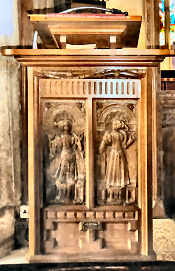
I visited Mullion towards the end of March 2018 in order to look around St. Melina's church, which stands towards the northern edge of this large village on the western side of the Lizard peninsula. There is a donation car park fairly close by and a pub, the Old Inn, almost opposite. The sturdy tower of the church is striking, built of a mix of granite and serpentine blocks. Otherwise the church consists of porch, nave and two aisles. The porch is worth attention with its Cornish wagon roof, studded door and three stage door surround. Inside are 15th century wagon roofs, an impressive three part rood screen incorporating some of the original screen, complete with rood, an Elizabethan lectern carved with two female figures, a 13th century hexagonal font with simple decoration, and elaborate royal coat of arms of Charles II. There are several monuments, though none of great significance. All this is fine but the reason for visiting St. Melina's is to see one of the best collections of 16th century carved bench ends in Cornwall - and that's saying something. In the churchyard, several crosses include the head of an octagonal section medieval cross. From Mullion I went on to Perranuthnoe, a couple of miles south-east of Marazion.
Mylor Bridge, All Saints Church
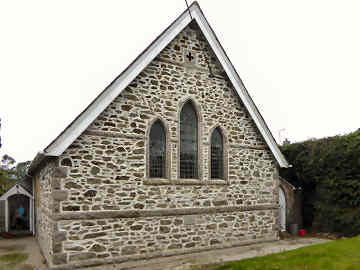
On our way from Peranarworthal to Mylor Churchtown Jane and I called in at otherwise uninteresting Mylor Bridge to take a look at All Saints Church. We thought we were out of luck, finding the church locked, but almost immediately a very helpful churchwarden, who lives across the road, spotted us and dashed over to unlock the church. Thank you, churchwarden. The exterior is of little interest, dull stonework with far too much mortar. At the west end there is a small bellcote in the gable. However the interior proved to be quite unexpectedly interesting. Above an unusual arch-braced roof, the ceiling is painted blue, something I have otherwise only encountered a couple of times elsewhere, most notably at St. Peter's, Newlyn and St.Probus in Probus. The feeling is much more of a Methodist chapel with a gallery at one end and chairs rather than pews. A circle of chairs is presumably used for parish meetings. Stained glass behind the altar is simple and geometrically patterned.
Mylor Churchtown
Churchtown