
Mylor Churchtown, more images of St. Melor's Church
Melor's Church
In late August 2018 Jane and I had a most enjoyable outing down Falmouth way. First, at the invitation of churchwarden Paul Stuart, we had a look at the interior of St. Piran's Perranarworthal, normally closed except for services. Then we stopped in Mylor Bridge to take a look at the interior of All Saint's Church, again courtesy of an obliging churchwarden. We then spent some time in St. Melor's Church, set above Mylor Harbour. Finally we enjoyed an excellent light lunch in Mylor Cafe where, if you spend more than �5, you may get your car park fee refunded. I was quite taken with the interior of St. Melor's with its elaborate screen, elaborately carved pulpit and a series of ceiling bosses which rate no mention in Pevsner; they reminded me of the far more comprehensive collection in St. Nectan's, slao reviewed on this page.
Elaborately Carved Pulpit
St. Melor's Chancel and Screen
One of several Ceiling Bosses
Photographs
More in Churches & Holy Sites
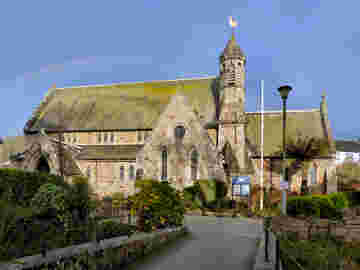
Newlyn, St. Peters
I was quite surprised by this church, associating Newlyn essentially with the fishing industry and its associated trades. If you walk up The Coombe, cross the third little bridge over the tiny Coombe River, there in front of you is St. Peters. What I was looking for, a Cornish Cross head formerly in Trereife Park,, was straight in front of me by the south wall. The church is on a relatively grand scale for a small harbour town. It dates from 1859-66 and is very much in the Victorian style of its time. I had really only gone there to photograph the Cornish cross head but was sufficiently impressed by the exterior to take a good look around inside. I was glad I did because the interior was quite a surprise. It is predominantly blue, with blue pews in the nave, a blue chancel ceiling and a blue ceiling in the transept where the organ is. The font has an attractive cover, topped by a dove. The chancel is striking with a reredos of the Last Supper and a crucifixion on a baldachino canopy over altar and reredos. A niche in the south wall has a charming small Madonna and Child statue. The granite pulpit is adorned with serpentine pillars. There is some good stained glass.
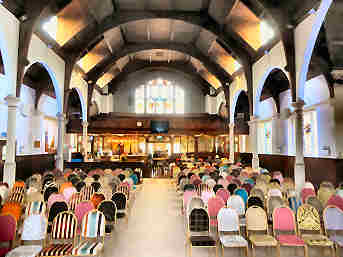
Newquay, New Creation Centre
In mid-March 2018 Jane and I visited Newquay together. Secondary purpose was to lunch at the Headland Hotel's excellent Terrace Restaurant, where we enjoyed a good lunch overlooking Fistral Beach - and made a booking for Jane's 80th celebrations in May. Primary purpose was to visit the Parish Church of St. Michael but yet again it was closed, despite being supposed to be open on Wednesday mornings. However we made up for that by visiting the Newquay Christian Centre on Seymour Avenue. This is an Elim ‘Foursquare Gospel Alliance’ church, part of the Elim Pentecostal Church. This proved to be very different from the usual Anglican church: we were greeted by a friendly, informative but in no way pushy lady and were immediately offered coffee and cakes. The church has a very open and welcoming feeling. The first two things to strike us were the lovely collection of fabrics on the seats and the striking blueness of the chancel. Then, looking around, we were very much taken by the contemporary stained glass which included a watermill and a carpenter's tools. The barrel-vaulted wooden ceiling is notable, too, very Cornish in style. Seating in the foyer features colourful cushions. A charming, welcoming place.
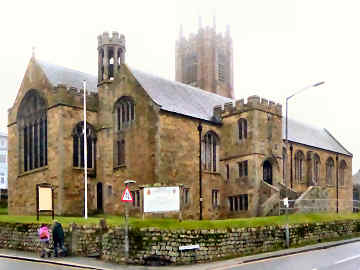
Newquay, St. Michaels
When I tried to visit St. Michaels, Newquay, towards the end of January 1918, I was thwarted. It was closed. I should have realised that, in a town like Newquay, it was not reasonable to expect a church to be open all the time, particularly as it had been the subject of an arson attack on 29th June 1993. So I emailed the church and received a very prompt reply from Canon Jem Thorold with details of opening days and times. I shall return there for a good look around. In the meantime I quote briefly from the new 2014 Pevsner. "1909-11 by Sir Ninian Comper, one of Cornwall's finest churches and the twentieth century's most significant architectural contribution to Newquay. The whole interior bestows a cool, calm, assured character".