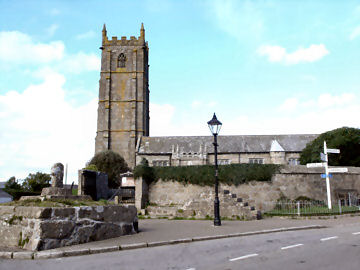
St. Burian's Church
Burian's Church
St. Burian, said to have been the daughter of an Irish king, is thought to have landed in St. Ives in the early 6th century and founded a chapel here on the site of the church which now bears her name. In the 10th century, this was made a collegiate church by English King Athelstan, and granted sanctuary rights by him. This might support the tradition that the village of St. Buryan was at one time something of a convict colony. St. Burian's church stands on a mound, a suggestion of antiquity, and is larger than you might expect of a small village - but the population is far smaller than in its mining heyday. The present church is largely 15th and 16th century and has some outstanding features. Inside is a beautiful carved screen, still painted in its original colours of red, green and gold. Although partly destroyed in the reformation, what remains is impressive. An unusually shaped early font is of Ludgvan granite, carved with figures of three angels. In the chancel are two pairs of oak miserere stalls. Under the tower a tomb slab to the wife of a Norman knight dates from 1119. Outside, the porch, as at St. Just-in-Penwith, matches the tower, battlemented and pinnacled. In the churchyard is an ancient cross head. Another is outside the churchyard, near a great mounting-block.
Visited during a St. Buryan figure-of-eight walk
Note the cross head and mounting block
St.
More in Churches & Holy Sites

St. Clederus Chapel and Holy Well
Clederus Chapel and Holy Well
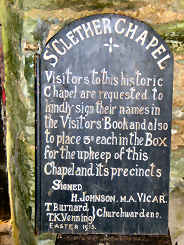
St. Clederus Chapel, more images
Clederus Chapel, more images
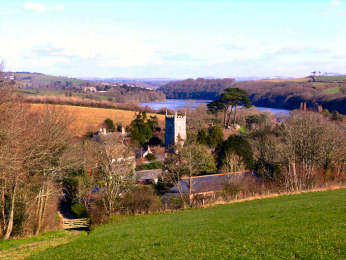
St. Clement near Truro - See below for St. Clement revisited
Less than two miles from the heart of Truro, St. Clement might be another world entirely. Reached by a quiet and narrow lane, it nestles above the tidal Tresillian River, its wooded banks a haunt of herons. Jane and I revisited after more than thirty years and, for the first time, took a close look at the church. The delightful churchyard is entered through an unusual lych gate, rooms above it and a filled-in coffen stile, like a great granite cattle grid, beneath your feet. The churchyard, itself part of a wildlife project, is full of ancient tomb stones with sentimental inscriptions. Near the south porch is a remarkable survival, an eleven foot high granite pillar, twice used as a 6th century memorial, re-cut as a Celtic Cross and later used as a gate-post. Inside is a pulpit of green serpentine, a 14th century font and a rather touching marble memorial to Samuel Thomas. An easy one mile, sometimes muddy, walk down-river brings you to the village of Malpas and its Heron Inn. A pleasant, but less often muddy, walk up-river brings you to Tresillian village just east of Truro. A walk uphill and across fields brings you to Boscawen Park on the Truro River just on the south side of Truro city centre. There is a small amount of parking at the creek below the church.