St. Erth
Erth
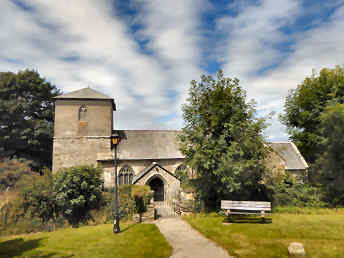
Walking the second stage of the Land's End Trail, I finished up in St. Erth and was pleasantly surprised to find a delightful church. According to the church guide, St Erth (or Erc or Ercus) was Irish, a brother of St. Ia and St. Uny and a close friend of St. Patrick. Tradition has it that he is buried beneath the church. Outside, St. Erth church is conventionally Cornish with its three-stage pinnacled tower, same height nave and aisles, and decorated and perpendicular windows. Inside is quite a surprise. Wooden barrel vaulted roofs have elaborate bosses and, at the chancel end, painted decoration. Corbels carry carved stone heads and two carved angels look out of dormer windows. The Trewinnard Chapel, in the south aisle, is colourful with painted roof and bosses, a gilded altar and reredos and a beautifully carved screen. The chancel, too, is colourful with more roof decoration, painted carved oak reredos and a good stained glass window. The surprise is that all this elaboration is late Victorian and Edwardian. There are associations with Harveys of Hayle; it was here that Richard Trevithick married John Harvey's daughter Jane. There are two Cornish crosses in the churchyard, one close to the porch, the other incorporated in a grave. A most unusual cross stands in the square in the village, its head rectangular but not in lantern form.
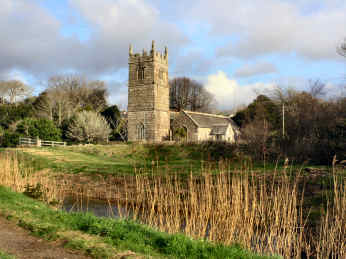
St. Erth church across the little Hayle River
St. Erth Revisited
After my Land's End Trail walk that finished in St. Erth, I read the guide book and realised that I had missed a lot in the graveyard. So I returned a week later in December 2007, when also visiting Cape Cornwall and Towednack Church. The graveyard is large and well stocked with graves. Most significant are those of the Harvey family (of Harvey's of Hayle) and of the related Trevithick family. Richard Trevithick married John Harvey's daughter Jane; it is a shame that he is not here but in an unmarked grave in Dartford, Kent. By the south-east corner of the church is a handsome chest tomb. There are two Cornish crosses, one near the south-east corner of the church, another topping a tomb to the north side of the church. There are also a couple of cast iron crosses, marking (I think) graves of children.
St.
Erth Revisited
I visited St. Erth on the last Saturday in September 2018 but found the church locked. I had to satisfy myself with photographs in the churchyard and village. An email then elicited details of a key-holder, George Lawry. I rang George who very kindly gave up his Saturday morning the following week, not only to open the church but also to give me a good guided tour, pointing out things I would have missed such as the single clerestory window in the nave. The most striking feature of the church is the Trewinnard Chapel in the South Aisle: Trewinnard Manor is south of St. Erth. The tower is of the early 15th century and the porch of the late 15th century but the body of the church was rebuilt by J D Sedding 1873-4. Restoration continued into the early 20th century and included the Trewinnard Chapel, described by John Betjeman as "one of the first really sensitive restorations in Britain." Dormer windows (I only spotted one) were inserted into the roof to add light. Unusually, Sedding used green Polyphant stone, from the far east of Cornwall, in the walls. His bench ends echo the late medieval bench ends found in so many Cornish churches. The chancel has an elaborately and colourfully decorated ceiling, as has the Trewinnard Chapel; it also features a finely decorated and gilded altar and a reredos of 1903. In the Trewinnard Chapel are tapestry copies of those in Trewinnard Manor. The square font is Norman. Painted Royal Arms are of George I. Among the late 19th/early 20th century stained glass, note the south window of the Trewinnard Chapel which shows Bishop Benson with a model of Truro Cathedral. Pevsner refers to a pre-Norman churchyard cross in the west corner of the south aisle; I think he may have mistaken a papier-m�ch� copy for the real thing, one of which may be seen in the churchyard.
Trewinnard Manor, near St. Erth, is known for its association with four families, the Trewinnards, the Mohuns, the Hawkins and the family of Sir John and Lady Nott, the present owners.
St. Erth Church South Aisle Ceiling
St. Erth Church seen from the east
St. Erth Cornish Cross
St.