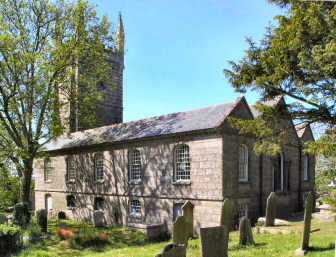
St.Euny
Euny,
We first saw St. Euny Church, from a distance, when we were doing a short walk on Carn Brea hill above Camborne and Redruth. Later, when we walked the full Great Flat Lode trail, we detoured to take a look at the church. At that time the church was closed and the tower hidden by scaffolding during a major restoration. But we found the whole place both atmospheric and unusual and promised to return. We did so in May 2005 when St. Euny's church was holding its annual Flower Festival.
This a remarkable place in many ways. The original church was founded in the 6th century by Irish monk St. Euny (see also St. Uny, Lelant). Nothing remains of that and the oldest part is now the restored Tudor tower. Inside is a complete and unexpected Georgian interior, light and airy, its windows more than a little reminiscent of those in mine engine houses.
But it is the churchyard that really takes your interest. St. Euny was the miners' church and the churchyard is filled with their tombs, all of granite, each carved with just a family name. Michell was clearly a prominent mining family as several tombs bear their name. The lych gate has a massive coffin rest. Mine accidents would often kill more than one and the rest was to support two coffins waiting to be borne into the church.
Apparently open only for Sunday services and Thursday p.m.
St. Euny's church, Tudor tower, Georgian body
Ruan
More in Churches & Holy Sites
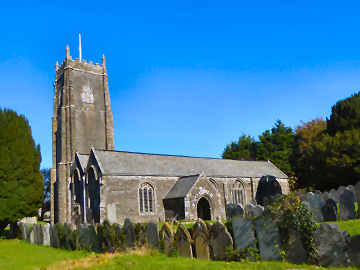
Stephen-in-Brannel
St. Stephen, more of a small town than a village is, perhaps, most notable for having a major car dealer, Hawkins, which is Cornwall's largest Peugeot dealer. It is also notable for being the former centre of the chinastone industry, related to the china clay industry further north. Indeed, back in 2016 I spent an interesting day exploring the chinastone mills, set in hilly woodland. On the same day, I tried to visit the church but it was closed and I had to content myself with photographing its Cornish Crosses. Brief research told me that the church is open on Fridays so I made the trip there on a Friday in mid-June 2019. Unfotunately it turned out to be closed again but an email to priest Emma Childs secured me an appointment to meet a helpful churchwarden in the church. The basis of the present church is 15th century but it is evident from the fine 12th century south doorway that the church's origins were Norman. Major restorations, as with so many Cornish churches took place in the mid and late 19th century. The plan is of chancel and north and south aisles. The interior is spacious. Stained glass includes a charming east window by George Cooper Abbs with scenes from local agriculture and the china clay industry. Choir stalls and prayer desks are 19th century Gothic with with stencilled decoration, reflecting the designs of screens to north and south. The font is late Norman of the Bodmin type, figures at the corners, between them trees of life and animals. The communion rail is early 17th century. In the churchyard is a Cornish Cross, plus the base of what may have been another.
Stithians
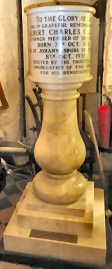
I visited Stithians in early September 2017 and was fortunate in having a warm and sunny day which gave me the chance to take some good photographs. I had not previously been in Stithians village though I had been to Stithians Lake on several occasions, including one when Jane and I walked the full circuit of the lake, and a couple of occasions when I had stopped there to eat my sandwiches. The only particularly interesting part of the village is the very northern end where the church is. I had gone there primarily for the Cornish Crosses, one in the churchyard, another in the grounds of the Old Rectory opposite. The church itself is of no special interest. Of standard constructions it has tower, nave and two aisles. Monuments include a handsome wall one to William Trewin. There is a conventional octagonal font with an interesting and elaborate wooden cover. The unusual altar cloth features a map of the parish. Stithians is probably best known for its annual agricultural show. Stithians Lake, a reservoir, is home to minor water sports including wind-surfing, canoeing and paddle boarding; a cafe is open there in season.
Stithians
I visited Stithians in early September 2017 and was fortunate in having a warm and sunny day which gave me the chance to take some good photographs. I had not previously been in Stithians village though I had been to Stithians Lake on several occasions, including one when Jane and I walked the full circuit of the lake, and a couple of occasions when I had stopped there to eat my sandwiches. The only particularly interesting part of the village is the very northern end where the church is. I was there primarily for the Cornish Crosses, one in the churchyard, another in the grounds of the Old Rectory opposite. The church itself is of no special interest. Of standard constructions it has tower, nave and two aisles. Monuments include a handsome wall one to William Trewin. There is a conventional octagonal font with an interesting and elaborate wooden cover. The unusual altar cloth features a map of the parish. Stithians is probably best known for its annual agricultural show. Stithians Lake, a reservoir, is home to minor water sports including wind-surfing, canoeing and paddle boarding; a cafe is open there in season.