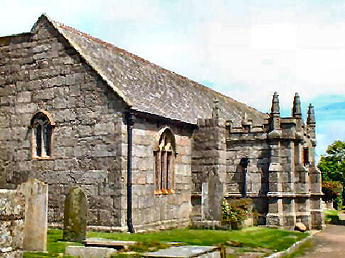
St. Just-in-Penwith Church
Penwith Church
Much of the early history of the Celtic Church is lost in the mists of time but, if the guide book on sale in the church is to be believed, this must be one of the earliest Christian sites in Cornwall. St. Just himself seems to have been Prince Iestyn, one of the sons of of Gereint, a 5th century Cornish King of Dumnonia (Devon and Cornwall). And this is said to be the site of his church or cell. Whatever the truth of that, St. Just is certainly a very early Christian location to judge by some of the inscribed stones with Chi-Rho symbols found locally, one of which, the late 5th century Selus stone is on display in the church.
The church is typically Cornish, with nave, south aisle, substantial tower and an impressive pinnacled porch. It is no surprise that it is built of the local granite. It dates partly from 1334 with later additions and alterations of the 14th and 15th centuries. In addition to the Selus stone, other things worth looking out for inside the church include the remains of the rood stairs (the rood loft and screen are long gone), and a 9th century Hiberno Romanesque carved stone, once part of a cross. But the real treasure is the pair of 15th century frescos on the north wall, one of Christ of the Trades, the other of St. George and the Dragon. What a crying shame that, in the 19th century restoration, walls were otherwise insensitively scraped bare.
South aisle and impressive pinnacled porch
By B3306 scenic coast road from St. Ives
More in Churches & Holy Sites
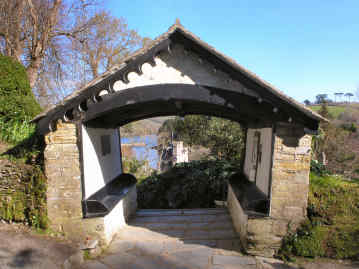
St. Just-in-Roseland Church
I must confess a special interest in the church at St. Just-in-Roseland. For twenty years my father's cousin Bertie was rector of the parish of St. Just with St. Mawes. As children we enjoyed family summer holidays staying with Bertie and Marjorie at the rectory, just across the road from the church (it's now the Old Rectory and a private home). Jane knows it well too, having lived just a few miles away at Gerrans. The church has a long history, reputed to have been founded by St. Anthony in the 6th century on a spot said to have been visited by tin merchant Joseph of Arimathea and his nephew Jesus! Remarkably, although the Celtic Church submitted to the rule of Rome in 664 AD, St. Just remained Celtic until the middle of the 10th century. The church is attractive from the outside but is disappointing inside, having been over-restored in the 19th century. The real attraction is the location, deep in a wooded valley with the waters of a little creek lapping the churchyard walls below the lower lych gate - unusually there are two lych gates - and the sub-tropical garden planted in the sloping churchyard by an enterprising Victorian rector. The churchyard is sufficiently steep that from the upper lych gate you are looking over the church tower. The church is easy to find; a sign on the road to St. Mawes points to St. Just Church and Bar - perhaps an illustration of the saying about thirsting after righteousness?
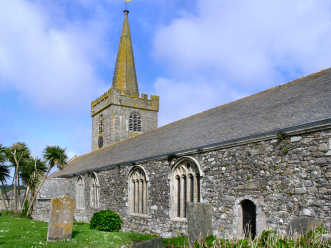
St. Keverne
Keverne
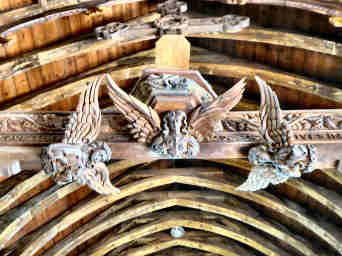
St. Keverne
Keverne