St. Keyne
Keyne
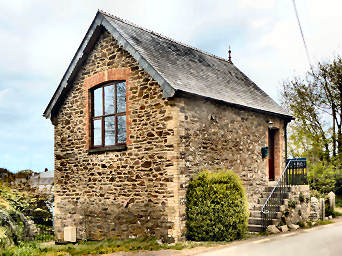
Reached by winding lanes from Liskeard, if you continue beyond St. Keyne you come to Duloe. There is not much to St. Keyne but on the south-east side is the Church of St. Keyne. It stands on a mound (lann), raised well above the road suggesting, as so often in Cornwall, a pre-Christian site. Opposite the church is the "Little Old School House" oriiginally, to judge by its tallet steps, a barn of some sort. South-east of the church is St. Keyne's Holy Well, which Pevsner describes as "the most famous of English holy wells." A little way beyond that is the Well House Hotel. Surprisingly, for an hotel with an AA 3 rosette restaurant, it seems to have no web site though it may just be a wedding venue these days (2017), having been bought by a German company a few years ago. On earlier visits I had found the church closed and it was only at the end of April 2018 that I finally found it open. Like a number of Cornish churches, what you think you see is not necessarily what you actually see. St. Keyne is an example: apparently medieval gothic, it is really largely a rebuilding by noted Victorian architect J P St. Aubyn; only the 15th century tower is largely untouched. The roof dates from St. Aubyn's time with scissored trusses with cambered collars with arch-bracing (I quote Pevsner). There are some fine slate memorials, notably to John Edgcumbe and John Hicks. The plain octagonel font is of the 15th century. The pulpit, unusually, is three-sided. Stained glass is of the early 20th century. The altar, unusually, was decorated with flowers when I saw it.
Little Old School House, once a barn
St. Keyne Church stands on a mound
St. Keyne's Holy Well
St.
Photographs
More in Churches & Holy Sites
St. Levan in West Penwith
Levan in West Penwith
St. Levan, St. Levan's Well and Baptistry in West Penwith
Levan's Well and Baptistry in West Penwith
St. Materiana
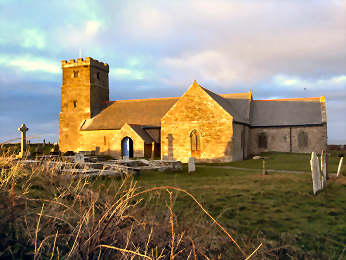
The two best things about Tintagel are the climb to the top of the 'Island' in search of King Arthur and the parish church of St. Materiana, both well away from the tawdry bustle of the tourist-trap village. Its siting is odd, stranded on a clifftop to the west of the town; a whole early settlement must have gone missing here. Inside, a simple Norman granite font stands on a most unusual plinth of small upright slates set in a checker pattern, almost as if architect Sir Edwin Lutyens had designed it as part of one of his unusual garden paths. Wood work in the church is unusual; the reredos appears to be made of old bench ends which carry carvings of the Passion and of local coats of arms. From the clifftop beyond the church you get a view of The Island on which Tintagel Castle stands. As you walk or drive along Church Hill on the way to St. Materiana's church, you pass Tintagel Vicarage, the tiny Fontevrault Chapel, converted from a barn, in its gatehouse, a dovecot in its garden. If you do drive, there are parking spaces close to the church. You can approach Tintagel Castle along the cliff from the church.