St. Michael Penkevil
Penkevil
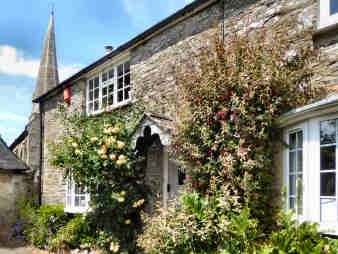
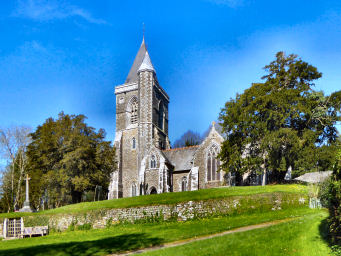
I visited St. Michael Penkevil church in early April 2017. I had twice previously passed it, but not stopped to investigate, after visiting the garden at Tregothnan, which you leave past the church. Though on a public road the church is part of the Boscawen family's private estate, reached by a turning by Tresillian Church.. The Boscawens, now Lords Falmouth, originate from West Penwith, near Lamorna, where the ancestral home still nears the name of Boscawen Farm. The churchyard is raised high above the road, causing one to wonder whether this might have been a pre-Christian site. Unusually the church, its stair-turretted tower and porch are all buttressed, making it appear older than its 19th century rebuilding. Again unusually, there is no lych gate. Inside the porch is part of an old font. Inside the church are a carved font, a fine partly marble pulpit and an eagle lectern. There are two flamboyantly detailed reredoses, that in the south transept dating from around 1300. There are some monuments to members of the Boscawen family including one to Admiral Boscawen, designed by Robert Adam and sculpted by Rysbrack. Brasses include John Trembras, rector of the parish, died 1515, and others of the 15th to 17th centuries. There are attractive cottages to the south-east of the church, and the former village pump stands on the green.
St. Michael Penkevil, note the odd stair turret
From A390 St. Austell - Truro, bear L after Tresillian church
Revd Canon Dr Lynda Barley, Canon Pastor of Truro Cathedral and Priest-in-charge of Tresillian and St Michael Penkivel, points out to me the appropriateness of adjacent memorials in St. Michael Penkevil. A window in the south wall contains a modern depiction of the Widow of Nain story in the gospels, about the son raised from the dead by Jesus. It is deliberately adjacent to the memorial to Lord Falmouth’s older brother who was killed in the second world war.
THE NAME: Here is an oddity. It may be spelled Penkevil but was once Penkivel and is mostly still pronounced that way.