
Stratton near Bude, St. Andrews Church
Of the three churches that I visited on a Saturday towards the end of January 2019, St. Andrew's in Stratton, set on a hilltop away from the centre of town, was, to my surprise, by far the most interesting. But first, may I quote Pevsner on Stratton village. "A medieval settlement that became a substantial market town and administrative centre, flourishing until the end of the 19th century when the arrival of the railway in 1898 fuelled the rapid rise of Bude as a seaside resort. Stratton's gentle decline in the 20th century has ensured the survival of its charming, coherent character, its narrow little streets (some one way) climbing up the hill to the church". The Church of St. Andrew stands on the top side of a triangle which, from the names, appears one to have contained a couple of pubs. Despite Stratton's now relatively diminutive size, St. Andrew's is the mother church of Bude. Unusually, one of the materials used in its construction was honey-coloured Ham Hill stone, imported from Stoke sub Hamdon in Somerset. Roofs throughout are of the Cornish Wagon type. The north aisle dates from the 14th century but was largely rebuilt in the 19th century at which time much restoration was carried out. The screen is perhaps the most striking feature, extending the full width of the church and the work of E H Sedding, completed in 1913; its rood and rood stair are still in place. There is a fine collection of bench ends, though Pevsner thinks little of them. The font is simple and circular with an elaborate, presumably Victorian, cover. The pulpit is 17th century with panels consisting of simple arches. There is a good collection of stained glass including work by Morris & Co and Burne-Jones. A pictorial altar cloth is (I think) of the three wise men (or is it of the three kings?); behind is wooden panelling, above a five-arched reredos. Pevsner says that the large Royal Arms is of Charles I but looks to me to be of George I.
The "Clink" Door
Stratton St.Andrew Rood Screen
Bench End
Photographs
More in Churches & Holy Sites
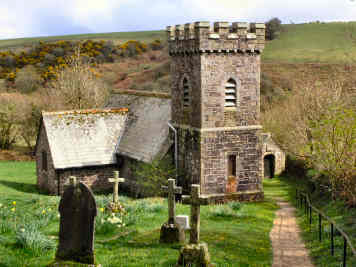
Temple Church (St. Catherine's) on Bodmin Moor
In late March 2006 I had just finished a tiring Copper Trail walk on Bodmin Moor. Heading home on the A30 highway, an impulse made me detour briefly to drive through Temple village. Once it was on an ancient route across Bodmin Moor but it has long been a backwater. I revisted in early April, after another walk, this time on East Moor. In the 12th century it was a place of some significance, boasting a small settlement and church built by the crusading Knights Templar (what on earth were they doing in Cornwall!). The Templars held the right to conduct marriages without licence or banns. As a result dubious marriages were made and the church acquired such a reputation that locals would say of a woman of ill repute "send her to Temple Moors", the ultimate ostracism. After Parliament passed the Marriage Act in 1753, the church saw little use and became ruinous. Sadly, rather than restoration, the Victorians pulled it down and built a new church. I say sadly because it would be wonderful to have a round Templar church in Cornwall. The saving grace is that stone from the old church was re-used and stones bearing degraded figures and crosses have been incorporated into wall of the outbuilding to the south side of the church.
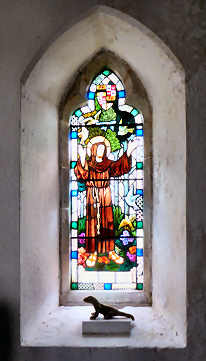
Temple Church (St. Catherine's) on Bodmin Moor
I revisited Temple Church in early August 2019. This time I was delighted to find it open so I was able to take some interior photos. The church is essentially very simple and its best feature is its stained glass much of which relates to the founders of the church, the Kights Templar and their successors here, the Knights Hospitaller.
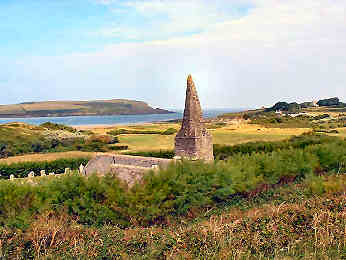
The Three Churches of St. Minver Parish
On a hot late August Sunday we did a walk to take a look at the three churches in St. Minver Parish on the Camel estuary. This is Jane's home territory; she was raised in Trebetherick and Rock in the parish. We parked above Daymer Bay, walked across St. Enodoc golf course to St. Enodoc church and the Jesus Well, down through Rock to the Camel estuary for pasties at the Rock Inn, across the beach to St. Michael Porthilly, through pasture land to St. Menefreda's in St. Minver, and by Roserrow golf course back to Daymer Bay. You could do this by car for the churches, or as an eight mile walk, using OS Explorer sheet 106. Refreshments in Rock; Fourways Inn in St. Minver was poor (2013 believed much improved); the clubhouse at Roserrow (now The Point at Polzeath) serves excellent good value food.