Tresillian, Holy Trinity Church
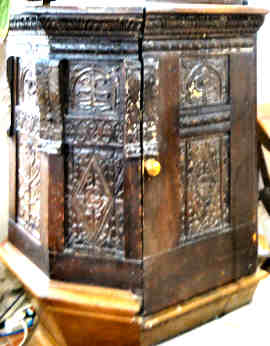
Tresillian, Jacobean Pulpit
St. Anthony Figure
Tresillian, Old Holy Water Stoup
Photographs
More in Churches & Holy Sites
Treslothan. St. John's Church
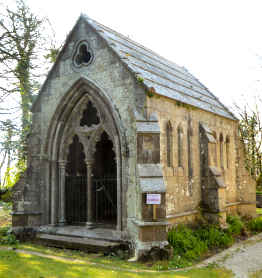
When I walked from Beacon to Clowance on the Land's End Trail I was really surprised by Treslothan hamlet. All very grey and Victorian othick but all most beautifully maintained. This was the estate village of nearby Pendarves House and survived intact when the Georgian home of the Pendarves family was demolished in 1955. All built in the 1840s by architect George Whitwick, the church, house and former school are all of the same silvery grey granite and surround a war memorial. Contrast the number of names on the memorial with the smallness of the village; these must mostly have been workers on the large but dispersed Pendarves estate. Next to the church is the Pendarves Mausoleum. Buried in the churchyard is self-taught Camborne poet John Harris. On a corner by woods is the former village well. From here a footpath heads roughly south, first passing the former schooll, now a private home, then continuing through fields and woods to the road from Troon to Carwynnen. If you are visiting Carwynnen Quoit, re-erected in 2014 by the Sustainable Trust, this is as good a route as any, turning right on the road towards Carwynnen, then right into a gate into a field. Inside the gate is a storyboard; the quoit is across the field.

Trethevy, St. Piran's Church
This Trethevy, just off the road between Tintagel and Boscastle, should not be confused with Trethevy Quoit at Darite south of Minions on Bodmin Moor. Yet, oddly, only a short distance from this Trethevy, and on the opposite side of the road, is a large flat stone known as KING ARTHURS' QUOIT. I visited this Trethevy early in October 2019, primarily to visit ST. PIRAN'S CHURCH, or Chapel as it should be known as it is a Chapel of Ease to St. Materiana's Church in Tintagel. I suggest, if there is space there, parking in the Rocky Valley Car Park, on the other side of the main road from the lane up to St. Piran's Church. The lane is signed to Rocky Valley and it is only a hundred yards or so up the lane to church and well. There is more than just the church at Trethevy. Diagonally across the lane from the gate to the churchyard is ST. PIRAN'S HOLY WELL, the beehive shaped well house topped by a small iron cross. And, if you turn down the lane at the side of the church, signed as a footpath to Rocky Valley, you will find a ROMAN MILESTONE. This is believed to date from AD 251-3 and bears a rather illegible Latin inscription reading "For the Emperor Caesar, our Lords Gallus and Volusian." A few yards further along the lane is the entrance to St. Piran's House, believed once to have been part of a monastery. The first mention of the church was in 1457 when Parson Gregory received licence from the Bishop to celebrate Mass. A century later, after the Reformation, it was used as a farm building and it was not until 1914 that the owner, Sidney Harris, gifted it to the Church. After restoration, it eventually reverted to use as a Chapel and the first service was held in it on 9th February 1944. Further restoration took place as recently as 2015. Externally, the church is set partly into a small hill and is rectangular under a slate roof. Inside it is quite simple, the nave just a plain rectanguIar space. In the east wall is a small lancet window with a trefoil head. In the north wall an attractive modern stained glass window depicts St. Piran against a background of Rocky Valley. On one wall a plaque commemorates the Reverend Dudbridge Arundel, the vicar responsible for the restoration of the church. Another remembers Sidney Wickett Harris who gifted the building to the Church. The simple altar is made of darkish, slatey local stone. Furnishing is simple with plain wood pews, lacking in carved bench ends.
Trevalga, Saint Petroc
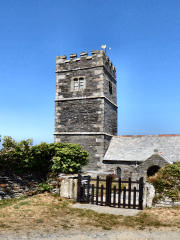
I was first in Trevalga when walking the Cornish Coast Path; that particular walk was a round one from Boscastle along the coast to Trevalga, returning inland. I was much taken with the village and by its history but only did a brief walk around on that occasion. However, on a fine Saturday in July 2018 I had been to visit the churches of Minster and Forrabury and, having some time in hand, decided to take a good look at St. Petroc's, Trevalga which I had not previously been inside, despite having visited to photograph the Cornish Cross in the churchyard. The church's origins are probably in Norman times but much of the fabric is of the 13th to 15th century. The chancel and transept still have their original medieval roofs but the nave roof was part of an 1875 restoration by J P St. Aubyn (who else!). The altarpiece is a 16th century carved Flemish triptych; it is flanked by 17th century panelling with re-used medieval bench ends below (Pevsner). Two windows of 1893 are by Clayton and Bell. A small wall monument to Samuel Roscarrock dates from 1640. In the graveyard, a wheel-headed Cornish Cross stands near the porch; not far away a small slate memorial of 2016 commemorates Beth Lugg, Bard of the Cornish Gorsedd.