Truro Cathedral
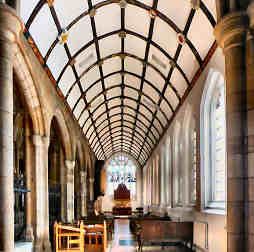
I should be ashamed of myself that, except for my friend Robert's marriage to Hayley, I had never been inside the Cathedral in Truro until I visited in early March 2018. Truro's new cathedral, architect J L Pearson, also responsible for St. John's in Devoran, was begun in 1880 on the site of St. Mary's church. Very sensibly - and sensitively - Pearson did not pull down St. Mary's Church on the site but instead incorporated part of the old church as a south aisle. Nicely, Pearson retained the wagon roof of St. Mary's, complete with modern bosses, a very Cornish feature to keep. The style is an elaborate form of Early English Gothic and the west front, overlooking a cobbled square, is impressive. The exterior of the cathedral is of Cornish Carnsew stone with Bath stone for the detailing. The interior is of St. Stephen granite, again with Bath stone dressing. Pevsner describes Truro Cathedral as Pearson's masterpiece and I certainly would not dispute that. As always in great buildings, whether homes or churches, look up: this cathedral soars. Among the things to look out for are: in the south aisle, the Boer War Memorial, the Newlyn Harbour stained glass, the Wesley Window showing both John and Charles at Gwennap Pit, and a 14th century Pieta of Caen granite. In the south transept the Delabole slate floor commemorates the visit in 1994 of the Queen and the rose window remembers Bishop Benson whose brass is in the chapel next to the Baptistry, where a marble font has an elaborate wooden cover. Above the altar, an ornate triptych was designed by the architect's son, Frank. Behind the High Altar is a superb reredos of Christ first crucified, then glorified. In the North Quire Aisle is a large terracotta frieze of The Way of The Cross. In the North Transept a grand monument commemorates John and Phillipa Robartes. There is superb stained glass in the North Transept Rose Window and in the West Rose Window. In the North Aisle do not miss John Miller's painting Cornubia, Land of The Saints or the superb Eagle Lectern. On leaving, across the square, I was delighted to notice for the first time a Cornish Cross, not a modern one but a genuine early one, albeit it somewhat degraded.
Old St. Mary's Church
Cathedral West Front
Caen Stone Pulpit
Photographs
More in Churches & Holy Sites
Tuckingmill, All Saints Church
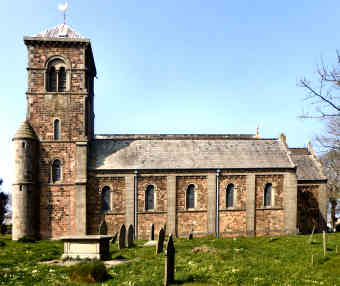
I had hoped to visit All Saints in Tuckingmill on the same day that I was at Penponds and Treslothan. Unfortunately it was firmly locked. For the moment, the best I can do is use a couple of exterior photos and take my information from Pevsner. This is an early Victorian church, completed by John Hayward of Exeter in 1846. Externally, Pevsner admired it but I find it not very prepossessing, too dark and massive. Unusually, the tower, instead of attaching to the west end of the nave, is attached to the south aisle. This five-stage tower, with its low pitched roof and stair-turret, is perhaps the most striking exterior feature. The interior is both unusual and striking, the walls white-painted but un-plastered. The roof is arch-braced. The chancel arch is semi circular slender set-in shafts and dog-tooth moulding. The font is early Norman and came from a former chapel at Menadarva, a small settlement north-west of Camborne. Stained glass in the chancel, described by Pevsner as "bright and dazzling," is from around 1847 by Joseph Bell.
Tywardreath, St. Andrew's Church
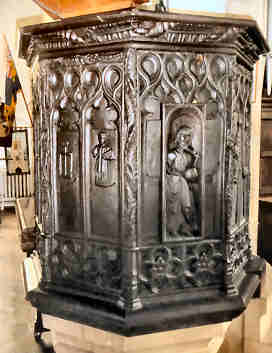
I made three church visits on a dull Saturday at the beginning of September. First call was at Tregaminion Church - closed but I got photos of the two Cornish Crosses - my second was to Tywardreath's parish church and my final visit was to the church of St. Fimbarrus in Fowey. There was once a Priory here but no sign of it remains although there is still a Priory Lane and Prior's Cottages. Tywardreath's church is easy for parking, there is room right below the west gate and the War Memorial at the western end of Church Street. Before entering the church it is worth first going to the east gate, outside which is a tiny Memorial Square. Enter by that east gate and you pass another War Memorial on your way to the south porch. But, before entering, look to the left of the porch where there is some old masonry on a grassy patch. The octagonal upright to the front of the grass is said to have been the stone post that marked the route across the bay in the days when the sea came right up to Tywardreath, as described in Daphne du Maurier's "House on the Strand", a literal translation from the Cornish Tywardreath. St. Andrew's Church looms large in the attractive village. The tower is 14th and 15th century; the body of the church was rebuilt in the 1880s. The lofty, spacious interior is attractive. Oak Cornish Wagon roofs have boarded panels and carved - but not painted - bosses. Furnishings are impressive. An octagonal font is 15th century and has shields within quatrefoils within circles. The attractive pulpit is made from 16th century bench ends and parts of the former rood screen, all varied and quite distinctive. There are some fine bench ends on the pews of the North Transept. The High Altar is of Caen stone with 14th century consecration crosses. There are a slightly cumbersome looking parclose screens. A slate memorial of 1534 remembers Thomas Colyns, last prior of the lost priory. On the walls are several memorials to members of the local Rashleigh family, most associated with their harbour at Charlestown. A partial slate memorial of 1632 remembers Jane Rashleigh.
Veryan, St. Symphorian
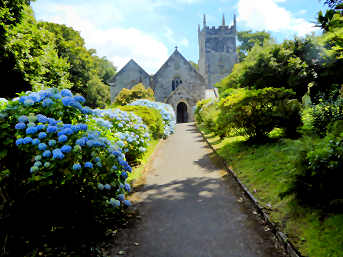
I revisited Veryan early in July 2017. I had been there many times before, most particularly when doing a round walk from Portloe, heading first to Veryan, then by Carne Beacon to Carne Beach and on back to Portloe by the high and relatively difficult Nare Head, where you have not one but two fair climbs. I had also been there especially to photograph the most unusual and attractive round houses and to visit the lovely Trist House garden (I think it still opens but it may be best to ring the Salmons on 01872 501422 to check). On this occasion I was there for the well and for St. Symphorian's church. But first I enjoyed coffee and a bacon roll in Elerkey House, opposite the excellent New Inn. The well was erected by the Rev. Samuel Trist (of Trist House) in 1910. The church, tucked into a hill-side, is approached along an avenue of hydrangeas. It consists of nave, aisle and three-stage pinnacled tower. In the sloping graveyard above are two sealed mausoleums. Inside the church is a font with four columns and heads at each corner; an attractive carved wooden pulpit; a wooden roof supported by wooden beams with carved bosses; two charming sections of the former rood screen; on a window sill is a model of a four masted sailing ship. In the slloping churchyard is the Trist family tomb-vault and a charming sun dial.