
Winwaloe
Church Cove on the Lizard, St. Winwaloe's
Follow a lane off the main Helston to Lizard road, through Gunwalloe, past the excellent Halzephron Inn and down to the coast, and you will come to Church Cove, set below Mullion Golf Course. There the little church of St. Winwaloe is tucked into the foot of the dunes. Winwaloe was born in Brittany of Cornish parents in the sixth century. The present church is mostly in the perpendicular gothic style. Inside are two earlier fonts and tiny rood stairs are still in place. Two inner doors are painted with the figures of eight of the apostles. Beyond the south porch a tower looks defensive but is really a detached bell-tower. By the porch is a figure of St. Winwaloe. In one corner of the churchyard is a Cornish cross. There is car parking nearby. Other Winwaloe locations include St. Winnow, Towednack and Poundstock.
St. Winwaloe's tucked into lovely Church Cove
The detached Bell Tower
Photographs
More in Churches & Holy Sites

Withiel Revisited
The most unusual thing about St. Clement's church is that, as you approach it from the east, it stands high above you on a site that was probably a pre-Christian lann site. The tower is striking; in three stages, it is crowned by tall crocketed pinnacles; a stair turret hides on the north-east side. The earliest part of the present church is the 13th century tall, narrow north door, long out of use. Nave and chancel appear to be 14th century. A north chancel, of the same period, was probably originally a chantry for the Brevill family. A south aisle was added in the early 16th century; it bears the arms of Prior Vivian of Bodmin. You enter through a porch carrying a sundial below a small elaborate cross. The porch is entered through a four-centre arch and has a wagon roof with a couple of carved bosses. Above the door to the body of the church is a tympanum with a carved shield; to the right of the door is a holy water stoup. Inside, the south aisle arcade has a carved wagon roof, the nave and chancel have plain wagon roofs. Unlike nearby St. Wenn, which has lost its bench pews, St. Clement's still has its. Several features about St. Clement's stand out: the font, believed to date from 1476, has an octagonal bowl with carved panels and the stem, too, is elaborately carved. Behind the font are painted gothic panels carrying the ten commandments and other texts. The organ is as colourful as any I have seen, painted vivid blue and gold. Windows have fragments of stained glass, including a fragment with the arms of Prior Vyvyan. A slate headstone dated 1811, remembers Henry Vyvyan. In the churchyard, 19th century gates are of cast iron.
Wyllow
Lanteglos-by-Fowey, St. Wyllow,
Advent Church near Tresinney
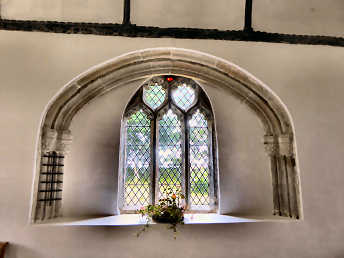
I was first at Advent church in 2014, in the course of researching a round walk from St. Breward to Camelford. Then I passed through Advent churchyard on my way from Camelford back to St. Breward. On this occasion, in July 2016, I had been to Lanteglos-by-Camelford in the morning and decided to continue to Advent, not far away, in the afternoon. Despite the name Advent church, and therefore the existence of a parish of Advent, there is no village of that name. The church is quite isolated and reached either by a footpath across a couple of fields from Trethin, entering the churchyard by a gate and stile, or by a narrow track from a lane at Tresinney. As churches go, this may well be Cornwall's least interesting - makes me wonder why I have bothered to report on it. There is very little or no atmosphere, there are no carved bench ends, which you get in so many Cornish churches, no interesting memorials, no good stained glass. About the only worthwhile features are an attractive window in the south aisle (see photo), a Norman font, bosses on the wagon roofs, and an apparently damaged pulpit with panels missing. There is a little interesting woodwork in the porch roof. Of some interest is the site, the bank surrounding the churchyard suggesting a very early Christian or even pagan site.