Daniel Gumb - Stonemason. self-taught mathematician
Gumb - Stonemason. self-taught mathematician
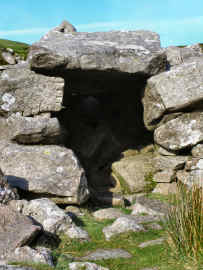
One of the great oddities of Bodmin Moor is the cave on the southern slope of Stowe's Hill, known as Daniel Gumb's Cave. I had been up Stowe's Hill several times without ever spotting the cave - each time I had passed just above it - but in November 2006, with my sister Frances who was visiting, I made a point of seeking it out - and found it this time. Daniel Gumb was born somewhere in the nearby Tamar Valley in 1703 and found work as a stone cutter at Minions. Rather than rent lodgings there, it seems that he built himself a home on the slope of Stowe's Hill, where the workable stone was, by tunnelling into the hillside and constructing three stone-lined rooms in the hill itself. There he is said to have raised 9 children by 3 wives. It must be said that this is not the original cave dwelling. When the present quarry was worked, some of Gumb's dwelling was reconstructed in its present location. That at least some of the rocks were Gumb's is attested by one stone with his name and the date 1735, another bearing the self-taught mathematician's carvings of mathmetical symbols. It is said that some of his work as a stone mason can be found on tombstones in several local graveyards including that at Linkinhorne.
The 'cave' by the Cheesewring
An odd part of a curving column nearby; Gumb's work?
The Cheesewring itself
Billy
Photographs
More in Miscellanea
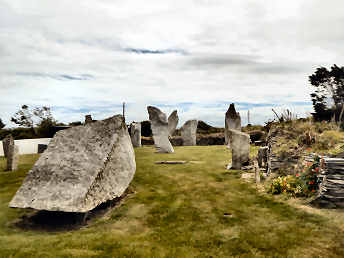
Ed Prynn and his Prynnhenge
Prynn and his Prynnhenge
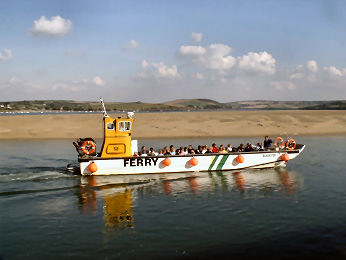
Ferries - some for cars, most just for passengers
With a coastline so indented by rivers and tidal creeks, particularly in the south, it is no surprise that many ferries operate, mostly across south coast inlets. Only three carry vehicles - Torpoint ferry from Plymouth to the Rame Peninsula; King Harry, across the deep Fal estuary from the Roseland Peninsula; and Bodinnick across the river at Fowey. Pedestrians and cyclists are better served. Theirs operate from Plymouth to the Rame Peninsula, from Fowey to Polruan, across the Helford River near Trebah Garden, and, in the north, across the Camel from Padstow to Rock. There are said to be couple of seasonal high tide ones - over Gillan Creek in the south and over the Gannel to Crantock Beach in the north near Newquay. Falmouth is best served of all. Ferries operate from here to St. Mawes across broad Carrick Roads; to Flushing just across the Penryn River; to Mylor Yacht Harbour up the Fal; and to Truro by way of the National Trust's Trelissick Garden, the Smugglers Cottage Tea Rooms at Tolverne, and Malpas, location of the excellent Heron Inn. There is even a 'park-and-float' service which operates from Ponsharden, up the Penryn River, to the National Maritime Museum in Falmouth but, because of tides, this is only intermittent. St. Mawes has a second ferry, across Percuil River to Place.
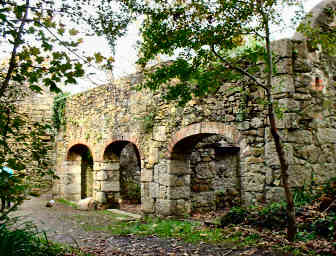
Harvey's of Hayle - The Great Cornish Engineers
Walking around the run-down town of Hayle these days, you would never guess that the industrial heart of Cornwall once beat strongest here. Yet in the mid-18th century Hayle boasted perhaps 5000 jobs in industry. The National Explosive Company, the Cornish Copper Company and the docks were all major employers but the greatest of them all was Harveys.