Landscapes of King Arthur
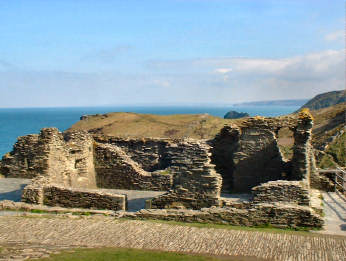
You may or not believe in King Arthur - there is no physical evidence and scant contemporary record of the British hero killed in battle around AD500 - but he has had a hold on the imagination ever since the romantic chivalric tales of the early middle ages. I choose to believe that there is no smoke without at least a hint of fire. So I like to think that there is something to the legends that locate him in Cornwall. The photo is of the medieval Great Hall on the 'Island' at Tintagel where some archaeological remains of the appropriate period are known as Arthur's Castle; the site is very steep and not for the faint hearted and there is quite a long walk down from the nearest car park. A few miles away, at Slaughterbridge near Camelford, an inscribed stone is claimed to refer to Arthur's final fateful battle of Camlaan, where he was mortally wounded by Modred. Near Wadebridge, a hill fort is named in the Welsh Mabinogion as Arthur's home 'Kelliwic'. In the middle of Bodmin Moor, near Jamaica Inn, is Dozmary Pool; here Sir Bedivere is said to have thrown Excalibur after Arthur's death. Another Dozmary Pool legend has poor Jan Tregagle condemned forever to try to empty the pool with a leaky scallop shell. Some way north of Dozmary Pool, also on Bodmin Moor, is King Arthur's Hall - there is no serious connection.
Tintagel Castle. King Arthur'e Hall
Daniel
More in Miscellanea
Literary Cornwall - 1 - Fowey - mostly Daphne du Maurier
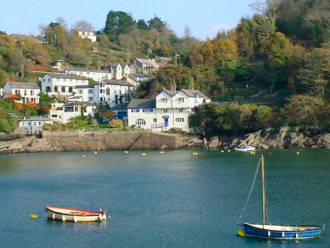
Fowey is best known for its connection with Daphne du Maurier. In 1926 her parents bought 'Ferryside' at Bodinnick and she fell in love with it and Fowey. In 1932 she married Boy Browning at Lanteglos church. They lived in London but in 1943, with Boy away at war, Daphne rented a house at Readymoney Cove south of Fowey. She then persuaded local landowners, the Rashleighs (builders of Charlestown harbour), to rent her Menabilly, a mile west. Menabilly was the model for 'Manderley' in Rebecca. When her lease expired in 1969 she moved to another Rashleigh home, Kilmarth, where she died in 1989. There is a du Maurier Literary Centre shop at 5 South Street in Fowey and each May a Literary Festival honours her. Other du Maurier locations are Frenchman's Creek on the Helford River and Jamaica Inn at Bolventor. Before du Maurier, Q - Sir Arthur Quiller-Couch - was the literary lion of Fowey. Born in Bodmin and, although Professor of Literature at Jesus College Cambridge, he lived most of his life at The Haven on The Esplanade, where a plaque commemorates him; his memorial stands high on Hall Walk across the river. One of his friends and visitors was Kenneth Graham, author of Wind in the Willows; Graham was inspired by the Fowey River and Q himself - who loved 'simply messing about in boats' - is believed to have been the model for Ratty.
Literary Cornwall - 2 - A Miscellany
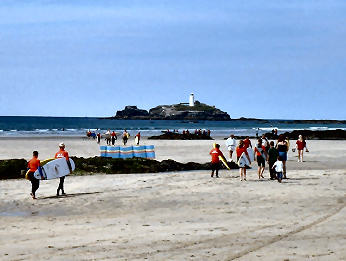
A. L. Rowse - he would have wanted to be first in the list - was born of a poor family in Clay Country, won a place at Oxford and became a Fellow of All Souls. Major historian, Shakespearean, controversialist; lived at Trenarren near St. Austell; memorial stands on nearby Black Head. Richard Carew - of Antony - was Cornwall's first historian, publishing his Survey of Cornwall in 1602; a plaque on Hall Walk opposite Fowey remembers him. D. H. Lawrence rented a house in Porthcothan in 1915, then at Higher Tregerthen Farm near Zennor in 1917. Hounded out as a German spy! Hugh Walpole, of Herries Chronicle fame, stayed in St. Ives, visited Truro renaming its cathedral Polchester in Cathedral and Old Ladies. John Betjeman, late 20th century Poet Laureate, loved his holiday home by Daymer Bay. He is buried in St. Enodoc churchyard. Virginia Woolf spent childhood summers at Talland House in St. Ives, from which she could see Godrevy Light (From the Lighthouse). Thomas Hardy came to St. Juliot in 1870 as architect. He stayed at the rectory and in 1874 married the rector's sister Emma Gifford. A Lawrence Whistler window in the church commemorates him. In A Pair of Blue Eyes St. Juliot appears as Endelstow, Boscastle as Castle Botterel. Charles Causley - poet and children's author - was a Launceston man. Maria Branwell, the Brontes' mother, lived at 25 Chapel Street, Penzance
Literary Cornwall - 3 - Winston Graham and the Poldark Novels
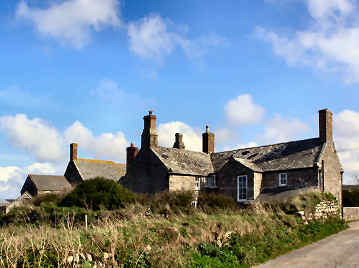
Poldark Novels