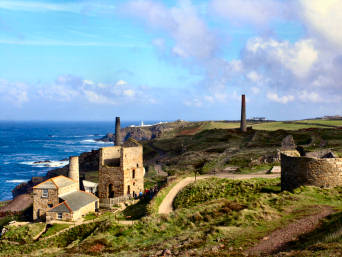
Levant Mine near St. Just in Penwith
Cornwall's oldest working beam engine lay idle for 60 years after Levant Mine closed. Built in 1840, to power lifts taking miners down 1800 feet, and tin and copper ore up, it operated continuously until Levant Mine closed in 1930. In 1935 an enthusiast purchased it for �25, founding a preservation group - later the Trevithick Society - in order to try to save it. Around 1990 a group of volunteers, known as the Greasy Gang, restored the engine, said to be the only Cornish beam engine still operating in its original engine house. The whole site is now in the care of the National Trust, which owns much of the cliff top in this part of Cornwall. Now that the beam engine is fully restored and in steam again, the site is open as a museum and is part of the Cornwall and West Devon Mining World Heritage Site. In addition to the engine, you can see a restored electric winding engine and the pumping and winding shafts, take a short underground tour and see a film. Not far south, at the old Count House at Botallack Mine, there are historical displays. Although there is parking on the site, my own view is that the best way to visit Levant Mine is in the course of a wonderful cliff-top walk between Pendeen Watch and Cape Cornwall, offering Cornwall's finest collection of mine remains in beautiful locations. Suggested round walk in the area.
Signed from B3306 coast road at Trewellard
Levant Mine Engine Complex
More in Museums & Galleries
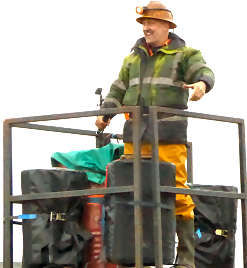
Man Engine
Cornishman Will Coleman is author, film maker, musician. educationalist and former director of Cornwall's renowned Kneehigh Theatre. He is also funder of Golden Tree Productions which promotes Cornwall and its history. He is also an enthusiastic promoter of the Cornish language and has published a book about the Plen-a-Gwary, Cornwall's medieval amphitheatres. A talented engineer, too, in 2016 he and his team created Man Engine, a 33 foot high mechanical puppet of a Cornish miner. This was first unveiled in Tavistock in 2016 and has since toured the country. We were lucky enough to see Man Engine in early April 2018 on the Wadebridge Showground. I say lucky but the weather was dreadful, the ground soggy and the site sufficiently awkward that good view of the action were not always to be had. That didn't prevent us from enjoying Will's show. He is a great showman and an entertaining raconteur. The original Man Engine was the device of ladders and platforms that transported miners as much as 1600 feet down mine shafts. The performance of Will Coleman's Man Engine was remarkable for such a giant robot. In addition a young lad, perched precariously at the top of a 40 foot ladder, gave an inverted demonstration of the use of the ladders and platforms of the real-life man engine. It may have been wet and muddy on the Showground but it was well worth tolerating the conditions for Will Coleman's great show.
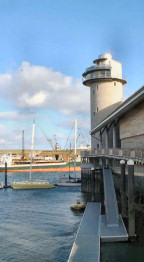
National Maritime Museum Cornwall
Hot 2003 museum news was the opening of Cornwall's brand new National Maritime Museum in Falmouth. Until 2002 a small maritime museum was oddly tucked up an alleyway on the landward side of Market Street. But in 2003 it moved, to become part of a brand new major Maritime Museum, on the waterfront by the docks. By 2004 it had settled in well. No local museum this, however, rather the most comprehensive small-boat maritime museum in Britain, housing, amongst many other exhibits, the national collection from Greenwich. In a vast but handsome oak-clad modern building, not unlike a ship-building shed with a lighthouse tower on the end, the National Maritime Museum Cornwall Charitable Trust has assembled a most impressive collection of small boats and of technological and inter-active displays. Here are not just the artefacts but the complete maritime story in a dozen purpose-built galleries. The two most striking features come at the beginning of your visit. After enjoying a superb showcase of scale models, you find yourself on a ramp leading past the screens of a vast audio-visual theatre telling the story of the sea – with impressive lighting and sound effects. Then, as you continue up, you find yourself alongside the ‘Flotilla’, a comprehensive small-boat collection spanning 150 years and including racing dinghies, record breakers, working boats, fishing vessels, canoes, punts, rafts and coracles. Simple interactive displays offer more information. A gallery is home to works by the Royal Society of Marine Artists and to an exhibition on the packet boats that sailed from Falmouth. At the top of the tower - reached by stairs or elevator - is a viewing gallery with telescopes and local displays. In the basement you are underwater with related displays. At ground level you will find a 'pilchard cellar' from the original Falmouth museum, sail loft, working boatyard where craftsmen work on restorations - and even a pool where children (of all ages) can try their model sailing skills.
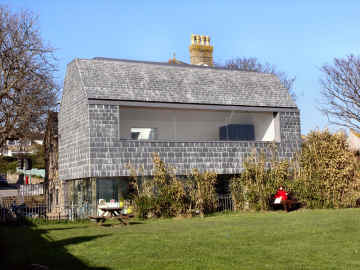
Newlyn Gallery and Exchange Gallery
July 2007 - Newlyn Gallery must have come into some money recently. Not only has it built a new caf� and bookshop extension to the original Passmore Edwards building on the eastern fringe of Newlyn, it has also acquired a brand new gallery in the heart of Penzance, the Exchange Gallery just off the town's attractive Chapel Street. We can't claim that our taste in art matches theirs but we do admire the new buildings and we imagine that the caf�s will prove a big attraction. We took a look at both places when we went to Penlee House for their marvellous Stanhope Forbes exhibition, definitely our taste. The exhibiton in Newlyn Gallery was quite beyond our comprehension; that in the Exchange Gallery, called Social Systems, was comprehensible but hardly our thing.