
Golden
I would never have thought of visiting Golden, were it not that, when operating my touring business for visiting Americans, I drove Kenneth and Anne Golden from San Diego, California. His Morley ancestors were from Minstead in the New Forest and I took them there. By remarkable coincidence, not far from MInstead was a Golden Farm but there was no connection. Kenneth believed that his Golden ancestors were from Cornwall but had no idea where. This tiny hamlet must have been his ancestors' Cornish home. Golden is an odd and unexpected little place. A sign on the road from Grampound Road to Tregony points to Golden Mill. On the way down the hill, first comes Golden, consisting of Golden Manor Farm, its farmyard and a massive former chapel, now used as a barn. At the bottom of the hill, just before you come to the little River Fal, is Golden Mill itself with a range of buildings, including Manor Farm Cottage and some handsome barns. One barn, with the "Vicar and Spaniel" sign in the photo below, may have been the miller's house and is now where the hunt takes its refreshments. This is all part of the Galsworthy's Trewithen Estate and is a centre for the Trewithen Hunt. There is a large car park used by the hunt on shoot days, when the game is pheasant - and all sorts of wildfowl, as well as woodcock and partridge.
Golden Chapel, now a barn
The Vicar and Spaniel
Golden Manor Farm
On my way to Golden, I looked at Cornelly where the church might be of interest. It was locked! But open at a later date!
Photographs
More in Towns & Villages
Gorran Haven and Gorran Churchtown
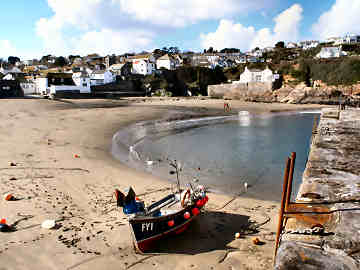
Jane and I had been here in 2002 on a round walk from Porthluney Cove. Then we thought little of Gorran. I repeated the walk in March 2008 and lingered long enough to revise my impressions somewhat. Gorran Haven is attractive with nice old fishing related buildings clustered around the harbour. Facing south-east, the harbour dries out at low tide and provides a safe bathing beach with a seasonal caf�. Some narrow old streets climb the hill from the harbour and there is a lot of recent development beyond. Undoubtedly many of the houses are second homes and holiday rentals. On the way up the hill is the little St. Justus Church, a chapel of ease once used as a fish cellar and net store. Further up, the former Llawnroc Inn is now the boutiquey Lawnwroc Hotel. Keep going for another mile and you come to Gorran Churchtown. Here is the Barley Sheaf Inn (restored and re-opened 2012 by a descendant of the 1837 founder) and the handsome St. Goran's Church. St. Goran (or Goranus) is probably the Guron of Bodmin, who moved here when St. Petroc arrived there. His 13th to 15th century church is typically Cornish with its crenellated and pinnacled porch, a fine collection of original bench ends and some good modern wood carvings. Outside there is an unexpected vault dated WSG 1813 and, when I was there, a lovely display of daffodils.
Grampound
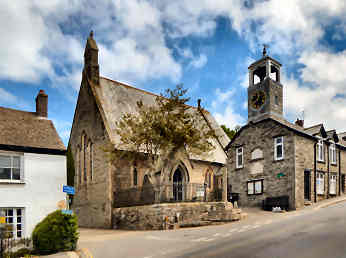
In early June 2016 I visited Creed Church, where my father's cousin Bertie - the Rev. Albert Edward Coulbeck - was rector for three years from 1947 before he moved to St. Just in Roseland. Creed is down a narrow country lane, a mile south of Grampound, so after looking around the church, I carried on to Grampound and parked by the Village Hall. I walked up one side of the long hill that is Grampound's Fore Street and back down the other, stopping for an excellent light lunch and coffee in the St. Austell Brewery's Dolphin Inn. A pleasant pub, with car park behind, with something of a gastro-menu but enough ordinary fare to appeal to me. I enjoyed an excellent, reasonably priced bacon butty. The name of the village is thought to derive from the Norman French Grand Pont, the great bridge over the little River Fal at the bottom end of the village. Grampound appears larger than its population of around 700 would suggest but, then, it is not much more than a one street village, climbing a moderate hill up from the river. For a village which lines a busy main road - the A390 from Truro to St. Austell - it is surprisingly attractive, filled with what appear to be 18th century houses and cottages but are probabaly, like the thatched Manor House, far older. But it can't be a lot of fun living on such a busy road. Grampound Revisited

Gulval
On New Year's Eve 2016 I headed down west to visit All Saints Church in Marazion to see an exhibition of works by a local artist - no sign of it. I didn't think much of the church either though I was impressed by a large collection of embroidered kneelers. I walked around Marazion and was tickled to see that three successive photos were all of buildings or shops with colours in their names - In the Pink, Out of the Blue and Silvermine! From there I went on to Gulval, an attractive late Victorian dormitory suburb of Penzance. I was there for the much older church of St. Gulval. It has an attractive painted chancel ceiling, two unusual reredos, a nicely carved wooden screen, a marble lectern, a carved pulpit on a marble plinth, and good memorials to members of the locsal Bolitho family. The particular interest to me, however was outside by the porch: an ancient Cornish Cross head and an inscribed stone. I wouild have liked to try the Coldstreamer Inn, named for a member of the Bolitho family killed serving in the Coldstream Guards, where Tom Franklin Pryce, formerly of Porthminster Beach Caf�, is a renowned chef, but time was pressing as I wanted to get on to Ludgvan.where the church has an attractive font and a wooden ceiling with carved bosses. In the churchyard are two Cornish Crosses. Adjacent is the simple but good White Hart Inn where I enjoyed a quiet coffee.