
Gunnislake and Drakewalls
I was in these two villages, shortly before Christmas 2018, only by accident. My intention had been to visit the National Trust's Cotehele for the Christmas Garland and for the Chapel, favourably described by Pevsner. However, the queue for the Garland was 100 strong and not moving and the Chapel was firmly locked. So, I decided to take a look at St. Anne's Church in nearby Gunnislake. Frustrated again; this, too, was firmly locked. A pity because, to judge by Pevsner's description, St. Anne's is a good example of the work of of Victorian Cornish architect J P St. Aubyn. I had to make do with photos of the impressive exterior and the sight of three good examples of St. Aubyn's trademark boot-scraper. From the outside, the church is impressive, seeming to tower over you. There is a small tower at the north-east corner, by the road. The bell tower, at the north-west corner, has a circular stair turret. Slightly surprisingly there is a railway station, linking Gunislake, by the Tamar Valley branch line, with Plymouth, passing through the Bere peninsula and crossing the historic Calstock viaduct. Bealswood Road in Gunnislake leads towards the River Tamar where it meets the southern end of the Tamar Manure (really) Navigation Canal, constructed in the early 19th century as part of a plan, which never came to fruition, to link the Bristol Channel at Bude with the English Channel. Disused locks and a lock keepers cottage still stand. Drakewalls is the western continuation of Gunnislake. Just south of the main road through is the new Tamar Valley Centre, a modern building but of traditional local materials, acting as an information and research centre. To its north-east and south-east are remains of Drakewalls Mine, chimneys and parts of engine houses still standing. The mine produced tin, copper and arsenic there was also some lead, silver, wolfram and molybdenum mined.
St. Anne's Church Gunnislake
Tamar Valley Centre, Drakewalls
Photographs
More in Towns & Villages

Gunwalloe and Church Cove
I had an outing down west in mid-February 2017, primarily to visit Mullion but also to re-visit delightful Gunwalloe Church Cove on the west side of the Lizard peninsula, not to be confused with equally charming Landewednack Church Cove on the east coast of the Lizard. There is some name confusion here, too, as both are named for St. Winwaloe, also know as Wednack and commemorated elsewhere too: at Towednack near St. Ives and at Poundstock near Bude. I was last in Church Cove in 2010 in the course of walking the whole of the Cornish Coast Path. Things have changed a bit; there is now a large National Trust Car Park with space for 100 cars and, linked to that, the Cove is much busier than I remember it, even in February. Not surprising, with a sandy beach, all that parking and, in season, refreshments. Between the car park and the Cove is Winianton Farm, National Trust property but farmed by Roddas, famed for their clotted cream. On this occasion I also looked around Gunwalloe village, a most attractive and surprising place in that half the cottages are thatched, including Toy Cottage (pictured left) where Compton MacKenzie, author of Whisky Galore, lived in 1908. A mile or so north of Church Cove is Gunwalloe Fishing Cove, where the catch was hauled up to the pilchard cellars on the top of the cliff by winch, recently enough for one winch to have been petrol driven. At Chyanvounder, just south of Gunwalloe village is the Halzephron Inn, a bit gastro-pub for my tastes but not unreasonably priced.
Gwennap
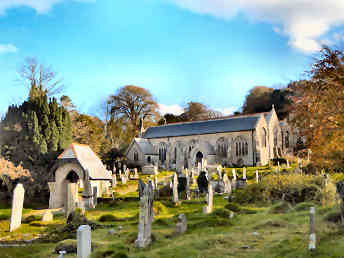
The name Gwennap occurs elsewhere. Gwennap Pit may make some sense as it is only about 2 miles away. Here it refers to St. Gwenap or Wenapa. Down on the south coast of West Penwith, the headland looming above the tiny Porthgwarra Cove, featured in the 2016 Poldark Series, is also Gwennap; the name thehe is a puzzle. After you turn off the Falmouth road, the church car park is straight ahead; up a drive to the left is the big house, Trevince. The graveyard is vast, the lych gate in the photo is halfway up it towards the church. Unusually you approach from the north side. The church consists of nave and two aisles. There is no tower but a separate bell tower stands to to south west. When I visited on a Saturday in early November 2016, when I also investigated Carharrack and re-visited St. Day and Gwennap Pit, I was disappointed to find the church locked, despite the usual 'Welcome' notice in the porch. Too often recently I have found churches locked; have those responsible wondered what God might think about his people being locked out of his house? I probably didn't miss much: Pevsner merely refers to rebuilding in 1862 and Cornish historian Charles Henderson took the view that "few Cornish churches are less interesting than Gwennap".
Gwithian
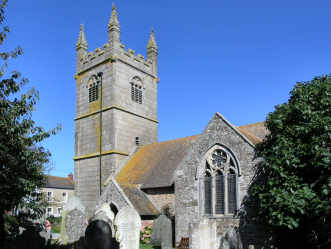
A tiny village on the road from Hayle to Godrevy, Hell's Mouth and Portreath, you are almost through Gwithian before you realise it. But it is worth stopping for a closer look. At the Hayle end of the village are the attractive Gwithian Farm, handsome Churchtown House, a thatched Methodist Chapel, recently restored and the rather ugly Red River Inn which (2015) has apparently had a makeover and is much improved with enterprising food. The inn, originally the Pendarves Arms, was renamed for the river that reaches the sea here, discoloured by mine spoil. At the Godrevy end is another handsome house, Churchtown Farm, and a charming church with a Cornish cross in the graveyard. The church remembers the 5th/6th century St. Gwithian or Gocianus. The saint's remains were said to have been found in the sands in the 19th century but lost again. The present church was originally built in the 15th century. It was rebuilt in 1866 though the tower is original. Gwithian Towans (dunes) lie between the village and the sea. The beach runs from just south of Godrevy Point for three miles to the mouth of the Hayle River. It is popular with surfers, swimmers and families.