Kilkhampton
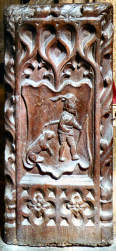
I had been in Kilkhampton previously but mostly just passing through and once to seek out the remains of a Norman motte-and-bailey castle, down the lane towards Stibb and the Combe Valley. On this occasion, in late August 2016, I was visiting three villages and their churches, the others being nearby Poughill and Stratton. Kilkhampton is a largish village, strung long the A39 north of Bude, with a few shops and a couple of pubs, The London Inn and the New Inn. I enjoyed a bacon roll and a coffee in the latter. In the small square, a war memorial commemorates Lt. Colonel Algernon Carteret Thynne DSO, killed in the Great War. The church is typically Cornish, with nave, two aisles and a battlemented and pinnacled three stage tower. Above the tower door stands a small statue, presumably of dedicatee St. James. The porch has a remarkable feature, a deeply and elaborately carved Norman doorway. Inside are three wagon roofs, higher than is usual in Cornwall, Granville memorials and a coat of arms by a pupil of Grinling Gibbons, and a superb collection of original bench ends.
'Man and Dog' Bench End
Impressive Norman Porch Doorway
Thynne Memorial in the Square
Photographs
More in Towns & Villages
Kingsand and Cawsand
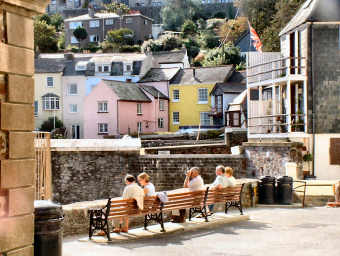
This is a charming, tucked away part of Cornwall, more easily accessed by car ferry across the Tamar to Torpoint or by foot ferry from Plymouth to Cremyll than from most of Cornwall. Here on the very south-eastern tip of Cornwall, the twin villages of Kingsand and Cawsand tumble down their hillsides to meet at small harbours facing broad Plymouth Sound with long views of Drake’s Island and the Devon coast. Where they meet at the bottom is the Halfway House Inn, a comfortable pub with a good welcome, a good atmosphere and excellent food. Rather surprisingly, until 1830 the Halfway House stood at a county boundary; Kingsand was in Devon, Cawsand in Cornwall. This is a great place to explore on foot with steep streets filled with colour washed stone cottages, jostling for space. Climb high above the Cawsand side to find an old fort, converted to housing with breathtaking views. Climb above the Kingsand side, past a tiny village green, to find a gate near the cliff that leads into glorious Mount Edgcumbe Park with its house with formal garden and Earl's Garden. There is more good walking around Rame Head to the south. There is a smallish car park next to the Halfway House and a much larger one above Cawsand.
Ladock
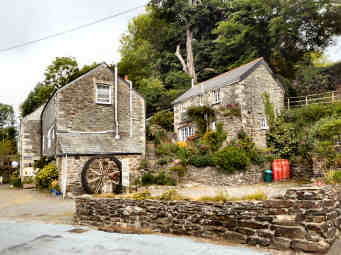
Ladock is a small village which we regularly pass through on our way to Truro. It is pleasant enough, just passing through, but the best is to be found uphill on the east side of the road. My first experience of Ladock was visiting Ladock House Garden, open under the National Gardens Scheme, in April 2007. In June 2016 I parked in the large public car park on the main road through. Here in the car park is the local shop and post office which sells hot drinks, sandwiches and good Cornish pasties. Outside is a decking area with free Wi-Fi. The little Tresillian River flows behind the car park. On the other side of the road is the Falmouth Arms pub, Bissick Old Mill more-or-less behind it. To the north of the pub a path runs streeply uphill to the church of St. Ladoca. The church, standing in a large graveyard, consists of nave, south aisle and pinnacled tower. Inside there are no carved bench ends but the chancel screen seems to made up of them, as does the lectern. Noteworthy featues included windows by Burne Jones, Ford Madox Brown and William Morris, a dark carved font, possibly of Catacleuse stone from the north coast near Padstow. There are some interesting old memorial slabs, not easily readable. Just west of the church, a track leads past attractive Glebe Farm, down into the valley to St. Ladoca's Holy Well. There is a disabled toilet.
Lamorna
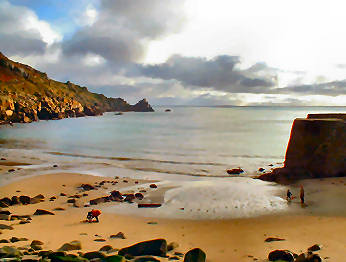
A long and lovely wooded valley drops down for about a mile from Trewoofe to reach the sea at Lamorna Cove. When you get there it is really something of a disappointment: to your right a short view of wooded cliffs; to your left a view, only slightly longer, of the debris of a vast former granite quarry; in the middle a car park, a seasonal caf�, rental cottages, public toilets and a small sandy harbour. Frankly, it is all a bit scruffy. You would do best to leave the car and walk up the steep hill and its side turnings (where possible) to see what you can of the village. Cottages, some attractive, some a little ramshackle, are tucked away in woodland on either side of the lane. Up a side turning is a charming row of cottages, a little way beyond them a tiny waterrmill. Quarter of a mile up the main lane is the Lamorna Wink inn, set a little back from the road and with tables outside. It is a plain place inside but with a lot of fascinating nautical memorabilia. Welcome is not always very friendly but food is simple and good value. Three gardens here deserve to be better known; above the village is Chygurno, at the head of the valley are Trewoofe and Trewoofe Orchard. Lamorna's main claim to fame was as an artistic colony in the early 20th century. An offshoot of the famous Newlyn School colony settled in the valley here. It included Lamorna Birch, Laura and Harold Knight and, for a while, Alfred Munnings. Their work can be found in Penlee House in Penzance.