Menheniot
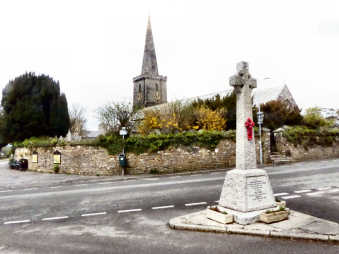
I only discovered Menheniot [the name means Hyniet's land according to Craig Weatherhill, St. Neot's place according to Julyan Holmes - take your choice] towards the end of April 2016. Jane wanted to see an exhibition of Norman Hartnell's designs and materials, being held in the church. I drove her there and quite liked the look of the village so, a week later, I had an outing to explore the village. It was a dull day so photos were disappointing but I still enjoyed the village. There are some good homes and cottages: I particularly liked the Poads Trust cottages and the old Police Station. The church is typically Cornish in that it has nave and two aisles, Perpendicular windows and fine wagon roofs with carved bosses. Less typical is the spire, not seen on many Cornish churches, set on a tower old than the body of the church. Sadly, inside little that is original remains thanks to over zealous Victorian restoration. However, the font, of Caen stone, is medieval and a brass by the pulpit dates from 1386, perhaps Cornwall's oldest. Memorials mostly commemorate Trelawneys. The churchyard is of little interest - no Cornish Crosses - but does contain a grand Vestry building. There is, apparently a holy well to the south of the church but somehow I missed it.
Menheniot War Memorial and Church
From A38 eastbound, pass Liskeard, take 1st or 2nd turn on left
More in Towns & Villages
Merrymeet and St. Ive
St. Ive

Merther Uny
According to one authority Merther translates as the burial place (perhaps of a martyr). In this case, referring to the tiny settlement in the middle of nowhere near Helston and Gweek, it probably refers to a chapel of St. Uny which once stood here. Uny, or Euny, appears elsewhere in Cornwall. The Georgian church in Redruth Churchtown is dedicated to St. Euny, as is a well and iron age settlement, Carn Euny, to the east of Chapel Carn Brea. The church in Lelant, near St. Ives, is dedicated to St. Uny. Merther Uny is an isolated place, reached by what OS103 shows as a bridleway though it is actually a perfectly good track. It consists of Merther Uny Farm, substantial and attractive Merther Uny House, which apparently incorporates part of the former chapel, and a couple of cottages. The old Chapel is long gone but, where it stood is now woodland with a probably extremely ancient four-hole Cornish Cross, possibly in fact originally a pre-Christian inscribed stone. Another, simpler, Cornish Cross stands about 200 yards south of this, on a lane running east-west. Confusingly, there is another Merther, this one with the disused and neglected church of St. Cohan, on the east side of the Tresillian River.

Mevagissey and Port Mellon
From the photo on the left you would think Mevva (as the Cornish call it) entirely a delightful place: busy harbour, old cottages clustered around it, large newer homes above. I used to think so and I used to drive American visitors down Cliff Hill, along the harbour, and up Tregony Hill on our way to Heligan Garden. I had never really lingered there before so I got something of a shock when I parked by the harbour in February 2005 and took a walk around. I concluded that Meva is a bit of an odd mixture, rather spoiled by its own success. Once a charming small fishing village, in the 20th century it has been over-run by modern development and the worst of cheap tourism. The harbour is still a delight - if you don't look at the cheap cafes and shops - and it is still Cornwall's third busiest fishing port. But it is definitely not a place to spend much time in. However, if you follow the narrow street southwards and climb Polkirt Hill, (great overview of harbour and coast, looking back from here) you come to Port Mellon. Here is a quiet cove with a boatyard, a decent pub and second homes clustered around. Continue and walk left up a lane and you come to photogenic Chapel Point, its whitewashed buildings looking rather like a small Mediterranean monastery. Continue along the coast path and you will soon find yourself in Gorran Haven.