
Roche
Oddly for Cornwall, the name Roche, pronounced Roach, is neither Cornish nor English but is from the Norman French La Roche, meaning The Rock: the reason why, to anyone looking at the central photograph below of Roche Rock, will be obvious. The Cornish name was Tregarrek, meaning "Farm or hamlet by the rock". It is a large village with a population of around 4000 and it has many of the facilities which go with that: a couple of pubs, a post office, a primary school, a fish and chip shop, kebabs. The church is of little interest, except for a fine carved 12th century Pentewan stone font and a tall Cornish Cross in the graveyard. Just a mile or so away, just off the main A30, is Cornwall Services, a major highway service areas with petrol stations. In a vast modern building are several food outlets, including Rowe's Bakery, pizza, Macdonalds, Costa Coffee, burgers and hot dogs. There are also a Saltrock clothing shop, a climbing wall, and a children's 'soft play' area.
Roche Church
Roche Rock with its hermit's chapel
Roche, a Cornish Cross
Photographs
More in Towns & Villages
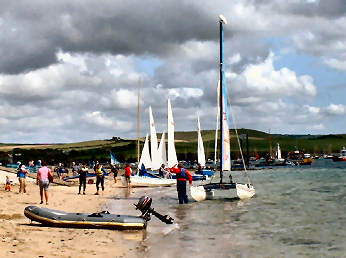
Rock, on the Camel Estuary
If Newquay is Cornwall's down-market playground, the Camel Estuary is its distinctly up-market counterpart. This is where the seriously rich gather - the permanent rich all year, the vacationing rich in the season. Come here in the summer and you might be in 'Kensington-on-Sea', an impression especially strong a few years ago when the royal princes regularly holidayed with their friends in Rock. The main activity is sailing and the estuary is often crowded with small boats. Highlight is when the Cornish Crabbers or the small brown-sailed Drascombe Luggers (working-boat look-alikes) are out. Windsurfers congregate downstream at Daymer Bay - though not in summer as it's a family beach then - surfers downstream again at Polzeath. Social life centres around the sailing club, St. Enodoc Hotel and - for the drinkers - the Mariners and the Rock Inn down by the water. Golfers enjoy St. Enodoc Golf Club, one of Cornwall's best - and most expensive! During the day coast path walkers cross the water here, by ferry to and from Padstow. In the evening the foodies cross to Padstow for Rick Stein's famed Seafood Restaurant and several other top spots. One of our favourite short walks takes us from Polzeath via Daymer and across the springy turf to Rock; a short, and legal, golf course detour takes in St. Enodoc church and the nearby Jesus Well. See also Porthilly on my Churches page.

Ruan Lanihorne
Towards the end of September 2017 I headed down to the Roseland to pay visits to three churches, at Philleigh, Ruan Lanihorne and Lamorran. My memories of Ruan Lanihorne [not to be confused with Ruan High Lanes on the St. Mawes road, or with the many Ruans on the Lizard] are of an early meeting there with Jane and of lunching there with her at the attractive and excellent King's Head. On this occasion I just had a coffee in the King's Head before taking a look at the church. Almost opposite, and a bit below, is St. Rumon's church, mostly 14th century, with a tower of the late 17th century. Pevsner suggests that the font is 14th century, its cover made of wall plates of a previous roof. The pulpit is made of old bench ends and dates from around 1530. A monument of a praying priest is 13th century. Two wall-mounted boards carry the Ten Commandments. Where the ceiling springs from the nave wall there are several painted shields, one noting the restoration of 1866, others with unfamiliar (to me) coats of arms. When I was there a tapestry was on display, depicting "Historical Ruan".

Ruan Minor, Ruan Major and St. Ruan
Here is an odd collection of small villages, all within a few miles of one another on the Lizard. You would expect Ruan Major, named for St. Rumon, to be the most substantial of the three. Instead it almost doesn't exist at all. All you will find there are a couple of farms, a graveyard and the deserted St. Rumon's church, standing amongst trees. Some of the rood screen is still in place, simple carving on it including mason's tools. To the south west of Ruan Major is St. Ruan, a small village with no church but with St. Ruan's holy well nearby and an "incised stone" in the grounds of Westie Way. The largest settlement, just to the north-east of St. Ruan, is Ruan Minor. This is the one with the church, not one of any great significance. St. Ruan's church is of little interest. It's single stage crenellated tower is stubby. The nave is commensurately low. A Norman font carries a simple zig-zag motif. Outside, by the porch is another font, used as a flower pot.