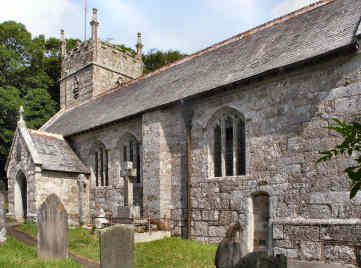
Sancreed
I have been in Sancreed, way down west in West Penwith, almost to Land's End, on three occasions. The first was in July 2006, the second in March 2008 then, after a gap of more than nine years, I was back there in October 2017. In 2006, in search only of antiquities, I had ignored the village and had been to Sancreed Beacon and Caer Bran. In 2008 I had concentrated on the church itself and he nearby Holy Well and Baptistry Chapel. This time, in October 2017, the church was closed for renovation so I again concentrated on the Cornish Crosses, one of the finest church collections in Cornwall: I counted five in all, including one on the graveyard hedge to the road and one on the wall by the main steps. I hope to revisit when the church restoration is complete in, probably early in 2018. In the meantime, some information gleaned from Pevsner. Saint Sancredus church is largely of the 15th century and consists of nave, north transept and short pinnacled tower. The porch has an original wagon roof. Inside are remains of a rood screen with amusing carvings and a 15th century font. Some notable artists are buried in the churchyard, including Stanhope Alexander Forbes, Elizabeth Adela Forbes and Thomas Cooper Gotch. Nearby, a holy well and baptistry are marked by a modern Cornish Cross. 2019 - restoration complete, see item on my holy sites page.
Sancreed Church
One of the Cornish Crosses
Photographs
More in Towns & Villages
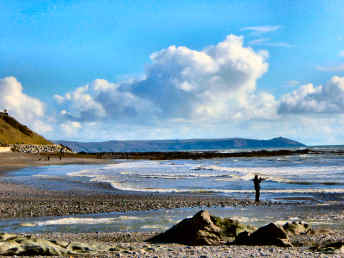
Seaton
Previously, I had only been in Seaton when passing through walking the Cornish Coast Path and had paid it little attention except to be surprised by the greyness of the beach. This time I made a proper visit in February 2016 in order to see what it really looked like and to find out what I thought of it. Seaton is a strange place, unlike anywhere else I know on the Cornish coast. You automatically think of Cornwall's beaches as being sandy and golden; not Seaton's which is of rounded slate stones, blue-grey in colour. The little River Seaton, which rises only 10 miles or so away, on the fringes of Bodmin Moor, not far from Minions, bisects the beach. Not surprisingly, rising in mining territory, the little river has suffered from bad copper and arsenic pollution. Presumably it is this mineral pollution that has led to to blue-grey colour of the beach and its shingle. The last two miles of the river's course is through Seaton Country Park; you can walk through it for 2 miles to Hessenford. Views from the beach are to Looe to the east, Rame Head to the west. Surprisingly, there are three places for refreshment in the little village: a good beach caf� with an extended outside undercover seating area and the excellent value Smugglers Inn (note pensioners and fish and chips prices). Waves, a fairly new glass fronted caf�-bar, overlooks the beach.
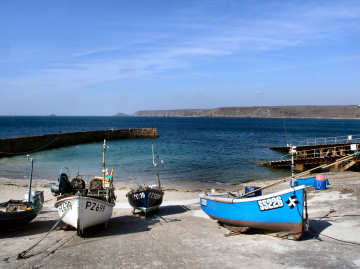
Sennen Cove
When I was in Sennen Cove in poor weather in 2004 and 2005 I was distinctly unimpressed. I was back again in sunny weather in April 2008 and my view is now a little more favourable, though it's still not really my kind of place. What Sennen Cove is is very much a family holiday destination for its superb beaches in Whitesand Bay, the main beach running all along the village and continuing north to become Gwynver Beach (not very easily acccessible). It is also a top surfing destination with the inevitable surf shops and beach caf�, this one called The Beach. When passing through on a walk from Land's End in April 2008, I enjoyed some excellent sweet potato soup, sitting on the terrace in the sun, watching families on the beach and surfers trying to ride disappointing waves. There is also an acceptable pub, the Old Success, and some other caf�s and restaurants, including fish and fish and chips. The well known First and Last pub is not down at the cove but on the main road to Land's End. For more information about facilities try Sennen's website - informative but slightly confusing. And, if they are still up, you should take a look at the remarkable images taken during the storm of 10th March 2008; some are quite amazing and one appeared in national newspapers.
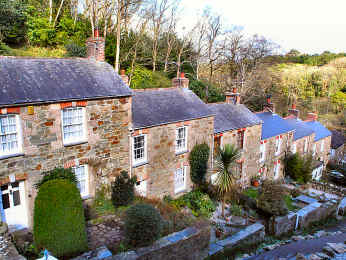
St. Agnes
It is amazing what tourism, second homers, coast path walkers and surfers have done for some Cornish towns and villages - St. Agnes more than most. When Jane first knew it in the 1960s, St. Agnes was a dull, run-down former mining village. Now it is considerably revitalised, bright and colourful. Shops seem to flourish - local stores as well as art and craft galleries. The beach at Trevaunance Cove attracts families and surfers. Chapel Porth has one of the great beach caf�s, with a simple but unusual menu - and their renowned hedgehog ice cream. Walking is good here, too. The coast path from St. Agnes to Chapel Porth is one of the most gloriously scenic sections with high cliffs and ruined mine engine houses; highlight is Towanroath engine house, part of Wheal Coates mine. Views from the path and from 629 foot St. Agnes Beacon stretch from St. Ives to Trevose Head by Padstow. And, if you want to walk up a steep hill, try Stippy Stappy, picured on the left. Tin workings at Blue Hills Sett, above Trevellas Porth, have been restored. Once tin was streamed in this valley; the mine closed in 1897 but the Wills family have continued tin streaming. A short tour of the works demonstrates processes - panning, vanning and jigging! At the top of town a village museum covers 'Tin Mining, Turtles, Fishing, Folklore'.