Coastal Round Walks
Favourite Cornish Round Walks, based on the Coast Path
This page is for those who like to walk on the coast but prefer round walks to linear ones. This is the format: descriptions, Oliver's Diary, detailed route directions, GPS data and information about parking, refreshments, interest etc. As at November 2015 a total of 46 walks are included here, listed in a counter-clockwise direction, starting at Northcott Mouth, and finishing at Kingsand. From time to time I hope to add other walks, probably in a random order. Click here for the full index to the walks. Click here for Cornwall's excellent Mapping Website
01 Northcott Mouth, Stowe, Coombe, Duckpool
05 Holywell Bay, Ellenglaze, West Pentire
16 Loe Bar, The Loe and the Penrose Estate
19 Landewednack, Cadgwith, Poltesco, St. Ruan
22 Helford, St. Anthony, Manaccan, Frenchman's
Northcott Mouth, Stowe Barton, Coombe and Duckpool - 6� miles
Easy farmland to a lost great house; woodland to a delightful village;
Strenuous at first on scenic coast, then easier
A walk of three contrasting sections, much interest along the way. To Stowe Barton is over open farmland on a bridleway with few waymarks. You climb gradually to 400 feet, the ascent scarcely noticeable. One route difference from the OS map; at 1.77 miles, a bridleway right was the old route but the NT’s new route brings you out opposite Stowe Barton. The second part is mostly wooded. After Stowe Barton and charming Driftwood Cottage, a kissing gate (pick up a Stowe leaflet) leads through a field to Stowe Wood. Path then track stay in Stowe and Lee Woods to Coombe; care is needed as there are many turns on cross tracks but few waymarks. The woodland is lovely, native broadleaf of oak, ash, birch, beech and hazel with a few rhodos. Coombe is photogenic and worth lingering over. Coombe to Duckpool is on tarmac but with little traffic. The final section to Northcott Mouth uses the Coast Path and is fairly strenuous with steep ascents and two major flights of steps. However, going is mostly grassy so easier than you expect. It might be possible at low tide to use the beach between Duckpool and Northcott Mouth, rocky at first then sandy. From the cliffs, views are good. You look back to Steeple Point and GCHQ and forward round a shallow curve to Tintagel Island.
Oliver's Diary - Route Directions - Statistics, Interest and Info
Jane and I first walked this route in 2003. We used a walk booklet called Circular Coast Walks Cornwall by Chris Adams. This particular booklet is not the easiest for route following. Sketch maps really are sketchy and the route directions are somewhat skimpy. So, if you do use it, be sure to take the appropriate OS Explorer with you. The walk was a revelation as, at that time, we had never heard of either Stowe Barton or Coombe, the inland highlights of the walk. I soon walked it again, this time with my sister Mary, and later included both Stowe Barton and Coombe on inland walks. This particular walk was done on a gloriously warm and sunny day in June 2010 and proved even more enjoyable than I had remembered. It also proved slightly easier as, when I first walked it, I remember scrambling up very steeply from Duckpool with no clear path; now there is a clear route up. Much of the walk is on National Trust property, on the Stowe Estate. Coombe hamlet, once part of the same estate, is now owned by the admirable Landmark Trust and is kept in immaculate order. This time, the cottages by the ford had just been re-thatched and were looking very smart. Do make a point of seeing all the hamlet, including the mill and the unusual porches and unexpectedly elegant Georgian windows of Hawkers Cottages, named for Parson Hawker.
Description - Route Directions - Statistics, Interest and Info
Route with detailed GPS Data, grid refs, heights & distances --- Click here for easily printable PDF page
Route without GPS Data but occasional distance information --- Click here for easily printable PDF page
Round Walk 01 - Statistics, Interest and Useful Information
Distance: 6.67 miles on the GPS. Ascent: 1260 feet in all, of which 775 feet in 2.20 miles on the Coast Path. Highest Point: 400 feet shortly before Stowe Barton. 315 feet above Warren Little Beach on the Coast Path. Biggest Climb: 400 easy feet out of Northcott Mouth. 280 feet up from Duckpool. 160 feet up from Warren Gutter. Steps: Up, flight of 63 up from Warren Gutter. Down, 105 down to Northcott Mouth. Stiles: Just 2 wooden stiles. Gates: 7 regular gates and 6 kissing gates. Footing: Good paths and tracks - some tarmac - all the way to Duckpool. Mostly grass along the Coast Path. Difficulty: Overall moderate; easy to Duckpool, fairly strenuous on to Northcott Mouth.
Stowe Barton: John Grenville, Earl of Bath, built a grand new home in 1679, his daughter demolished it in 1739. Rev. Sabine Baring-Gould (Rock of Ages) wrote "within the memory of one man, grass grew and was mown in the meadow where sprang up Stowe House, and grew and was mown where Stowe had been." Contents of Stowe were dispersed when the house was demolished and d�cor of one room ended up in Prideaux Place in Padstow, as the Grenville Room. The previous Tudor house probably stood opposite the present farmhouse. The farmhouse may be a conversion of part of Grenville’s stables, behind are handsome and massive farm buildings. The great house of 1679 stood on the left of the path beyond the present Driftwood Cottage; the raised platforms opposite were part of the extensive gardens. Stowe Wood and Lee Wood: All part of the National Trust’s thousand acre Stowe Barton estate, the two woods merge into one. They are a delight of native broadleaf woodland – oak, ash, beech, birch and hazel with a few invading rhododendron ponticum. As you approach Coombe, the stream below was a leat which fed Coombe Mill. Coombe: Once part of the Stowe estate, the hamlet of Coombe is now owned by the Landmark Trust, which specialises in restoring interesting historic buildings and letting them as up-market holiday rentals. The surrounding land is part of the Stowe estate. The hamlet consists of a tall watermill, the mill house, two semi-detatched cottages and a couple of converted barns. All, apart from the mill, are rentable. The mill is intact, including all its machinery and a large waterwheel, but a large colony of bats prevents its conversion at present. However, the Landmark Trust hopes to use the mill to provide Coombe’s electricity. The hamlet is divided by a small river with a shallow paved ford and a footbridge. Cottages are thatched and whitewashed, all are quite charming and easy to photograph. One pair of cottages is known as Hawker’s Cottages. For a while Rev. Stephen Hawker, rector of Morwenstow, lived in the left-hand one. Sandy Mouth: The National Trust owns much of the coastal strip along here and has made Sandy Mouth a popular destination by providing car park, caf� and toilets above the long sandy beach. At low tide you can walk for miles along the beach, almost all the way from Duckpool to Bude.
Parking: NT CP above Northcott Mouth beach at 20349/08440. Getting there: From A39 at Stratton, N of Bude, follow signs for Poughill, then sign for Northcott Mouth. Intermediate Parking: Duckpool, by the beach at 20225/11700. Refreshments: Seasonal tea garden, Northcott Mouth (poor). Seasonal NT caf�, Sandy Mouth. Toilets: Duckpool, by the Car Park. Sandy Mouth, by the car park. Map: OS Explorer 126 Clovelly and Hartland
***********************************************************************
Boscastle, Valency Valley, St. Juliot, Beeny Cliff, Boscastle - 6� miles
Wooded river valley to Hardy country; farmland to the coast. On the coast path, strenuous with great views .
Like Walk 01, this is also very much of three parts. The first follows the delightful valley of the River Valency through broadleaf woodland for one-and-a-half miles, much of the way to St. Juliot church with its Thomas Hardy associations. The last half mile is through pasture with pleasing views of the wooded valley below. Entry into the churchyard is unusual, up substantial granite steps and over a slate cattle stile, complete with coffin rests. This section climbs over 500 feet but the ascent is easy. The second section, 1� miles from St. Juliot to Beeny Cliff, after a short stretch of country lane, is also over farmland, mostly pasture but with one arable field. At the end of the lane, Hardy enthusiasts may like to make the short detour to see the Old Rectory. Crossing the fields, there is an odd mixture of stiles, originally of slate, several now hybridised with wood. This section is easy going, well waymarked and easy to follow. The final section, 2� miles on the Coast Path, is the most difficult, particularly the steep climb up from Pentargon. The descent down Beeny Cliff is awkward, too, steep with loose stones; however, you can avoid it by following the NT’s easier white-waymarked alternative. Views along the coast are superb, back to Steeple Point and beyond, forward to Tintagel Island. And, when you reach Penally Point, the view into Boscastle is a delight.
Oliver's Diary - Route Directions - Statistics, Interest and Info
I originally walked this in early 2008, first solo, soon after to St. Juliot and back with Jane. I was on part of it in February 2009 when I walked Frank Squibb’s Coast-to-Coast Smugglers Way from Boscastle to Looe. I love the Valency Valley with its little river tumbling over rounded boulders and stacked shelves of slate. After leaving the river at Newmills, I love Rose Cottage; if you have room in the backpack, look out for plants for sale there. On this June 2010 walk, after visiting St. Juliot church I stopped at the Old Rectory, where Sally Searle, who provides classy Bed and Breakfast, was happy for me to wander round her garden and take photos. I found myself a little irritated with the stiles between there and Trebyla Farm. Three were once proper slate cattle stiles but the farmer, rather than repair them properly, has added wooden struts to make odd hybrids, not easy to get over. The Coast Path section reminded me of encroaching age. In 2004, first walking the Coast Path from Crackington Haven to Boscastle, I found this part only moderate. Six years on I must confess to finding it fairly strenuous, most particularly the steep climb up all those steps from Pentargon Shute. Back in Boscastle, a cup of coffee while siitting outside a caf� on the main street, watching the world go by, was more than welcome.
Description - Route Directions - Statistics, Interest and Info
St. Juliot Church - Thomas Hardy Associations
Route with detailed GPS Data, grid refs, heights & distances --- Click here for easily printable PDF page
Route without GPS Data but occasional distance information --- Click here for easily printable PDF page
Round Walk 02 - Statistics, Interest and Useful Information
Distance: 6.42 miles. Ascent: 1330 feet. Highest Point: 555 feet inland near St. Juliot Rectory. 485 feet approaching Fire Beacon Point on the Coast Path. Biggest Climb: Easy 500 feet to St. Juliot. Strenuous 180 feet from Pentargon. Steps: Up 233, includes 189 up from Pentargon. Down 168, including 67 down Beeny Cliff. Stiles: 20, of which 13 wooden, 4 slate, 3 hybrid. Gates: 4 regular, 7 kissing gates. Footing: Good as far as the Coast Path. Some grass on the Coast Path but a lot of loose slatey stone. Difficulty: Overall moderate; easy to Coast Path, some strenuous on Coast Path, especially at Pentargon. Map: Ordnance Survey Explorer 111 Bude, Boscastle and Tintagel.
Interest - Features on Boscastle and Thomas Hardy
Boscastle: See feature below. River Valency: It is hard to believe that this stream could have caused such devastating floods as occurred in Boscastle in August 2004. It rises at Trevilla Down, on the edge of Bodmin Moor, and flows for a mere seven miles to the sea at Boscastle. But its valley, wooded for much of the way, is steep and surrounded by springs. The even smaller River Jordan, joining the Valency in Boscastle, provided the final impetus for the floods. The name Valency is probably a corruption of the old Cornish Melin Chy, meaning mill house. In medieval times there were many mills along the river. St. Juliot Church and Thomas Hardy: See feature below. Pentargon: The cove is narrow enough, and steep enough, almost to be a chasm (Zawn in Cornish). For the photographer, tt is worth spending a little time here to get photos of the narrow but impressive waterfall, Pentargon Shute. The best time to catch the waterfall is after heavy rain and with a strong westerly wind. Then the spray can be carried back inland 10 or 20 feet above the footbridge that you cross on the Coast Path.
Parking: Use the main Boscastle Car Park on Penally Hill at 10005/91271. Getting There: B3266 from A39 at Camelford. B3263 from A39 1� miles south of Wainhouse Corner. Intermediate Parking: Room for a couple of cars by St. Juliot Church. Refreshments: Boscastle only, pubs, restaurants, caf�s. Toilets: Boscastle, by the car park
When I started this web site I didn't like Boscastle very much. I was about ready to post a critical item when the dreadful flood of August 2004 happened. That was no time for criticism so I decided to leave it until repair and restoration were complete. I am glad I did because, before and after a walk up the Valency Valley in June 2008, I took time to explore the village. Now not only am I most impressed by the way Boscastle has recovered but I also find that I now like it. It may be very tourist oriented - Visitor Centre, National Trust shop, Witchcraft Museum, art and craft galleries, gift shops, restaurants, caf�s - but it looks terrific. Scenically it is hard to beat thanks to its setting in a steep valley, the River Valency winding down to a small harbour (dry at low tide) with a few fishing boats, beyond it two high headlands, both on the coast path, and the sea. In the photo a lime kiln stands in front of the former 'pilchard palace'; this latter houses the TIC, a National Trust shop and caf� and a Witchcraft Museum. And don't miss walking up Old Road, a narrow no-entry street, to admire its charming cottages. I can't comment on eating places as I have only had coffee here, but for sociability the Wellington Hotel bar is probably top; other pubs are the Cobweb opposite the car park and the Napoleon at the top of the village.
River Valency and the former Pilchard Palace
Thomas Hardy: Not all his works were set in his native Dorset. His ‘Wessex’ extended to include Cornwall and that was the setting for ‘A Pair of Blue Eyes’. In his earlier guise as architect, Hardy undertook plans for the restoration of St. Juliot Church near Boscastle between 1870 and 1872. He stayed at St. Juliot Rectory with the Giffords - and married the Rector’s sister Emma who encouraged his writing. In ‘A Pair of Blue Eyes’, St. Juliot appears as St. Agnes, West Endelstow. A house between church and rectory is now called Endelstow. In his 'Poems of 1912-13', written after Emma's death, the background is mostly St. Juliot. It is not only church and old rectory that are associated with Hardy; Beeny Cliff, where the walk joins the coast, was a favourite location of the couple.
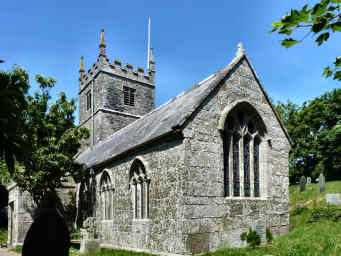
St. Juliot Church: Attractive from the outside with a handsome tower and vaulted south porch but inside disappoints. The only interest is the Hardy association: a memorial tablet to him and another, which he himself designed, to Emma; two of his drawings and one of her paintings; and a superb engraved glass window by Simon Whistler, depicting Hardy's journey to Cornwall, the church, Beeny Cliff and waterfalls on the Valency. There are three Cornish crosses in the churchyard and coffin rests on the stile up from the field.
*******************************************************************************
Round Walk 03 - Polzeath, The Rumps and Pentire Point - 5� miles
An easy walk with a great promontory fort and glorious views of coast and Camel estuary
A relatively short and easy walk which, even with a fair amount of interest and some sublime coastal scenery, need occupy no more than a morning or afternoon. Again, this is a walk of three parts: the first cross country to reach the coast at Pengirt Cove, the second along the rugged north coast to Pentire Point; the third heading back to Polzeath along Padstow Bay. The climb on the first cross-country part amounts to 300 feet but is easy all the way. The second north coast section is very much up and down but with no severe climbs except for the optional Rumps – the distance includes going up both Rumps. The scenery here, from Pengirt Cove to Pentire Point, will look great at any state of the tide. Views forward along the coast are good though restricted but are magnificent looking back over Port Isaac Bay to Tintagel Island, Cambeak, the dishes of GCHQ at Steeple Point, and on along the coast to Hartland Point in Devon and, on a clear day, to Lundy Island. The final section, back to Polzeath, looks at its best when the tide is out and acres of golden sand are exposed in Hayle Bay and the Camel Estuary. There is quite a lot of interest along the way: the National Trust’s Pentireglaze Farm, lead mines nearby, sheep gates in the massive Cornish hedges much of the way along the north coast, and the remarkable iron age promontory fort known as The Rumps.
Oliver's Diary - Route Directions - Statistics, Interest, Info
This is probably my favourite short walk of all and one to which I like to introduce all visitors. It’s a great stand-by, too, as from home it doesn’t need a car, just the bus to and from Polzeath. Oddly, I had walked out to Pentire Point many times with Jane, and had walked from Port Isaac to Polzeath on several occasions, before it occurred to me to look for a round walk starting in Polzeath and taking in the Rumps and Pentire Point, two of my favourite viewpoints along the Cornish coast. If I start from Polzeath itself, I tend to do this walk exactly as described. If I start from New Polzeath, I tend to go for a slightly shorter route, starting on the coast path then taking the bridleway from Pentireglaze Haven to Pentireglaze Farm. I may also omit climbing the steeper eastern Rump and take the path circling it. When researching this walk in June 2010 I did the full route described and included both of the Rumps. Probably my favourite viewpoint of all, and one I favour taking a snack break at, is the bench by the Lawrence Binyon memorial plaque at about 92544/80599, at the top of the climb after the Rumps. For refreshments I tend to favour New Polzeath over expensive Polzeath, at least at weekends when Mr. Surfy operates a reasonably priced snack wagon at the north end of Atlantic Terrace.
Description - Route Directions - Statistics, Interest and Info
POLZEATH REFRESHMENTS: Looking for somewhere to get a coffee in winter in Polzeath, we happened upon Tubestation. Open Tuesday to Saturday throughout the year, it's in the former Methodist chapel. It's dog friendly, child friendly (complete with a small skateboard ramp), serves good soups and sandwiches and great coffee. The welcome is genuine, the place feels comfortable and the prices are very reasonable and, although Tubestation is the public face of a religious organisation, they don't make an issue of it.
Route with detailed GPS Data, grid refs, heights & distances --- Click here for easily printable PDF page
Route without GPS Data but occasional distance information --- Click here for easily printable PDF page
1. On the lane to Pentireglaze farm at 94375/79736 at 0.90 miles a gate on L leads to a Bridleway downhill directly to Pentireglaze Haven.
2. Halfway between Com Head and The Rumps, at 93551/80545 at 1.90 miles, a path up L heads uphill through a gate, crosses a field and turns L on a track to Pentire Farm. At the end of the farmyard a path goes R down to Pentire Haven.
3. Halfway between Rumps and Pentire Point, at 93015/80726 at 2.98 miles, WM points L to a gate to Pentire Farm � mile.
Round Walk 03 - Statistics, Interest and Useful Information
Distance: 5.20 miles. Ascent: 1200 feet in all. Highest Point: 285 feet halfway between Rumps and Pentire Point. Biggest Climb: Easy 195 feet out of Polzeath. 5 other climbs over 100 feet, biggest 150 feet. Steps: Up, 51. Down, 43. Stiles: None. Gates: 7 regular gates. Footing: Mostly very good but some loose small stone on the Coast Path. Difficulty: Fairly easy but with some moderate on Coast Path and steep climbs up the Rumps (optional). Map: OS 106 Newquay and Padstow
Interest - See Feature on The Camel Estuary, Polzeath and Rock
The Camel Estuary, Polzeath and Rock: See feature below. Pentireglaze Lead Mines: The mines here, and at Polzeath and Trebetherick, produced lead ore for around four centuries. Despite their longevity, they were never very successful and production ceased in 1857. A storyboard here covers the coast from Polzeath to Port Quin and has information about the NT's Pentire Farm and clifftop grazing. Sheep Gates: Note, all way from Pengirt Cove to Pentire Haven, gaps in the thick Cornish hedges, about 3’ x 2’, which were once used to allow sheep to graze the cliff-top but keep cattle off cliffs. Look out for the massive one in the next walk, from Padstow, not long before descending to Trevone Bay. The Rumps: A major promontory fort (or cliff castle) defended by three ramparts across a narrow isthmus, isolating a relatively level area and the two hills of the Rumps themselves. The site was occupied in the late iron age, for about three centuries up to around 100 AD, evidence of round houses and pottery having been found. It may not have really been a fort at all but rather a defended trading post, with two usable coves below. From the west The Rumps have quite a reptilian look. The rump-like island is called The Mouls. Lawrence Binyon: poet, 1869-1943, is commemorated at 92544/80599. He wrote For the Fallen on these cliffs in 1914.
Parking: Polzeath Beach (beware on some tides) or CP behind Ann’s Cottage Surf Shop.
Intermediate Parking: Lead Mines, Pentireglaze (free); New Polzeath, Atlantic Terrace or Mews (free) and pay CP up hill.
Getting There: From Wadebridge, B3314 for 4 miles, L fork signed Polzeath, then R fork New Polzeath. Refreshments: Polzeath, Tubestation, caf�s, restaurants. New Polzeath, Mr. Surfy's seasonal weekend snack wagon. Toilets: Polzeath, opposite S end of beach. New Polzeath, Atlantic Mews, one street behind beach.
If Newquay is Cornwall's down-market playground, the Camel Estuary is its up-market counterpart. This is where the rich gather; the permanent rich all year, the vacationing rich in season. In summer you might be in 'Kensington-on-Sea', an impression especially strong a few years ago when the royal princes would holiday here. Rock’s main activity is sailing and the estuary is often crowded with small boats. Windsurfers congregate at Daymer Bay - though not in summer as it's a family beach then - surfers at Polzeath. Social life centres around Rock sailing club, St. Enodoc Hotel and - for the drinkers - the Mariners and Rock Inn by the water. Golfers enjoy St. Enodoc Golf Club, one of Cornwall's best - and most expensive! During the day coast path walkers cross the water from Rock, by ferry to and from Padstow. In the evening foodies cross from Rock to Padstow for Rick Stein's famed Seafood Restaurant and other top spots. Polzeath’s raison d’�tre is surfing with hire shops and stalls, surf schools, and caf�s priced for well-heeled surfers. At least there is a reasonably priced seasonal snack wagon, Mr. Surfy’s, on Atlantic Terrace in New Polzeath and the excellent Tubestation in Polzeath. The surfing is among the safest, best and busiest in Cornwall and I have counted 200 in the water on occasions. Spring tides go out for the best part of half-a-mile. Car parking is on the beach but beware high spring tide; you might return to find your car awash.
Description - Diary - Directions - Statistics, Interest and Info
***************************************************************************
Round Walk 04 - Padstow, Stepper Point, Trevone, Padstow - 7� - 8� miles
fairly easy going on coast; over farmland back to Padstow.
This, like all the preceding walks, is a walk of three parts. The first, starting from Padstow, is along the delightful estuary of the River Camel, finishing at Stepper Point. This is easy going most of the way but culminates in a long, fairly steep, climb up to the Pepper Pot to the west of the point itself. For some of the way, views are obscured by high hedges but where there are views they are delightful, especially at lowish tide. The second part of the walk takes you along the coast to Trevone Bay. The going is fairly easy, much of it on grass, which is a relief after some of the more rocky parts of the coast. Views are somewhat restricted, only to Pentire Point to the east and to Trevose Head in the west. Nonetheless, the views over Harlyn Bay, once you get that far, are lovely. The third part is the inland section from Trevone Bay back to Padstow. It starts with a fairly stiff climb up the lane towards Crugmeer. You than have a choice: the more direct way by Porthmissen Farm and Trethillick or a longer route, mostly over fields, by Crugmeer. Both come into Padstow by the town’s great house, Prideaux Place and then follow the attractive Church Hill back down to the harbour. There is one great oddity about the first two parts of the route – the vast number of totally superfluous waymark posts, about twenty where three or four would suffice.
Oliver's Diary - Route Directions - Statistics, Interest, Info
June 2012. Good news for those who like to stop for a snack in lovely surroundings. I learned about Rest-a-While last November but had my first chance to try it in June 2012. A couple of miles out of Padstow, towards Stepper Point, it is in the garden of 7 Coastguard Cottages at Hawker's Cove. Open (weather permitting) daily in summer, weekends in winter, it serves soup, sandwiches, cakes, cream teas and hot and cold drinks. Seating is on a terrace with glorious views over the Camel Estuary. On my June 2012 visit, I enjoyed a ham and cheese sandwich - superb home-baked ham - and a mug of good coffee. Clearly signed, reasonable prices, strongly recommended
Living, as Jane and I do, in Wadebridge, this is one of walks that we have done time and time again. All it needs is a short bus ride into Padstow and we are away. It is also another of those walks to which we like to introduce all our visitors. Of our two local, bus-friendly walks, I would opt for Walk 03, the Polzeath, Rumps and Pentire Point one, over this as coastal views are longer and more striking. I still, however, get a great deal of pleasure from this one. You could, of course, equally well start from Trevone Bay – parking is a little cheaper there than in Padstow – but, from our point of view, the bus doesn’t go to Trevone. If you do start at Trevone, I still suggest doing the walk in a counter-clockwise direction in order to enjoy the feeling of freedom that the coastal section gives at the end of the walk. I have still never managed to catch either of the two blow holes at their best. It needs careful calculation, and a deal of luck, as you really need earlyish morning, with the sun in the east high enough to be shining on entrances, and a tide high enough and strong enough to produce a cascade of water. At the start or end of the walk in Padstow, I like to stop off at the Crib Box caf� by the bus terminus for the best value bacon butty and coffee in town. In season, or on fine winter weekends, I can recommend Rest-a-While at Hawker's Cove for good value good food.
Description - Route Directions - Statistics, Interest and Info
Route with detailed GPS Data, grid refs, heights & distances --- Click here for easily printable PDF page
Route without GPS Data but occasional distance information --- Click here for easily printable PDF page
Low tide variation: Soon after leaving Padstow, at Harbour Cove there is an awkward little inland bit. You can miss this by getting down to the dunes or beach soon after Gun Point. And, if the tide is fairly well out, you can continue on the beach right round to Hawker's Cove.
Round Walk 04 - Statistics, Interest and Useful Information
Distance: 7.78 miles (or 8.16 if using higher route from Trevone Bay to Padstow). Ascent: 1100 feet (or 1150 ). Highest Point: 250 feet at the Pepper Pot on Stepper Point. 240 feet between Trevone Bay and Tregirls Lane on the higher route from Trevone Bay to Padstow. Biggest Climb: 270 feet, in two stages, up to Stepper Point. 120 ft out of Padstow. 155 feet (or 200) out of Trevone Bay. Steps: Up, 19. Down, 32. Stiles: 13, of which 10 slate cattle stiles, 3 wooden stiles. (17 stiles if using higher route back to Padstow). Gates: 5 regular gates, 2 kissing gates. Footing: Mostly very good, quite a lot of grass, but some loose small stone on the Coast Path. Difficulty: Overall moderate but with two fairly steep climbs. Map: OS 106 Newquay and Padstow.
Interest - Features on Padstow and Prideaux Place
Padstow: See feature below. Prideaux Place: See feature below. Camel Estuary: The coastal views, on north coast section of this walk, may be a little disappointing as they are restricted to a relatively small area bounded by Pentire Point to the east and Trevose Head to the west. The views on the first part of the walk, along the Camel estuary, are magical. Best seen on a sunny day, at about mid-tide so that ample stretches of golden sand are revealed. The finest view is probably from the gate after Padstow’s war memorial, taking in Brea Hill, Daymer Bay, Trebetherick, Pentire Point, Newlands rock, and Stepper Point. And see feature in Round Walk 3. Holy Wells: According to the OS map, there are supposed to be two holy wells between Padstow and Stepper Point. St. George’s Well should be by St. George’s Cove. Although it is said once to have had a chapel, I can find no trace of it. Nor can I find St. John’s Well named on the waymark where you turn left up to the Pepper Pot. Hawker’s Cove: An attractive hamlet which owes its existence to a combination of the RNLI and the Coastguard. A converted boathouse dates from 1931 but the Padstow Lifeboat had been kept in the cove since 1855. There was a Coastguard Station here and one row of cottages housed the coastguards; 7 Coastguard Cottages has a tea garden. Stepper Point: The odd shape of the headland is due to it having been quarried away between 1918 and 1948. This must have been one of the most inaccessible quarries imaginable. After crushing, all the stone was taken away by sea from a small jetty. The tower (Pepper Pot), just west of the point, was constructed as a daymark to assist shipping. Blow Holes: These are formed by the collapse of the roofs of coastal caves, leaving a great bowl-shaped depression with a small entrance from the sea. At the right state of the tide, and with a heavy sea running, the sight and sound of the sea blasting through the entrance can be most impressive. There are two blow holes on this walk, Pepper Hole and Round Hole. Trevone Bay: A sheltered little sandy bay, popular with families and surfers. There are three car parks – by the beach, in a field above and on grass by the toilets and caf�. The caf� is seasonal, there is a surf shop, and a shop in village.
Parking: Padstow South Quay (arrive early). Also large car parks A389 and very S end of harbour (by bus terminus). Intermediate Parking: Trevone Bay, 2 above beach plus a large field. Getting There: From A39 S of Wadebridge, take A389 to Padstow. Refreshments: Padstow is full of caf�s, restaurants, pubs. Hawker's Cove, Rest-a-While (see above, below description). Trevone, caf� above the beach (seasonal). Toilets: Padstow bus terminus car park, South Quay car park and on Coast Path opposite North Quay. Trevone.
To first-time visitors this will seem like unchanging Cornwall. But for those who remember Padstow from the 1940s, things have changed greatly. The railway has gone - it's now a cycle trail; most restaurants and shops concentrate on tourists; foodies have arrived, enticed by Rick Stein's famed seafood empire. Fishing boats do still land their catches (much of it is exported ) and many restaurants specialise in seafood. Views across the Camel estuary are to the village of Rock and a little ferry carries hikers and holiday makers. Cream teas are all you expect; we prefer to take ours in the lounge of the Metropole. Some of the Cornish pasties are good, too, especially at the Chough bakery close by the harbour and at Rick Stein’s patisserie. Wander around narrow, steep streets; walk up the hill behind the town to visit the 'great house', Prideaux Place. For all this, Padstow is no longer very likeable. In the season it heaves with people and cars; out of season it seems deserted, caf�s and restaurants closed, many shops deserted. Thanks to second homers, housing is very expensive so less and less native Padstonians actually live there. It should be a lovely small harbour town but now it disappoints us. The Camel Trail starts here, offering cyclists an 18 mile trail to Wenford Bridge, by way of Wadebridge and Bodmin, on level hard surfaces.
Fentonluna Lane in Padstow leads to Prideaux Pace
Home to the Prideauxs (now Prideaux-Brunes) since Edmund acquired the property at the Dissolution of the Monasteries, Prideaux Place looks from the outside like an ivy-clad minor Robert Adam castle. Inside it is a riot of totally unexpected Strawberry Hill Gothick with pendant plasterwork in brilliant white, only the Great Chamber and Grenville Room not conforming. In the former a superb 16th century plasterwork ceiling tells the story of Susannah and the Elders; the latter has an interior brought from lost Stowe House near Bude, demolished in the 18th century. Contents include Royal Worcester armorial porcelain, heraldic glass, painted panels by Verrio and Cornish artist Alec Cobbe. Our favourite rooms are the Morning and Drawing rooms, charming, comfortable, well lit and clearly in family use. Gardens are (2010) undergoing major restoration, supervised by Tom Petherick, one of the leading figures in the restoration of the 'Lost Gardens' of Heligan. This includes woodland walks and clearing and replanting large areas. A Formal Garden, lost for years, has been recreated in a simpler manner than the original. There are exhibitions in the stableyard, where you should walk through the dairy to see its gothic disguise. Near the deer park is a large well. It was excavated in 2007 and is believed to be St. Petroc’s original holy well. Long views east take in Roughtor and Brown Willy. There is a tea room and parking by the house.
********************************************************************************
Round Walk 05 - Holywell Bay, Ellenglaze, West Pentire - 6� miles
Easy walk. Valley, farm and Open Access land to the coast; glorious coastal views; 2 holy wells
The first leg of three starts from Holywell Bay on a tarmac lane through Holywell Bay holiday park. Towards the end of the park a path heads off through woodland and along fields to the tiny hamlet of Ellenglaze. Here you follow a grassy track through fields, over a hill to cross the road into Trevornick holiday park. The second takes you alongside Holywell Bay golf course then across the NT’s Open Access land of The Kelseys and Cubert Common on the way to the village of West Pentire and the coast. The final section follows the Coast Path, almost entirely on National Trust land, including The Kelseys, back to Holywell Bay. Despite it being coast path, the walking here is easy, mostly on grass once past Porth Joke. Views along this section are lovely, at first back over Crantock Beach to Pentire Point East and on to Trevose Head, later forward over Holywell Bay, Gull Rocks and Penhale Point and on to Godrevy and the West Penwith hills. The final half mile is less straightforward than expected. Waymarks across the Holywell dunes tend to get buried by shifting sands. In November 2012 they were clearly visible; route in the box below. Should you get lost, from 76739/59579 follow steps on the right down to the beach, follow the beach to its southern end and ford a stream to reach the road and car park.
The Holy Well on the golf course, just off the route
Oliver's Diary - Route Directions - Statistics, Interest, Info
Holywell Dunes - November 2012: Waymark posts, yellow topped, have been replaced and are currently easy to spot. They lead you (correctly) SSW round the left side of the top of the highest small dune, after which there are less, but still visible, posts. You head eventually SSE down to a small wooden footbridge over a stream, at which point you can take the left track to the village, shops and toilets, or bear right of that to the back of St. Piran's Inn.
The short version of this walk, omitting Ellenglaze and Trevornick was one of the very first Coastal Round Walks I ever did. Jane and I found it in Jarrold Pathfinder Cornwall Walks and I was so taken with it that, having done it with Jane, I soon did it with each sister and with friend Craig from New York. Jarrold describes the walk starting in West Pentire and walking clockwise; I prefer it counter-clockwise from Holywell Bay, partly because I like Holywell, partly because, as a member, I like NT free parking. I have done it many times since but this time I decided to make more of a walk of it by adding the obvious extension, something I had done before with my sister Frances. I prefer it for the extra bit of distance, the woodland walk to Ellenglaze and the chance to visit the holy well on the golf course. When I did the extended walk with Frances, we were challenged by the owner of Lewannick who wanted us to believe that there was no footpath through his property. Having researched it carefully, and spotted a waymark that you don’t see unless you are approaching from Cubert, I can assure you that there definitely is a right of way. This is a walk that I never tire of. I find its variety a delight, its coastal views superb and its minor degree of difficulty entirely suitable for 70 year old legs and joints.
Update September 2011: I walked this again with my sister Mary on a blustery September day (the tail end of Tropical Storm Katia) and, though the route remains the same, I have several information updates. The owner of Lewannick Farm, presumably a second homer and I can't think who else could have done it, has now removed the waymark post where the path through Lewannick comes to the path to the Kelseys. Be in no doubt that this is a right of way: the path through Lewannick Farm is Parish Path 302/5/6 and it joins 302/8/4 to the Kelseys. The route through the dunes to Holywell has been newly waymarked. It is as I describe but is now easier to follow. Beware of the shop in Holywell. It has a sign outside, claiming to serve Cornish Coffee, a proper coffee. What it served to us inside was instant Nescaf� - and the proprietor was a rude Londoner, not a good advert for Cornwall.
Route with detailed GPS Data, grid refs, heights & distances --- Click here for easily printable PDF page
Route without GPS Data but occasional distance information --- Click here for easily printable PDF page
Round Walk 05 - Statistics, Shorter Options, Interest, Useful Information
Distance: 6.25 miles. Shorter options 5.50, 5.00 or 4.25. Ascent: 800 feet, of which 400 feet to West Pentire, 400 feet on the Coast Path. Highest Point: 200 feet between Ellenglaze and Trevornick. 175 feet near Kelsey Head. Biggest Climb: Easy 185 feet out of Ellenglaze. Easy 135 feet up to Kelsey Head. Steps: None worth mentioning. Stiles: None. Gates: 5 regular wooden gates. 6 kissing gates. Footing: Mostly very good on good paths and tracks. Mostly grassy from Porth Joke on the Coast Path. Difficulty: Overall easy.
Map: OS Explorer 104 Redruth and St. Agnes.
(a) Omit Ellenglaze and Trevornick. Reduces walk to 5.00 miles. Continue past Holywell Bay holiday park pedestrian entrance. Turn L on lane passing shops. Use a FB over the stream and R NE along the edge of the dunes to follow a path up onto The Kelseys to rejoin the full walk at approximately 77820/59383.
(b) Omit West Pentire village and West Pentire Point. Reduces walk by � mile. At the T at the beginning of West Pentire at 77635/60611, turn L following a sign to Porth Joke on first a track and then a FP. (c) Combine the two to reduce by 2 miles.
Feature on Holywell Bay, its Holy Wells and Ellenglaze
Cubert Common and The Kelseys: Easy walking on grassy Open Access National Trust land. West Pentire: Small village with the child friendly Crantock Bay hotel, several holiday lets including a small Tudor manor, 2 car parks and a pub, the Bowgie Inn. Porth Joke: Known locally as Polly Joke, this is a quiet cove with an extensive beach but no life guards. Camp site and car park about � mile. Kelsey Head: Several cairns and a cliff castle, bank and ditch still prominent. Great views over Crantock Bay to Pentire Point East and up the coast as far as Trevose Head. Holywell Bay Dunes: A massive dune system, not easy to find your way through. There have been waymarks but they tend to disappear under the shifting sands.
Parking: NT car park at Holywell Bay. Intermediate Parking: Treago Mill, Cubert Common/The Kelseys. West Pentire (2 CPs). Getting There: From A39 at Halloon Roundabout, take A392 past Newquay, then A3075 (Redruth) and go R following Holywell Bay sign. Refreshments: St. Piran’s Inn and Treguth Inn, Holywell Bay. Stables Caf�, Trevornick. Bowgie Inn, West Pentire. Toilets: Holywell Bay. Upper West Pentire CP (closed in 2010)
A popular resort with families and surfers. Superb mile-long beach of golden sand, fully accessible at all states of the tide and can cope with large numbers of visitors; full life-guarding during the season. Two large holiday parks - there is also one small one - have good facilities, including a golf course attached to one. In the village there are two pubs - the Treguth Inn and St. Piran's Inn - and a reasonable selection of shops. The large National Trust car park copes well even in high season. Holy Wells: When a village is named Holywell you would certainly expect to find one holy well but Holywell boasts two. One is in a cave at the northern end of the superb beach and accessible only at lowish tide. The cave is just before the mussel covered rocks. Don't go straight in but climb the rocks on the left-hand side; beware, they are very slippery. You then come to the calcified rock steps, water running down and leaving small cool pools. The spring is at the top of the steps. The other is by the bottom pond on the golf course and is easily accessed by a path though Trevornick Holiday Park. It was only rediscovered in 1916 and restored in 1936. Just up the valley is Ellenglaze: A large manor house and some attractive cottages. A Wheelpit and Waterwheel at the manor house are evidence a former mill.
There is a large National Trust car park in Holywell
Gull Rocks (or Carter's Rocks) off Holywell beach
*****************************************************************************
Round Walk 06 - Holywell Bay, Penhale Sands and Ellenglaze - 9 miles
Easy walking. Fine coastal views; Christian history on dunes; tracks, farmland, wooded valley
Combine this with Round Walk 05 for a total distance of about 13 miles
This time the walk is of four parts, as befits its greater length. For a change, it starts on the Coast Path but still in a counter clockwise direction. The first section is surprisingly easy for the Coast Path, just a moderate climb up to Penhale Point to begin, then undulating on grass, past Hoblyn’s Cove and Ligger Point, to Perran Beach. Views along the Coast Path are a delight, initially back over the sweep of Holywell Bay, subsequently forward over Perran (or Ligger) Bay to St. Agnes Head and on to St. Ives and the West Penwith Hills. The second section, from Perran Beach to the road near Gear Farm, is entirely across the dune system (towans to the Cornish) of Penhale Sands. Green permissive path waymarks leads you over MOD property to a kissing gate onto open unrestricted land. You could easily get lost between here and the end of Penhale Sands, so follow the directions carefully. The third section, on to near the hamlet of Mount, is almost entirely on good tracks, through farmland and past some attractive farms. Views here are of rolling, well-wooded, mostly pastoral, farmland. The fourth section, back to Holywell Bay, takes you first across a vast open field, then through wet woodland and farmland to the interesting hamlet of Ellenglaze and along down the wooded valley to Holywell.
Continue from Ellenglaze by TrevornickGolf Course, Kelsey Downs, Treago Mill, West Pentire and the Coast Path for the full 13 mile walk
Oliver's Diary - Route Directions - Statistics, Interest and Info
Round Walk 06 - Holywell Bay, Penhale Sands, Ellenglaze - Oliver's Diary
Much of this 2010 round walk was already very familiar to me. I had walked from Perranporth to West Pentire with my New York friend Craig in 2006 and had walked from Holywell Bay to Perranporth in 2009. I had been on Penhale Sands many times, mostly with Jane, and had got thoroughly lost there more than once - it’s a confusing place but I think I know my way now. I had also walked between Holywell Bay and Ellenglaze on several occasions, most recently in researching the previous Round Walk 05 from Holywell Bay, a walk including Trevormick, The Kelseys and West Pentire. I had also done a shortened version of this walk, but using Perran Beach to get up onto Penhale Sands and using the road from there to Mount. What was entirely new to me was the part from Perran Round to near Mount. The OS map had suggested I could do it largely on tracks and I was pleased to find this was the case. I was also pleased to discover just how interesting the farms along the way are, Stampas, North Treamble and Treworthen, all with interesting barns, some of them converted to holiday accommodation, the fate of so many Cornish farm buildings in these days of diversification. I was also entertained to realise that the tracks, some signed as byways, had clearly been minor roads at one time, hence the wooden fingerpost direction signs.
Description- Route Directions - Statistics, Interest and Info
UPDATE MARCH 2014: I walked this again on 8th March 2014 as a way of combining exercise on a lovely day with a visit to the site of St. Piran's Oratory. A major archaeological dig was under way - at least 20 working there - apparently this time to uncover the Oratory on a permanent basis, which will be wonderful. Good progress had been made and walls were appearing for the first time since 1980.
UPDATE NOVEMBER 2014: Excavation of the Oratory is now compete. Consolidation Spring 2015.
Round Walk 06 - Holywell Bay, Penhale Sands and Ellenglaze - Directions
Route with detailed GPS Data, grid refs, heights & distances --- Click here for easily printable PDF page
Route without GPS Data but occasional distance information --- Click here for easily printable PDF page
Round Walk 06 - Holywell Bay, Penhale Sands and Ellenglaze -
Statistics, Interest and Useful Information
Distance: 9.00 miles. Ascent: 1000 feet, of which 385 feet on the Coast Path, 300 feet over Penhale Sands. Highest Point: 310 feet at Perran Round. On the Coast Path, 225 feet at Penhale Point. Biggest Climb: Easy 225 feet up to Penhale Point. Easy 150 feet up over Penhale Sands. Steps: None worth mentioning. Stiles: 3 only. Gates: 10 regular gates. 5 kissing gates. Footing: Mostly very good on good paths and tracks. Mostly grassy on Coast Path and over Penhale Sands. Difficulty: Overall fairly easy. Map: OS Explorer 104 Redruth and St. Agnes
Holywell Bay: Resort popular with families and surfers, with superb beach, 2 large holiday parks with good facilities, 2 pubs, shops and a National Trust car park. Offshore rocks are Carter's Rocks but known as Gull Rocks. Penhale Camp: A military training camp, used mainly by the TA and university units. It is rumoured (2012) that it is to close. I sincerely hope so, it is a crying shame that so much of these dunes, and their mining remains, are off limits. Penhale Mine: At Ligger Point you pass Ligger House, formerly the Count House for Penhale Mine. Lead was mined here from at least as early as 1777 until around 1870. Some copper, iron and silver was also mined in Penhale’s later days. I think you can see the remains of an engine house in Penhale Camp. Penhale Sands: A vast dune system, stretching from Holywell Bay to Perranporth and inland almost to Mount. The southern extension, marred by holiday parks, includes Gear Sands and Reen Sands. St. Piran: Patron saint of Cornish tin miners, thought to have been born in Ireland in around AD480, schooled in South Wales and founded Clonmacnoise monastery in Ireland, where he was known as Ciaran. Myth has him captured by heathen Irish, tied to a millstone and thrown over cliffs in a storm. The storm abated, Piran floated across to Cornwall and built a hermitage on the vast Penhale sand dunes. He died at his hermitage. St. Piran’s Oratory and Church: Buried beneath the dunes, the Oratory, which may have replaced Piran’s original chapel, was twice excavated in the 19th century. In 1910 a concrete shell was erected over it. In 1980 it was reburied beneath the sand and a marker placed over it. It was re-excavated in late 2014. It was in use until 1150 when, overwhelmed by shifting sands, a replacement was built further inland. This, too, was abandoned in 1804 and much of its stone used to build a new church at Perranzabuloe. Excavated in 2005, it can now be seen. Perran Round: No St. Piran connection that is known. Thought by some to have been constructed as a Plen-a-Gwary (Playing Place) for the performance of the Cornish Ordinalia, it is more likely to have been a fortified iron-age farmstead. Still used for special Cornish occasions. Farms near Mount: Stampas, North Treamble and Treworthen farms all have delightful barns, some now holiday cottages. Some are of part cob construction and still have their exterior tallet (loft) steps. Ellenglaze: A large manor house and some attractive cottages. A Wheelpit and Waterwheel are evidence a former mill at the manor.
Parking: NT car park at Holywell Bay at 76690/58763. Intermediate Parking: Tollgate to Mount road at lay-by near Rose at 77486/55356. Getting There: From A39 at Halloon Roundabout, take A392 past Newquay, continue on A3075 Redruth road and go R following Holywell Bay sign. Refreshments: St. Piran’s Inn and Treguth Inn, Holywell Bay. Also seasonal snack wagon on beach. Toilets: Holywell Bay.
Patron saint of Cornish tin miners, thought to have been born in Ireland in around AD480, schooled in South Wales and founded Clonmacnoise monastery in Ireland, where he was known as Ciaran. Myth has him captured by heathen Irish, tied to a millstone and thrown over cliffs in a storm. The storm abated, Piran floated across to Cornwall and built a hermitage on the vast Penhale sand dunes. He died at his hermitage. St. Piran’s Oratory and Church: Buried beneath the dunes, the Oratory, which may have replaced Piran’s original chapel, was twice excavated in the 19th century. In 1910 a concrete shell was erected over it. In 1980 it was reburied beneath the sand and a marker placed over it. It was re-excavated yet again in late 2014 and is now accessible. It was in use until 1150 when, overwhelmed by shifting sands, a replacement was built further inland. This, too, was abandoned in 1804 and much of its stone used to build a new church at Perranzabuloe. Excavated in 2005, it can now be seen. Perran Round: There is not known to be any connection to St. Piran. Thought by some to have been constructed as a Plen-a-Gwary (Cornish for Playing Place) for the performance of the Cornish Ordinalia, it is most likely originally to have been a fortified iron-age farmstead. It is still used for special Cornish occasions.
Description - Diary - Route Directions - Statistics, Interest, Info
******************************************************************************
Round Walk 07 - Chapel Porth, Beacon, Trevaunance Cove - 6� miles
Moderate. Long climb up St. Agnes Beacon.
Strenuous start to easy coastal part with major mine remains
Again, a walk very much of three parts, as so many of these Coastal Round Walks inevitably are. The first part, from Chapel Porth to the trig point on the top of St. Agnes Beacon, is mostly in woodland, up the gently sloping valley of Chapel Coombe on a mixture of tracks and paths. You come out into the open when you reach the road and continue to climb easily up onto the open ground of St. Agnes Beacon. It is something of a surprise to realise that you are already at almost 500 feet when you start the final steep ascent to the trig point with its tremendous views. The second part, on to Trevaunance Cove, is all gently downhill except for the last steep � mile. Paths are obvious descending from St. Agnes Beacon, winding down the heather clad slope. Then, except for two short stretches of road, you are on tracks or quiet lanes much of the time, with one fairly steep path down to the road to Trevaunance Cove. The third part, from Trevaunance Cove back to Chapel Porth, is on the Coast Path. It starts with a steep climb, which includes 107 steps and some awkward rising granite setts but once you get up to around 300 feet it becomes easy going with only undulations. The Coast Path is waymarked to miss Wheal Coates mine but you should take my suggested route to include these fine remains of the 19th century tin mining industry as well as Towanroath engine house on the coast path below.
Oliver's Diary - Route Directions - Statistics, Interest, Info
Round Walk 07 - Chapel Porth, Beacon, Trevaunance Cove - Oliver's Diary
I first did part of this one with Jane, as a short walk from the AA 50 Walks in Cornwall book, back in 2003. The AA’s walk leaves out Trevaunance Cove, settling for the alternative of coming down off St. Agnes Beacon to continue to the Coast Path at a point near Newdowns Head. I did it again in 2005 with my sisters, Mary and Frances, this time starting and finishing in St. Agnes. I have done it again, in one form or another, several times since. It is one of my favourite round walks though Jane, who prefers the coast just to the west of Padstow, finds it a little bleak high up on St. Agnes Beacon and along this stretch of the coast – not my view at all. I especially love the views from the top of St. Agnes Beacon and find those along the Coast Path, once you get to St. Agnes Head, lovely too, stretching round a long curve, past Porthtowan and Portreath all the way to Godrevy Light and beyond to St. Ives and the hills of West Penwith. And, as a fanatic for mine remains, I love the many ruined buildings of Wheal Coates. My recommendation for the best time of year for this one is July to September when the Beacon and the coast are ablaze with brilliant purple heather – and the superb Beach Caf� in the National Trust car park at Chapel Porth is sure to be open.
Description - Route Directions - Statistics, Interest and Info
Round Walk 07 - Chapel Porth, Beacon, Trevaunance Cove - Route Directions
Route with detailed GPS Data, grid refs, heights & distances --- Click here for easily printable PDF page
Route without GPS Data but occasional distance information --- Click here for easily printable PDF page
Round Walk 07 - Chapel Porth, Beacon, Trevaunance Cove -
Distance: 6.75 miles. Ascent: 1200 feet. Highest Point: Inland, St. Agnes Beacon 630 feet. Coast, 360 feet at Tubby’s Head. Biggest Climb: Mostly easy 630 feet up to St. Agnes Beacon. Steep 295 feet up out of Trevaunance Cove. Steps: Up, 120, of which 107 up from Trevaunance Cove. Down, 14. Stiles: None. Gates: Only 3. Footing: Mostly very good, but some loose small stones on the last part up St. Agnes Beacon and on the Coast Path. Difficulty: Overall moderate but with long climb up St. Agnes Beacon and steep climb up from Trevaunance Cove. Map: OS Explorer 104 Redruth and St. Agnes
Chapel Porth and Chapel Coombe: Chapel Porth is a delightful small cove, popular with beachgoers and surfers, at the foot of Chapel Coombe. It is a picture of tranquillity now but, in its heyday, was a hive of industrial activity, processing tin ore, its works stretching far up the valley. The toilet block in the car park (NT) incorporates part of the former wheelpit that housed a 24 feet waterwheel. Excellent seasonal beach caf�; the filled garlic baguettes and hedgehog ice cream are strongly recommended. St. Agnes Beacon: In all senses the high point of the walk, the trig point (one of the earliest) at the top has a toposcope, indicating the vast 360� panorama that can be seen, including Perran Beach, Chiverton wind farm, Carn Brea, Godolphin Hill, Gull Rock at Portreath, Godrevy Light, St. Ives and, it is said, St. Michael’s Mount. Trevaunance Cove: Now another attractive cove, with a popular beach, covered at high tide, Trevaunance was once the main harbour for exporting the local tin ore, including that from Chapel Porth. The last quay, built around 1760, was finally washed away by storms in 1934; its massive tumbled granite blocks are still there. Good pub, the Driftwood Spars, and Schooners, a seasonal caf�/bar; also a seasonal takeaway. Toilets and car parks. St. Agnes: Attractive hillside village, once prosperous from mining, rundown after mine closures but now revived with second homes, arts and crafts, pubs and caf�s and good village shops. Look out for Stippy Stappy, a steep row of former miners cottages. Bat Cones: Along the coast you will see several inverted conical metal frames. These cap mineshafts and allow bats in and out. Wheal Coates: The impressive remains date mostly from the 1870s and include winding engine houses, stamps engine house, arsenic calciner and, below on the Coast Path, Towanroath pumping engine house, probably the most photographed in Cornwall.
Parking: NT car park at Chapel Porth. Intermediate Parking: Small CP near Trevaunance Cove at 71971/51470. 3 CPs at Trevaunance Cove. St. Agnes Head. Getting There: From A30 at Chiverton Cross take B3277 St. Agnes. At roundabout take L for Chapel Porth. Refreshments: Beach Caf� (seasonal), Chapel Porth. Driftwood Spars Inn and Schooners (seasonal) Trevaunance Cove. Toilets: Chapel Porth NT car park. Trevaunance Cove, just before beach.
********************************************************************************
Round Walk 08 -Portreath, Tehidy, North Cliffs, Portreath - 6.81 miles
Moderate. Wooded Tehidy; farmland to coast; easy coast but with steep sections;
Unusually for my Coastal Round Walks, this one goes clockwise and is really only of two parts, linked by a short section across fields. The first part uses 3 miles of Mining Trails, first the Portreath Branchline and then the Tehidy Trail, though the latter is not a proper mining trail, lacking any obvious mine remains. The going is very easy on this section as the Mining Trails are all constructed as multi-use trails and are therefore motorised disability scooter friendly. Looking at the statistics, you might expect the first mile to be steep but its 250 foot climb is gradual. Through Tehidy Woods the Trail undulates but easily. At its termination at Coombe we used to recommend Polcrowjy caf� but now have reservations, see the separate box below. A short stretch of quiet road then leads to an easy climb through fields to the Coast Path at North Cliffs. First impression of the Coast Path to Portreath is that it is all going to be easy as it is pretty well level over Reskajeage and Carvannel Downs. However, the two are separated by a pair of valleys at Porthcadjack Cove. Here the going is fairly steep, with 79 steps up and 51 down, and loose stone may demand some care. Views, once you reach the coast are grand, back to Navax Head and later to Godrevy Light and the West Penwith hills, forward to St. Agnes Head and on to Trevose Head, inland to Carn Brea.
The lake in Tehidy Park, short detour from the route
Oliver's Diary - Route Directions - Statistics, Interest and Info
In October 2013 I walked this in the reverse direction. I found one great benefit: the climbs - one up Western Hill and the pair at the "double-dip" at Carvannel - come at the start of the walk so tough first, easy after, definitely my preference. For those who may prefer it, go to Coastal Round Walk 08a
Update August 2013: Refreshments. We used to recommend Polcrowjy as a simple dog-friendly caf� at the western end of the trail at Coombe. Its straightforward food is good but we now feel that it is too expensive for a simple owner-run caf� with almost no overheads. We think �3.30 for a fried egg sandwich too much and �2.75 for a very small pot of Earl Grey tea for one, that turns out not to be Earl Grey, too expensive for this kind of place. When we queried the cost, we received a fairly offensive 'take-it-or-leave'it' response. We now prefer the caf� at Tehidy Country Park visitor centre near the South Lodge entrance and car park. A pot of of Earl Grey tea (yes, it was) for one was �1.55 and excellent cakes are less than �2. Lunchtime soup is usually very good. Some outside tables overlook the small lake.
Round Walk 08 - Portreath, Tehidy, North Cliffs, Portreath - Oliver's Diary
Jane has known Portreath since she was a child in WWII. It was then a strange place, occupied by the military and with a top secret airfield on the cliffs above at Nancecuke. It is very different now but still an odd place with a lot of post-war housing and downmarket places of refreshment, a long harbour far larger than it needs and a nice family beach. We have a fondness for this kind of place and like to visit Portreath, Bude and Hayle, all something of a kind, as often as we can. I think what appeals to us is their lack of pretension. Just as well I like Portreath as I have been there on my own on many occasions, walking the Coast Path and researching the Mining Trails. This round walk was done at the end of July 2010, on a day far kinder than the forecast. As a result the Tehidy woodland was light and dappled, the heather and low furze along the coast path in gloriously colourful bloom. Although I describe this walk as starting at Portreath, parking there can be awkward. In winter there is no problem parking on the approach road. In summer you may find the car park by the beach rather expensive. On this occasion Portreath was so busy that I chose to start my walk at Tehidy East Lodge. That meant that I finished with a 250 foot climb - but it is an easy one.
Description - Route Directions - Statistics, Interest and Info
Round Walk 08 - Portreath, Tehidy, North Cliffs, Portreath - Route Directions
Route with detailed GPS Data, grid refs, heights & distances --- Click here for easily printable PDF page
Route without GPS Data but occasional distance information --- Click here for easily printable PDF page
Round Walk 08 - Portreath, Tehidy, North Cliffs, Portreath
Statistics, Interest and Useful Information
Distance: 6.81 miles. Ascent: 900 feet. Highest Point: Coast, 300 feet on Reskajeage Downs. Inland, 275 feet approaching Tehidy East Lodge car park. Biggest Climb: Moderate 275 feet out of Portreath. Moderate 195 feet out of Coombe. Steep 170 feet and 165 feet at Porthcadjack. Steps: Up 100. Down 127, flights of 51 at Porthcadjack and 61 down to Portreath. Stiles: 2 only. Gates: 5 kissing gates. Footing: Good tracks to Coombe. Mostly grassy on Coast Path but rock and loose stone at Porthcadjack. Difficulty: Overall moderate. Easy to the Coast Path, but two steep climbs at Porthcadjack. Map: OS Explorer 104 Redruth and St. Agnes.
Features on Portreath's Industrial History and on the Mining Trails
Portreath: Small, slightly scruffy resort with a fascinating harbour, a good family beach and surfing facilities. It was an 18th and 19th century port, a major player in the tin and copper trade, serving mines around Redruth and Camborne. Mineral Tramways ran to the Gwennap area and to the Hayle Railway at Redruth. Mining Trails: Formerly known as the Mineral Tramways, many have been turned into multi-use trails, creating almost 40 miles of easy walking, cycling and horse riding. Linear Trails are the Coast-to-Coast, the Portreath Branchline, the Redruth and Chacewater, the Tehidy Trail and the Tresavean Trail. The Great Flat Lode is a circular trail around Carn Brea. A Tolgus Trail was planned but the money ran out too soon for it to be constructed. Coast-to-Coast Mining Trail: Runs 12 miles from Portreath to Devoran on the south coast, through some mining countryside. Of all the mining trails, this is the busiest so, if walking it, avoid high summer. Portreath Branchline Trail: This runs from Portreath to Brea Village, where it links with the Great Flat Lode Trail. Sadly the Portreath Inclined Plane was not able to be restored so the trail starts with a path up the wooded Feadon valley. Feadon Farm: On the Portreath Branchline, it is part of Gwel an Mor Holiday Park. The farm has Cornish Black pigs, Copper the fox and his friend Jack the lurcher, and reindeer Lowen and Nadelek, Merry and Christmas. Tehidy Country Park: Tehidy was home to the Bassets, mine owners and bankers. The estate was sold in 1919 and the great Georgian house became a hospital but was destroyed by fire and partly rebuilt. Cornwall Council acquired the 250 acre wooded estate in 1983. There is a golf course and some private housing but most is open to the public with well made tracks and paths around the woodland and lakes. There is a caf� by the lakes, another at the western end of the trail at Coombe. Tehidy Trail: Not really a mining trail, there are no mine remains, this short wooded trail is used by this walk.
Parking: Portreath, CP above beach (expensive summer), some free on Beach Road but in summer you need to be early. Intermediate Parking: East Lodge, Tehidy Park (free). North Cliffs (free). Above Basset’s Cove on Coast Path. Getting There: From A30, heading W, take Porthtowan turning, then 1st L, then R on B3300 Porthreath road. Refreshments: Portreath, 2 pubs, several caf�s (some seasonal). Tehidy Visitor Centre, near South Lodge car park, excellent value caf� all year. Coombe, caf� where Tehidy Trail joins road. Toilets: Portreath, on Beach Road, near car park. Tehidy, at the Visitor Centre and caf� near South Lodge car park.
At a glance you would be hard put to guess at Portreath's great industrial history. Nowadays it is a combination of dormitory town for industrial Redruth and Camborne and a scruffy looking small beach and surf resort. Yet in the past it has been one of Cornwall's most important ports. The clues are there: a long well constructed double harbour, a mineral tramway trail that runs to the mine sites and on to Devoran, and the remains of an inclined plane heading steeply south from near the harbour. Construction of the harbour began in 1760 and by 1800 it was bustling with copper ore heading for South Wales and coal returning. By 1819 a tramway had been built to bring copper ore from the mines around Poldice and St. Day. In 1836 the Portreath Branchline was built, linking to the important Hayle Railway. By now ships were being built here, too, and fishing was also important. The 20th century saw gradual decline. Tin streaming ceased when the Red River was diverted in 1933. After WWII the harbour lost its industrial trade and the railway closed. The harbour became home to just a small fleet of crabbers and to pleasure boats. The busy industrial area by the harbour was developed for housing. Few clear signs remain of Portreath's former importance except on the north side of the harbour and in the remains of the Branchline's inclined plane.
The Mining Trails - click here for my Mining Trails page
In 2006 UNESCO World Heritage status was granted to large areas of the mining landscape of Cornwall and West Devon. While much of the credit for this achievement must go to organisations like the Trevithick Truat and the National Trust, and to many concerned individuals, Cornwall Council acted as a major driver. Indeed their Mineral Tramways Project has, in its way, underpinned the whole business by opening up access to many of the inportant sites in the Camborne/Redruth area. First of the Mining Trails to open was the Great Flat Lode Trail. By 2010 the Portreath Branchline, The Redruth and Chacewater, the Tehidy and the Tresavean had opened. A planned Tolgus Trail never came to fruition and disappointingly, it looks as if the Portreath Incline, at the start of the Portreath Branchline, will never be restored. Despite the hiccups, all these official multi-user trails are well worth walking. Having walked all these trails several times, some before they even opened, I decided to do some further research and have devised additional walking trails of my own. My Tolgus Trail runs from the Coast-to-Coast at Scorrier and links Wheal Peevor and Tolgus Tin with the Coast-to-Coast at Bridge. My "Walkers Alternative Coast-to-Coast" incorporates the Portreath Branchline, the Great Flat Lode, the Redruth and Chacewater, and the final part of the Coast-to-Coast Trail.
Wheal Uny engine houses on Great Flat Lode Trail
****************************************************************************
Round Walk 08a - Portreath, Carvannel, North Cliffs, Tehidy - 6.57 mls
This is Coastal Round Walk 08 but done in the counter-clockwise direction, first using the Cornish Coast Path as far as the first of the North Cliffs car parks, then crossing fields to the hamlet of Coombe, and returning to Portreath along the Tehidy Trail and part of the Portreath Branchline Trail. There is just one small variation: this walk leaves the Tehidy Trail at Otter Bridge and offers the chance of a refreshment break at the excellent and inexpensive caf� by the small lake near Tehidy's South Lodge car park. Done in this counter-clockwise direction it becomes a very different walk from its clockwise counterpart (Coastal Round Walk 08). Where that walk has all its difficulty in a short distance half-way along the Coast Path, approaching the end of the walk, in this direction all the difficulty is concentrated in the first mile-and-a-half. First the steep climb up Western Hill from Portreath then, a mile later, the tough Carvannel "double-dip" where twice in rapid succession you descend then climb steeply, using steep steps with, in some cases, high risers. Once back on the plateau of Carvannel Downs it is all plain sailing: level on the coast path, easy across fields to Coombe, fairly level through Tehidy Country Park and, finally, down a steepish valley back into Portreath.
Oliver's Diary - Interest, Statistics, Useful Info, Route Directions
Portreath, Carvannel, North Cliffs, Tehidy, Portreath - Oliver's Diary
I first walked on this section of the Coast Path in 2008 with Jane and my sister Mary. We found the Carvannel "double dip" sufficiently tough that we walked back from Hell's Mouth to Portreath mostly on the road. That wasn't too easy either as there was a vintage car rally going on along there. Had we had thought, we might better have returned through Tehidy Park. I first walked in Tehidy in August 2007 in the course of a partly inland walk from Portreath to Gwithian. Since then Jane and I have been in Tehidy on many occasions, largely because it makes such a good outing for Meg the collie who we walk occasionally. On this occasion I did this Coastal Round Walk in this counter-clockwise direction in order to get the difficult (for me) bits out of the way early on. That wasn't entirely a good choice. Certainly I got the tough bits out of the way but, all along the Coast Path, I was being overtaken by (and was having to get out of the way of) runners doing the Atlantic Coast Challenge, 3 marathons in 3 days on the Coast Path from Constantine Bay to Land's End. This was their second day, Perranporth to Hayle. I must say, constantly having to give way on narrow stony paths was not a little aggravating and I reckon it cost me almost half-an-hour. It was a relief to leave the Coast Path at North Cliffs.
Interest, Statistics, Useful Information - Route Directions
Dangerous looking Western Cove, outside Portreath
Round Walk 08a - Portreath, North Cliffs, Tehidy, Portreath
Distance: 6.81 miles. Ascent: 900 feet. Highest Point: Coast, 300 feet on Reskajeage Downs. Inland, 275 feet approaching Tehidy East Lodge car park. Biggest Climb: Steepish 275 feet up Western Hill out of Portreath. Steep 170 feet and 165 feet at Porthcadjack. Steps: Up 127. Down 100. Flights of 61 up from Portreath and 51 down at Porthcadjack . Stiles: 2 only. Gates: 5 kissing gates. Footing: Mostly grassy on Coast Path but rock and loose stone at Porthcadjack. Good tracks from Coombe to Portreath. Difficulty: Overall moderate. Three steep climbs on the Coast Path, easy thereafter.
Map: OS Explorer 104 Redruth and St. Agnes.
Features on Portreath's Industrial History and on the Mining Trails
Portreath: Small, slightly scruffy resort with a fascinating harbour, a good family beach and surfing facilities. It was an 18th and 19th century port, a major player in the tin and copper trade, serving mines around Redruth and Camborne. Mineral Tramways ran to the Gwennap area and to the Hayle Railway at Redruth. Mining Trails: Formerly known as the Mineral Tramways, many have been turned into multi-use trails, creating almost 40 miles of easy walking, cycling and horse riding. Linear Trails are the Coast-to-Coast, the Portreath Branchline, the Redruth and Chacewater, the Tehidy Trail and the Tresavean Trail. The Great Flat Lode is a circular trail around Carn Brea. A Tolgus Trail was planned but the money ran out too soon for it to be constructed. Coast-to-Coast Mining Trail: Runs 12 miles from Portreath to Devoran on the south coast, through some mining countryside. Of all the mining trails, this is the busiest with cyclists so, if walking it, avoid high summer. Portreath Branchline Trail: This runs from Portreath to Brea Village, where it links with the Great Flat Lode Trail. Sadly the Portreath Inclined Plane was not able to be restored so the trail starts with a path up the wooded Feadon valley. Feadon Farm: On the Portreath Branchline, it is part of Gwel an Mor Holiday Park. The farm has Cornish Black pigs, Copper the fox and his friend Jack the lurcher, and reindeer Lowen and Nadelek, Merry and Christmas. Tehidy Country Park: Tehidy was home to the Bassets, mine owners and bankers. The estate was sold in 1919 and the great Georgian house became a hospital but was destroyed by fire and partly rebuilt. Cornwall Council acquired the 250 acre wooded estate in 1983. There is a golf course and some private housing but most is open to the public with well made tracks and paths around the woodland and lakes. There is a caf� by the lakes, another at the western end of the trail at Coombe. Tehidy Trail: Not really a mining trail, there are no mine remains, this short wooded trail is used by this walk.
Parking: Portreath, CP above beach (expensive summer), some free on Beach Road but in summer you need to be early. Intermediate Parking: Above Basset’s Cove on Coast Path. North Cliffs (free). South Lodge and East Lodge, Tehidy Park (free). Getting There: From A30, heading W, take Porthtowan turning, then 1st L, then R on B3300 Porthreath road. Refreshments: Portreath, 2 pubs, several caf�s (some seasonal). Tehidy Visitor Centre, near South Lodge car park, excellent value caf� all year. Coombe, caf� where Tehidy Trail joins road is no longer recommended.
Toilets: Portreath, on Beach Road, near car park. Tehidy, at the Visitor Centre and caf� by South Lodge car park.
Round Walk 08a - Portreath, North Cliffs, Tehidy, Portreath - Route Directions
Route with detailed GPS Data, grid refs, heights & distances --- Click here for easily printable PDF page
*******************************************************************************
Round Walk 09 - Zennor, River Cove, Zennor Churchway - 5� to 9� miles
Strenuous rocky coast path; easy on Zennor Churchway but 53 stiles; charming Zennor village.
This is a walk that appears in one form or another in many walk books. Some start in St. Ives, some in Zennor; I prefer to start in Zennor. Most who walk it seem to do so in a counter-clockwise direction, inland out, coast back. I prefer it clockwise, coast out, inland back. The primary route described is a 9 mile walk but a shortened version is only 5� miles. My own preference is for the longer route but with an interest detour adding a little less than half-a-mile. I have described all three possibilities below. I choose a clockwise route for three main reasons. First, as the coast part is tough going, I prefer to get that out of the way first. Second, for photography, I prefer the morning light on the coast. Third, on my preferred detour route, I am happy to linger over the interest on the easy return. On the 5 mile outward coastal section there is a total ascent of around 1200 feet, some on difficult footing – rocky ground, big boulders, and some mud with stepping stones and duckboards. Highest point, and where the very best views begin, is the Carn Naun trig point at 310 feet. Biggest climb is the 210 feet up to it. The inland return is remarkable for the number of stiles, 53 on the primary route, 28 of them in the last 1� miles to Zennor. Not an easy walk but a decidedly rewarding one.
Oliver's Diary - Route Directions - Statistics, Interest and Info
Round Walk 09 - Zennor, River Cove, Zennor Churchway - Oliver's Diary
I first did this walk with my sister Mary in September 2004 and chose then to do it clockwise, coast first. I walked part of it again from St. Ives to Zennor as part of my winter 2009/2010 linear coast path project. This time, in September 2010, because of wanting to research both long and short routes, plus my long route Trevail/Treveal detour, I chose to do it as two separate walks; first the short circular walk on the western part then, parking by Trevalgan Hill and walking the eastern part but adding in an out-and-back detour from Trevalgan to Trevail Mill. I found several points to note on these walks. First, on the Coast Path above River Cove at 47205/40583, where the path to Treveal starts, a confusing sign points inland to River Cove; it isn’t. Second, at Trevalgan, doing the walk in my clockwise direction, you could easily find yourself not on the primary route to Trevega but on my detour route to Trevail Mill. At the point where you have the choice, a Zennor footpath sign off to your left is obscured and missable. Third is the many names given to the WSW section of the inland route. Church Path, Coffin Path and Tinners Way. It most certainly isn’t the Tinners Way as that is up in the hills above. I rather like Coffin Path as so many of the stiles along it are coffen stiles but Cornish historian and antiquarian Craig Weatherhill rightly describes it as part of the Zennor Churchway.
Description - Route Directions - Statistics, Interest and Information
Round Walk 09 - Zennor, River Cove and Zennor Churchway - 8.93 miles - Route Directions
The primary route is 8.93 miles. With Trevail/Treveal detour 9.30 miles. Short route 5.55 miles.
Route with detailed GPS Data, grid refs, heights & distances --- Click here for easily printable PDF page
Route without GPS Data but occasional distance information --- Click here for easily printable PDF page
Round Walk 09 - Zennor, River Cove and Zennor Churchway
Statistics, Interest and Useful Information
Distance: 8.93 miles, with Trevail Mill detour 9.30 miles. Short route 5.55 miles. Ascent: Coast Path from Zennor to Hor Point total 1200 feet. Highest Point: 350 feet at Zennor. Coast Path 310 feet at Carn Naun Trig Point. Inland 440 feet at Boscubben.
Biggest Climb: 210 feet up to Carn Naun Trig Point. 4 others over 100 feet including 1 inland from Hellesveor Cliff. Steps: On Coast Path, Up 49, Down 103, includes 60 rock steps down to Economy Cove. Stiles: Coast Path, just 4 stiles. Inland section, 53 stiles, mostly granite coffen or cattle stiles, of which 28 stiles in 1� miles between Wicca and Zennor. Gates: 5 only. Footing: Rocky, stony, massive boulders, on coast path. Good paths, tracks and field paths on to Zennor. Difficulty: Overall moderate but fairly strenuous on coast path.. Map: OS Explorer 102 Land’s End.
Zennor: See feature below. River Cove Clapper Bridge: The last of the many bridges between St. Ives and Pendeen Watch to be restored after the April 2009 floods. Its restoration was a triumph for tradition. Because of difficulty of access, and fears of damage, heavy machinery could not be used. So Robert Eddy’s two shire horses dragged the stones to the site and William Alford’s 1950s Field Marshall tractor winched the capstones into place. More on Clapper Bridges on my Miscellanea page. Carn Naun Point: High point of the coastal section at 310 feet, the views from here are superb. You look over St. Ives Bay to Godrevy Light and on to St. Agnes Head and Beacon, Kelsey Head and as far as Trevose Head. Zennor Churchway: Cornish historian and archaeological expert Craig Weatherhill has identified the inland part of this route as being part of the Zennor Churchway, running inland between coast and moors, from St. Ives, by Zennor and Morvah, to Pendeen. Much of the way is identified by Cornish Crosses and names with Cross in them. Description and map Cornish Stiles: Proper Cornish stiles are made not of wood (Cornwall Council and National Trust please note) but of local stone, usually granite or slate. They come in three main types, Cattle, Sheep and Coffen. You will also find what I choose to call Step Stiles and Crude Stiles, both self-explanatory. More on my Miscellanea page. Trowan: The farming hamlet had fallen into bad disrepair when Yorkshireman Phil Bradby drove past the turning in 2003 and saw the farmer putting up a For Sale sign. He bought it on the spot and, with the experience of redeveloping mills in Yorkshire and advice from the National Trust, restored the hamlet as 12 cottages. Three are permanent homes, the other nine second homes. The whole place looks lovely. Trevelgan: This ‘holiday farm’ is where my Trevail/Treveal detour starts. You could easily miss your way on the primary route here. The natural tendency is to continue on the same line, leaving a cottage on your left, through a couple of gaps, to pick up a waymarked path. This, in fact, is the beginning of the detour. For the primary route you need to go to the left of the cottage to find an obscured Zennor footpath sign.
D. H. Lawrence: During the First World War, Lawrence and his wife Frieda stayed at the Tinners Arms in Zennor before renting Higher Tregerthen. The locals suspected they were German spies and eventually the police ordered them to leave. If you turn left up the lane at Tregerthen, you will come to Higher Tregerthen.
On the short route and the Trevail/Treveal detour
Along the way
This account was written by Oliver Howes and is reproduced here in his own words, preserved in his memory.