Carn Euny Iron Age Village
Euny Iron Age Village
Take a look at the large scale Ordnance Survey Explorer series map of West Penwith - Cornwall's sparsely populated far western extremity - and you will see the landscape littered with the symbols for prehistoric sites. The words in gothic script tell you just how heavily populated these parts were 2000 years ago - settlement, hut circle, farmstead, homestead, tumulus, cairn, quoit. On a bright sunny day in early October 2004, I took myself off to West Penwith in order to investigate several of these ancient sites - Carn Euny, Chun Castle, Chysauster, and Chapel Carn Brea. Most interesting of all these are the two hillside iron age villages, Chysauster and Carn Euny.
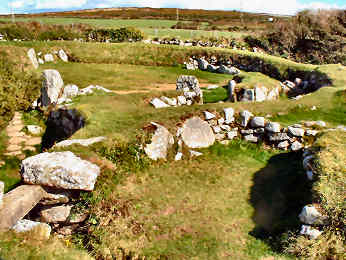
Carn Euny was only discovered by 19th century tin miners. Dating from around 500BC to 500 AD, it consists of early round houses and later more sophisticated courtyard houses. What looks like an extremely elaborate house turns out to be the later ruin of a tin miners cottage! The site has been less excavated than Chysauster and retains great charm. Most impressive feature is an enormous and fully excavated 'fogou', maybe an underground storage chamber. It is possible to drive almost to the site but much more enjoyable to park below Chapel Carn Brea and walk a mile, passing an old clay pit and St. Euny's Well, one of those wells where people tie strips of cloth in the trees, in prayer for the sick or remembrance of the dead.
Carn Euny iron age village courtyard houses
More in Antiquities
Carwynnen Quoit - or the Giant's Quoit
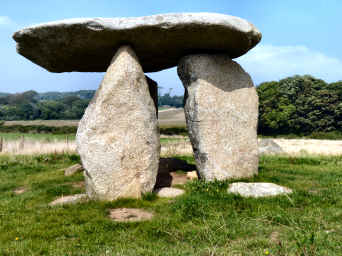
I first encountered this site when walking the Land's End Trail in an east to west direction in 2007. Carwynnen Quoit, also known as the Giant's Quoit or Devil's Frying Pan, was, when I first saw it, a totally collapsed neolithic burial chamber. To look at it then you might have wondered if it were not just a heap of rocks but there was an image of it still standing in The Modern Antiquarian. Apparently it was re-erected in the mid 20th century, only to collapse again in 1983. Now (2014) it has been re-erected by the Sustainable Trust which acuired the site in 2009. Fund-raising and acquiring the co-operation of official bodies enabled re-erection in 2014. Carwynnen Quoit is not entirely easy to find. You need to get to the tiny settlement of Carwynnen - where you can probably park - take the hill up towards Troon and go through a gate on the left. Just inside the field is an informative storyboard. When I re-visited in September 2014 I chose an alternative route. I parked in fascinating Treslothan villlage - well worth a visit in its own right - and walked through fields and woods to the road from Troon to Carwynnen, turning right to find the site. The Sustainable Trust has made a great job of restoration - though it will be some time before the now clean stones settle back into the landscape.
Castallack Round
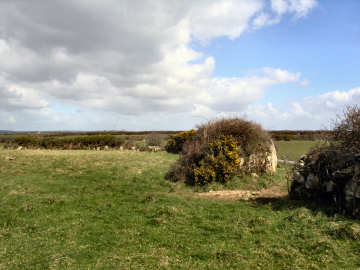
When I walked here with my sister Mary in March 2008, on my first stage of the Penwith Round, I was sufficiently puzzled by what OS102 clearly shows as Castallack Round that I returned a few days later to take another closer look. The Penwith Round route instructions are, I think, misleading, suggesting you turn right (north) on a grassy path. There is no grassy path and the entrance is before the track becomes a path and just before a wooden gate. Before I returned, I checked the usual sources (The Modern Antiquarian and Megalithic Portal) and found nothing useful. What I found on site was a large level field, a little higher than the land to its north, surrounded by a massive hexagonal wall. The image on the right shows what may have been the entrance. The site was definitely made by early man, presumably for occupation since the site was levelled. The name is confirmation, the Cornish Castallek meaning 'fortified' according to Craig Weatherhill. The wall, much degraded, stands about seven feet high in places and as much as six feet thick. Since there is supposed to be a Bronze Age hut circle in one corner - I couldn't find it - perhaps the site is of that period. What it certainly isn't is a conventional Cornish round; you only have to look at Piran or Pencarrow Rounds to see the total difference. A puzzling and fascinating site.
Castle Dore, King Mark's Hillfort
Dore, King Mark's Hillfort