Pencarrow Iron Age Hill Fort
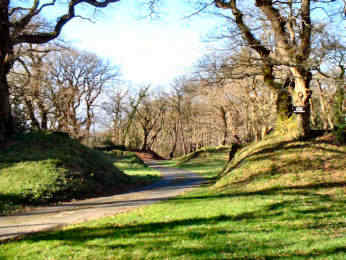
When we visited the Pencarrow estate for the snowdrops in February 2004, for the first time we drove in on the main drive. We were amazed to find that the road snaked through ancient earth works, first through an iron age farmstead enclosure, its banks still ten feet high, its outer ditch some four feet deep. Then followed a series of long outer curving banks, looking to us like a possible causewayed camp. All this in the most beautiful beech woodland imaginable. Later we visited Blisland village and lunched at St. Breward's excellent Old Inn. The site is halfway along the main driveway to Pencarrow House. Just follow the signs from Washaway on the A389 Wadebridge to Bodmin road.
Reviews Modern Antiquarian and Megalithic Portal
January 2008 - I understand that a major project is to be undertaken to clear obscuring growth from around the fortified farmstead and from around the other earthwoks between the farmstead and the house. I look forward to seeing the results of the work. May 2012, sorry still haven't been back.
Pencarrow, road snakes through fortified farmstead
More in Antiquities
Pendeen Vau Fogou
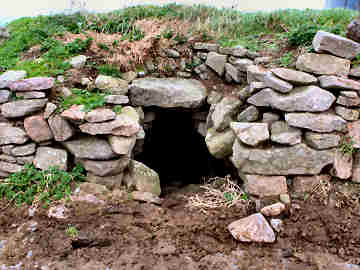
In Cornwall the word is 'fogou', in Scotland 'earth house', in France 'souterrain'. No one has any idea of the purpose of such an underground structure. Guesses include grain store and defensive retreat. Almost certainly not a burial site. I managed to miss both Pendeen Vau and Boscaswell when walking in mid-October 2007 but found both repeating the walk with sister Mary in late October. The fogou is in the farmyard of Pendeen Manor Farm - so ask permission and be prepared to ease your way past the cows and through slurry. It is worth it as you can negotiate the two main chambers easily; the second also has a small entrance. A rough subsidiary chamber has a very low opening and I did not try to enter it. If you want to, someone has helpfully put a board in place that you can crawl along. But beware, it is very muddy and messy so if you do go in, be suitably clothed. There are said to be eleven fogous in Cornwall, all in West Penwith or on the Lizard Peninsula, all dating from the late Iron Age. The most easily accessible one I know is that at Carn Euny, open all year. There is another to be found at Chysauster nearby but English Heritage does not allow access to it. Close to Pendeen Vau fogou is another at Boscaswell, now owned by the National Trust. Some say the best of all is Halligye Fogou on the Trelowarren estate on the Lizard.
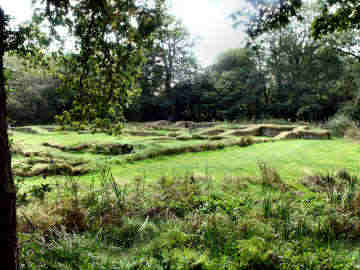
Penhallam - ruins of a very early Moated Manor House
This is both a remarkable and a confusing place. Start with confusing. Managers English Heritage call it Penhallam, but a farm a mile away is called Penhallym. Cornwall's Archaeological Heritage calls it Berry Court while the house next to the site is called Bury Court. And, just to add to the confusion, if you use the 1997 OS explorer map you will end up at Penhallym. I think the 2005 version may have it correctly located.
Piran Round near Perranporth
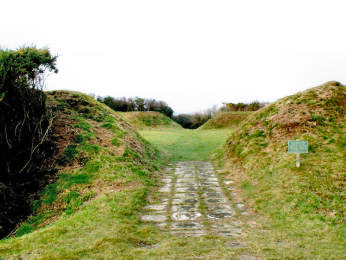
There are a hundred or more of these 'rounds' in Cornwall. Popular belief is convinced that they are 'plen-a-gwary' or 'playing places', amphitheatres created to stage the Cornish Ordinalia, early medieval Christian 'miracle plays'. Indeed, the Ordinalia was performed in these rounds, which made perfect amphitheatres, but most predate the Ordinalia by around 1000 years or more. At least the majority are the remains of iron-age fortified farmsteads. Piran (or Perran) Round, at the village of Rose near Perranporth, is an obvious example; 130 feet in diameter, its banks some 12 feet high, with a 6 foot ditch on the outside of the banks, and two entrances, it was clearly defensive. The St. Piran Project has begun clearing away scrub and weeds. An odd depression near the centre, two bowls joined by a straight channel, was probably made for one of the many activities that have taken place here - the plays, wrestling matches, village picnics, fetes and even the Cornish Gorsedd of Bards. Indeed in 1969 the Drama Department of Bristol University staged the Ordinalia here. A couple of miles north, in the sand dunes known as Penhale Sands, are the site of St. Piran's Oratory and a later church dedicated to him.