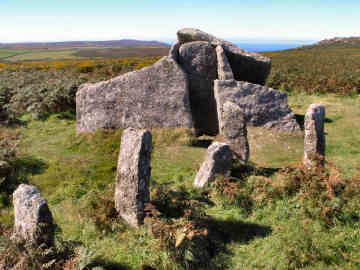
Zennor and Mulfra Quoits
Quoits
Believed to be remains of Neolithic burials, where the mound has weathered away, these quoits are known elsewhere as Cromlechs or Dolmens. Cornwall's best known are Lanyon Quoit in West Penwith and Trethevy Quoit on Bodmin Moor. This is probably just because they are easily accessible by car. Zennor and Mulfra Quiots, like their West Penwith companion Ch�n Quoit, are accessible only to those to like to walk the hills. My own view is that, of all five, Zennor is the finest - and the most unusual for having several standing stones to its front. From Zennor Quoit you can see the north coast, from Mulfra you can see the south coast and St. Michael's Mount.
Zennor Quoit
Mulfra Quoit
Photographs
More in Antiquities
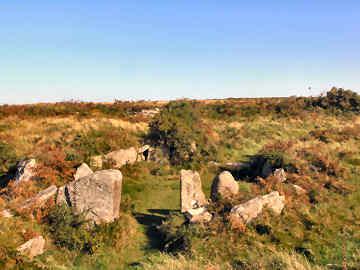
Bodrifty Iron Age Village
I know Carn Euny and Chysauster iron age villages well but had no idea that there was another with substantial remains in West Penwith. It was by pure chance, during a walk from Carn Galver car park - visiting the Nine Maidens and looking for boundary stones - that I came across Bodrifty. Within a badly degraded embanked enclosure are the remains of eight iron age roundhouses. Sadly an excavation in the 1950s did a lot of damage but the site, on a gently sloping hillside just north of Bodrifty Farm, is still well worth seeing. The location was apparently occupied in the Bronze Age but what you see now is what remains of occupation from 600BC to around 43AD. If you follow the yellow markers from the site you will find a good roundhouse reconstruction, done by Bodrifty Farm owner Fred Mustill. I believe this was done primarily for the benefit of school groups but anyone is welcome. I have passed through since on several occasions, particularly when walking the Land's End Trail. I have also learned that there are other similar iron age village remains in West Penwith, at places such as Trehyllys, Higher Porthmeor and Mulfra though these are even more degraded than Bodrifty and somewhat less accessible.
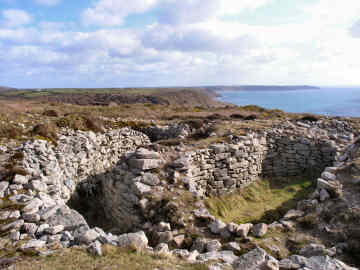
Bollowal Bronze Age Barrow
No one even knew this was there until 1878 when Cornish antiquarian W C Borlase discovered it under mining spoil. There are probably several similar barrows still hidden under the rubble elsewhere along here. The barrow was in use during both neolithic and bronze ages and includes an entrance grave, a cairn, several individual burial cists and a number of ritual pits. What you see is very striking: a central oval structure, 35 feet across with walls up to 10 feet high; all around this is a passage six feet wide with outside walls forming a 'collar' of the same height.
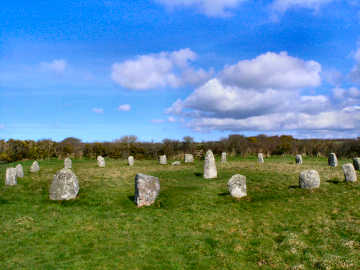
Boscawen-un Stone Circle and Trelew Longstone
In July 2006 I did a figure-of-eight walk from St. Buryan in West Penwith, mostly to find several new antiquities. On the first, southern, loop to the coast I found Cornish crosses near Boskenna, one built into a hedge by a stile. On the second, northern, loop I sought out Boscawen-�n Stone Circle and nearby Trelew Longstone. Boscawen-�n is a circle of 19 stones, a leaning 20th at its centre, a little to the west of Boscawenoon Farm. I understand the nineteen stone circle is the standard Cornish formation, though few remain thus. If you want to arrive by car, there is room for about 6 cars to park on the A30, about 2 miles west of the St. Buryan turn; a small wooden sign points towards the circle. I was back again in March 2008 while walking the Penwith Round. This time I also sought out the Trelew Longstone, eight feet high, standing near the edge of a field of maize and visible from a lane leading to Trelew Farm from the south-east. If not walking, I imagine you can probably ask at Trelew Farm for permission to park and to visit the longstone. On both walks I enjoyed coffee and a snack in the pub in St. Buryan and admired the handsome church there, itself the possessor of two Cornish crosses.