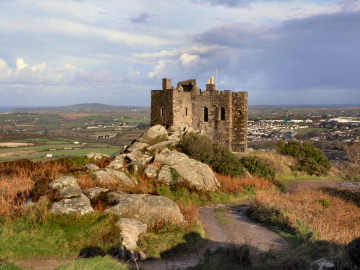
Carn Brea Castle
Brea Castle
Strictly speaking, this entry, like that for Castle-an-Dinas, does not really belong on this page. However, both feature 'castle' in their names, so here they are. Carn Brea Castle is really a medieval hunting lodge, built atop Carn Brea in the 15th century (perhaps adapted from an earlier chapel) by the Bassett family of nearby Tehidy as a hunting lodge. Its appearance, of a miniature medieval fortress, earned it its name.
Carn Brea Castle, St. Agnes Beacon far background
Wing balanced on rocky outcrop
Castle-an-
Photographs
More in Castles
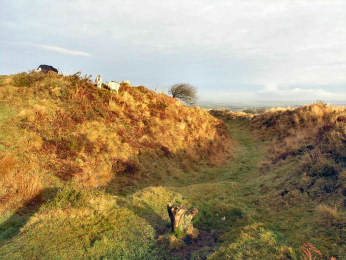
Castle-an-Dinas near St. Columb Major
Dinas near St. Columb Major
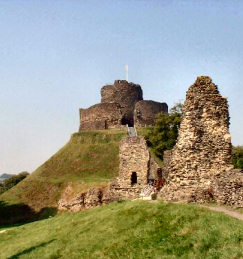
Launceston Castle
One of the earliest Norman castles, the original timber building was constructed for William the Conqueror’s brother Robert of Mortain. In the 13th century it was rebuilt in stone by Richard Earl of Cornwall, brother of Henry III. Unlike many castles, Launceston began to lose its importance early and ended as a prison – George Fox, founder of the Quakers, and with Cornish connections, was imprisoned there in 1655. Once the castle was of impressive size; now the only major structure standing is the round central keep, high on its motte. When you enter by the South Gate, you get some feeling for the original size of the castle and its once massive defences. From the keep parapet, the view of the town tells how it was once totally dominated by its castle, as therefore was the approach to Cornwall. English Heritage has good explanatory displays. Car parking nearby. You can walk freely in the park but pay for entry to the castle.
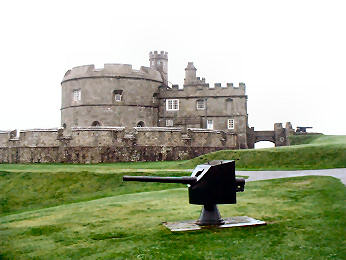
Pendennis Castle
While Jane was in Truro with her old school 'ladies who lunch' circle in mid-December 2004, I drove to Swanpool beach and walked into Falmouth to visit Pendennis Castle for the first time. Weather was dire, hence the poor sunless photo. With its counterpart across Carrick Roads at St. Mawes, the original castle was built by Henry VIII to guard Falmouth harbour. Vast encircling ramparts and bastions were built by Sir Walter Raleigh in Elizabethan times and updating (and use) continued right up to the 2nd World War, with eventual public opening in 1956. The castle has survived assault from the sea but, during the Civil Wars, was taken by siege. There are things to see of all periods: the original Tudor castle, the Elizabethan ramparts and bastions, Napoleonic War fortifications, late 19th century batteries that housed 'disappearing guns', big guns and rapid firing guns, and a World War II Observation Post. An exhibition explains Tudor coastal defences and there is a wonderfully entertaining collection of 2nd World War cartoons. The excellent guide book covers Pendennis and St. Mawes castles and the battery on St. Anthony Head. There is ample car parking and the tearoom now opens all year.