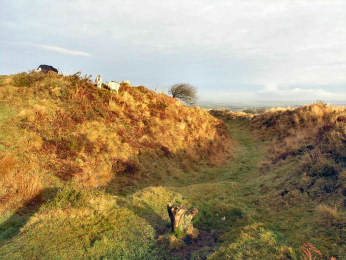
Castle-an-Dinas near St. Columb Major
Dinas near St. Columb Major
The largest easily accessible iron age hill fort in Cornwall, not to be confused with one of the same name in West Penwith, Castle-an-Dinas lies on a 700 foot hilltop to the south-east of St. Columb Major. There are two rings of banks and ditches, the outer perimeter a full half mile, the area around 10 acres. 4000 years ago all that stood here were two bronze age barrows; these are still just about discernable. Over 2000 years ago, when the fort was constructed, it would have been a hive of activity. In 1646, in the Civil War, it saw Hopton's royalist forces camping overnight. In the early 20th century it was the site of a major wulfram (tungsten) mine and an aerial ropeway ran from the ramparts to works buildings that still stand by the car park. Now it is just populated by sheep and goats, who probably pay no attention at all to the wonderful views in all directions - a toposcope stands by a barrow to help you orient yourself.
A lot of stories surround this isolated spot. Reputedly it was the site of King Arthur's hunting lodge and the place where Cador, King of Cornwall and husband of Arthur's mother Igerne, died. Ghostly armies have apparently been seen in the skies above the fort. Both murders and executions have taken place here. Standing on the ramparts, and enjoying the long views, it is hard to imagine any of these events.
Sheep and goats graze on inner ramparts
Un-numbered road, 2 miles E of junction A39/A3059
More in Castles
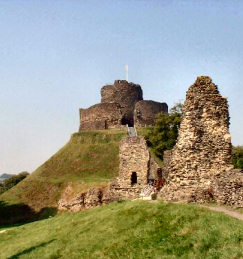
Launceston Castle
One of the earliest Norman castles, the original timber building was constructed for William the Conqueror’s brother Robert of Mortain. In the 13th century it was rebuilt in stone by Richard Earl of Cornwall, brother of Henry III. Unlike many castles, Launceston began to lose its importance early and ended as a prison – George Fox, founder of the Quakers, and with Cornish connections, was imprisoned there in 1655. Once the castle was of impressive size; now the only major structure standing is the round central keep, high on its motte. When you enter by the South Gate, you get some feeling for the original size of the castle and its once massive defences. From the keep parapet, the view of the town tells how it was once totally dominated by its castle, as therefore was the approach to Cornwall. English Heritage has good explanatory displays. Car parking nearby. You can walk freely in the park but pay for entry to the castle.
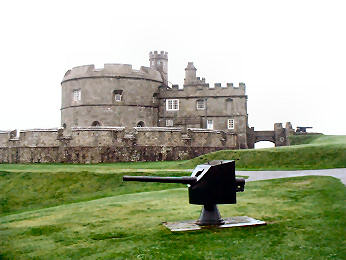
Pendennis Castle
While Jane was in Truro with her old school 'ladies who lunch' circle in mid-December 2004, I drove to Swanpool beach and walked into Falmouth to visit Pendennis Castle for the first time. Weather was dire, hence the poor sunless photo. With its counterpart across Carrick Roads at St. Mawes, the original castle was built by Henry VIII to guard Falmouth harbour. Vast encircling ramparts and bastions were built by Sir Walter Raleigh in Elizabethan times and updating (and use) continued right up to the 2nd World War, with eventual public opening in 1956. The castle has survived assault from the sea but, during the Civil Wars, was taken by siege. There are things to see of all periods: the original Tudor castle, the Elizabethan ramparts and bastions, Napoleonic War fortifications, late 19th century batteries that housed 'disappearing guns', big guns and rapid firing guns, and a World War II Observation Post. An exhibition explains Tudor coastal defences and there is a wonderfully entertaining collection of 2nd World War cartoons. The excellent guide book covers Pendennis and St. Mawes castles and the battery on St. Anthony Head. There is ample car parking and the tearoom now opens all year.
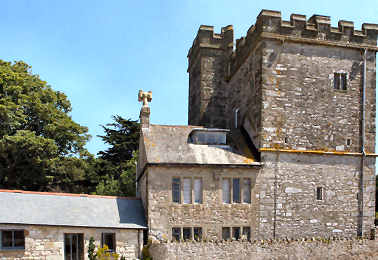
Pengersick Castle
It isn't really a castle, rather the remnant of a Tudor fortified manor house. The Pengersick family, who took the name from the lands they acquired here, have long gone, as has much of the house and the lands. The present owners do open Pengersick Castle to the public two days a week in July and by appointment. The most likely visitors are ghost hunters - there are ghost open nights too - as Pengersick has a reputation as one of the most haunted houses in Britain. The more than 20 ghosts that haunt Pengersick are said to include a 14th century monk; a 13 year old girl who danced to her death off the battlements; a small boy who tugs at ladies dresses; a woman who walks through a wall; a woman who was stabbed to death in the castle; another beaten to death in the haunted bedroom; a man murdered in 1546; a ghostly cat and dog; and several of the previous owners. If you do think of visiting and want a good bed and breakfast, if it's still operating, do try Pengersick Farm (next door) where Celia Wilson and her husband invited me to look around their garden. I guess they are blessed by being in the warmer, sheltered south but I could not believe what colour and variety they had created in just three years. To arrange a visit call 01736762579