The 'Lost Gardens' of Heligan
Heligan
Created by Henry Hawkins Tremayne in the late 18th century, Heligan was left untended in 1914 when the estate workers went to war. Later the house became apartments and the Victorian gardens went to rack and ruin. Tim Smit started restoration in 1991. Astonishingly, much original design remained under years of rampant growth. Vast areas have been revealed, restored and replanted. Of over 200 acres, the estate divides conveniently into four. Most accessible are the Northern Gardens with colourful borders in the Sundial Garden; immaculate vegetables, fruit and flowers for cutting; melons and pineapples in the Melon Yard; a small Italian Garden and a Northern Summerhouse Garden; a Rockery Ravine; and giant rhodos in spring. A long walk leads to The Jungle where a steep boardwalk guides you through lush sub-tropical growth with pools, giant gunnera, tree ferns and bamboos. A separate path leads to the Lost Valley with mature trees, small lakes and charcoal kilns. On the eastern periphery are a hilly 'Farm Walk', wildflower meadows and a Wildlife Project. Entrance is expensive so value demands that you cover at least the Northern Gardens and Jungle. There are simple food outlets at two locations. There is a good farm shop in the car park. Heligan is a vast operation and gets very busy. Stout footwear advisable.
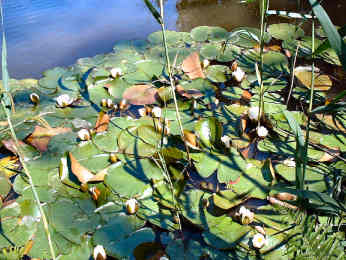
Water lilies in a pool in the Lost Valley
Signed from B3273 St. Austell-Meva. Heligan re-visited 2014
We couldn't resist Heligan's May 2007 offer of free entry for Cornish residents. We nearly didn't go in; it was pelting down when we arrived but, by the time we had finished Jane's excellent home made pasties, the clouds lifted and the sun came out. We did the whole garden and spent three hours there; you could well take longer. Since we were last there not a lot has changed but much has matured beautifully. In the Northern Garden the Ravine has filled out well and is now a marvellous rockery; the restored Greenhouse from Pencalenick was new to us; and we were delighted to see the 'handkerchief' bracts on the Davidia Involucrata in the Sundial Garden. The Jungle really does feel like one now and the boardwalk all round it is a superb way to see it. The Lost Valley has matured most and, where clearance had left it bare, now it is a lush paradise. Catering is simple but good, the car park is now vast and Lobbs Farm Shop has been extended and is now a venue in itself.
More in Gardens
The Japanese Garden at St. Mawgan
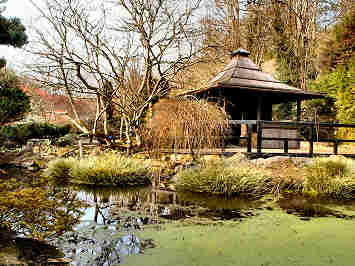
Japanese Garden at St. Mawgan
Trebah and Glendurgan revisited 2014
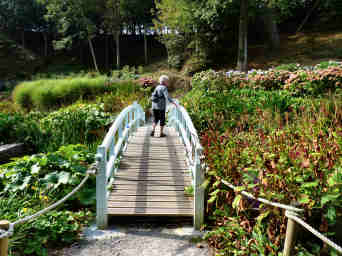
revisited 2014
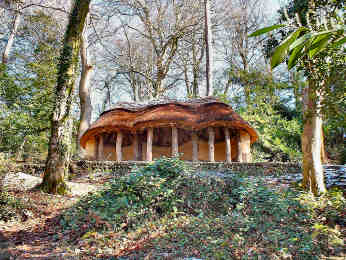
Trebah Garden
The renowned Fox family had a hand in the creation of many of Cornwall's finest gardens. Trebah, created by Charles Fox during the 1820s and 30s, is a casual and colourful semi-wild 'ravine' garden of some 25 acres, dropping 200 feet down a sheltered valley to a private beach on the broad estuary of the peaceful Helford River. After some 50 years of neglect, the Hibbert family began restoring Trebah in 1980. It is a garden of many parts and really merits the best part of a morning or afternoon to do it full justice. An impressive Visitor Centre - with shop, caf� and art gallery - is in the form of a tea planter's bungalow. Trebah’s essence is of Cornish Spring Garden - magnolias, camellias, azaleas and giant rhodos - but it is much more. Central in the ravine, a stream garden meanders through ponds and water gardens to the beach on the Helford River; around it are first bamboos, tree ferns and Chusan palms, later a sea of hydrangeas, brilliant in summer. High paths along the ravine offer glorious viewpoints and superb overviews. There is ample car parking. The National Trust's enjoyable and contrasting Glendurgan is very close by. For American interest at Trebah see the box below.