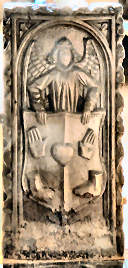
Altarnun, St. Nonna's Bench Ends
Hands and Feet
Christ on Handkerchief
Viol Player
Bagpiper
St.
Photographs
More in Churches & Holy Sites
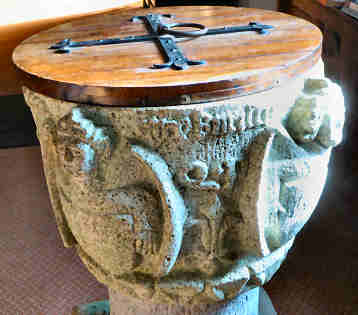
Anthony-in-Meneage
Visited on the same day in February 2019 as St. Manacaa's church in Manaccan, this is an unusually situated church, only a spit of shingle with boats parked on it separating the church from Gillan Creek and just a few cottages near it. The church was originally 13th century but only parts of the nave and transept now date from that time. To my delight, before even entering the church, I spotted a Cornish Cross, rather damaged. I found a lot to like within the church. There are fine wagon roofs with simple carved bosses. The font is circular, of the 15th century and has shield-carrying angels. In the chancel chapel a reredos of the Last Supper is said to be from Lord Byron's Newstead Abbey. In a niche in the transept is an unusual relief carving of the Last Supper. Unexpectedly, the pulpit is 20th century by Violet Pinwell, one of three Devon sisters. Stained glass is mostly late Victorian. The Royal Arms are unusually inscribed "GUL IV Rex" for James 4th. The lectern is a carved wooden eagle. Rood stairs are still in place but, disappointingly no rood screen. A carved wooden chest has a front of three panels. There is a good collection of kneelers; my favourite carried a lamb and flag within a sunburst.

Biscovey
This, rather oddly, is the parish church of the ecclesiastical parish of Par, which includes St. Blazey and Tywardreath; it's a big parish and a small church. On a sunny Saturday in early October I had a busy time visiting churches in the St. Austell/Par area. Major visit was Holy Trinity in St. Austell itself but I also enjoyed All Saints in Pentewan, St. Levan's in Higher Porthpean and, described here, St. Mary the Virgin in Biscovey. The location of St. Mary the Virgin is a surprise, high above a large circular car park on the north side of the A390 St. Austell to Lostwithiel Road. There are 32 steps to climb from car park to churchyard but the effort is well worth it. The first thing to note, in the angle between the external walls of the chancel and south aisle, is the tall remains of a Cornish Cross, sadly minus its head. This is a noteworthy church in at least one respect: It was built in 1848, the very first work of highly respected architect G E Street. The tower and spire are unusual for Cornwall, effectively a double broach spire with tiny dormers. Once inside, the high ceiling gives a feeling of spaciousness. The nave roof, of tie beam and crown post, is echoed in the aisle roof. The chancel has three stained glass windows to south, three to east, and a colourful altar cloth. The aisle chapel has a ceiling in blue and gold. The simple pulpit is of stone with blue carpeted stairs. There is an ornate brass lectern and a plain litany desk. A banner is of Virgin and Child.
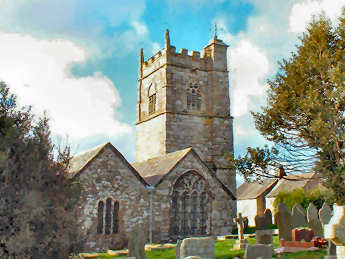
Blisland, the Church of St. Protus and St. Hyacinth
Blisland is an attractive small village set just below the western edge of Bodmin Moor. Most unusually the village centres around a large green, something you would have associated more with English shire counties than with Cornwall. Although there are some weekend homes here, there is quite a feeling of community in Blisland. Fund raising has seen a new primary school built and now the lost village stores and post office have been replaced by a new shop combining the two plus doctor's surgery, internet caf� and more. The pub on the green has a good reputation for its real ales. Architecture is typical of Bodmin Moor villages and even some new homes are granite faced. Highlight of Blisland is its church with the odd dedication to Saints Protus and Hyacinth; despite the latter's name, the two were apparently brothers. Outside, the church is typically Cornish with its squat tower and same height nave and aisle. Walk in and you might well be in a pre-Reformation church, faced as you are by a colourful rood screen, complete with rood, and chancel and chapel each with an elaborate reredos. All this was part of an 1894 restoration. There is a handsome Jacobean pulpit and the uneven roof timbers have carved bosses. The Blisland Inn is a pleasant and welcoming village local, open all day. We were very glad of its refreshments on a circular variation on a Camel Trail walk.