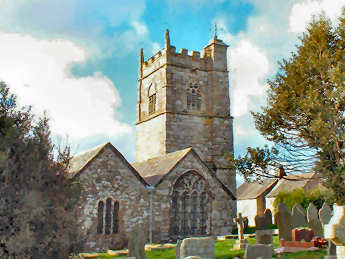
Blisland, the Church of St. Protus and St. Hyacinth
Blisland is an attractive small village set just below the western edge of Bodmin Moor. Most unusually the village centres around a large green, something you would have associated more with English shire counties than with Cornwall. Although there are some weekend homes here, there is quite a feeling of community in Blisland. Fund raising has seen a new primary school built and now the lost village stores and post office have been replaced by a new shop combining the two plus doctor's surgery, internet caf� and more. The pub on the green has a good reputation for its real ales. Architecture is typical of Bodmin Moor villages and even some new homes are granite faced. Highlight of Blisland is its church with the odd dedication to Saints Protus and Hyacinth; despite the latter's name, the two were apparently brothers. Outside, the church is typically Cornish with its squat tower and same height nave and aisle. Walk in and you might well be in a pre-Reformation church, faced as you are by a colourful rood screen, complete with rood, and chancel and chapel each with an elaborate reredos. All this was part of an 1894 restoration. There is a handsome Jacobean pulpit and the uneven roof timbers have carved bosses. The Blisland Inn is a pleasant and welcoming village local, open all day. We were very glad of its refreshments on a circular variation on a Camel Trail walk.
For a little more sophistication, eat at the Old Inn at St. Breward.
St. Protus & St. Hyacinth, Blisland
Parking by village green near church. More Blisland
Although I had already been through Blisland on several previous occasions, the first occasion on which I spent any time there was in February 2007. Then I took several photographs of the village and of the church exterior. In April 2016 i looked inside the church and took just a couple of photos. It was not until January 2018 that I took a proper look inside the church, having read Pevsner so that I had a fair idea of what I was looking at. From the outside the Church of Saints Protus and Hyacinth (a strange dedication) is a standard Cornish church, but differs a little from the Cornish norm. From the road you see a standard three stage tower with a stair turret serving as a buttress. But behind that tower is a south transept, next to it the entrance porch. Pay attention to the roof of the porch before entering the church: it is barrel shaped with carved cross struts and carved bosses. Unusually, several of the bosses are human faces; I wonder whether they were of parishioners of the time. The original Norman church was cruciform but has lost one of its arms. The interior is remarkable and unlike any other Cornish church that I know, except, to a lesser extent, Little Petherick. the extent of its colourful decoration suggesting rather a Catholic church. Ceilings are Cornish enough, barrel vaulted with carved bosses. But the rood screen, which extends across all three bays, is probably the finest example in Cornwall; pity it is a pastiche, rather than an original. For all that, its design, completed by F C Eden in 1896, is strikingly colourful and beautiful. The High Altar is in the Italian Renaissance style with an attractive altar cloth and a striking gilded reredos. Unusually there are two fonts, a circular Norman one of Polyphant stone and an octagonal one of the 15th century; the latter has an elaborate wooden cover. The pulpit is in the style of Grinling Gibbons. Stained glass in the chancel is by Sir Ninian Comper. There is a Cornish Wheel Cross in the graveyard; another stands at the western end of the attractive green and yet another on the road south to the A30.
Porch Ceiling Boss
The Elaborate and Colourful Rood Screen
Nicely Carved Pulpit
Photographs
More in Churches & Holy Sites
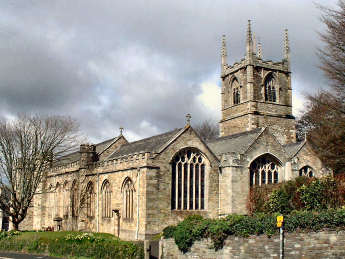
Bodmin
, St. Petroc's Church
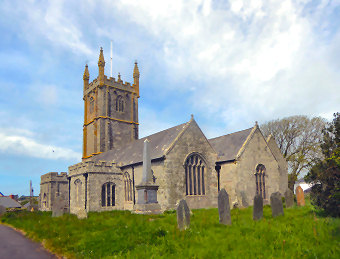
Breage and Sithney
I visited Breage, on the Marazion and Penzance road in mid-May 2017 to add to my collection of Cornish Crosses by finding one in Breage. As it turned out, the first one I found wasn't in Breage but on the Helston to Marazion road, on the corner of a lane, opposite the car park of Trevena garden centre. Having photographed the cross, I continued on to Breage where there was indeed a Cornish Cross in the churchyard, near the porch. The church, as so often in Cornwall, stands on a lann, a high mound, suggesting an older pre-Christian site. On Shute Hill, leading up to the church, there are attractive cottages; beyond the church is the Queens Arms Inn. The church itself consists of nave, two aisles and a three-stage tower. The lych gate opposite the pub lacks roof and coffin rest but does have a coffen stile. Inside, the nave is impressive and the chancel is approached beneath an elaborate rood screen, complete with rood, beyond it an elaborate reredos. On north and south walls are several wall-paintings. An inscribed "Roman" stone stands in a corner of the south aisle. A carved stone, possibly part of a headstone, inscribed in Latin, stands beneath a window. Sithney's church was closed (and in 2018) so no report yet.
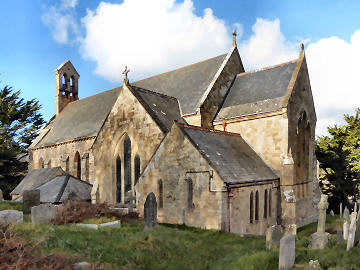
Bude's Churches
At the end of November 2017 I revisited both Bude and nearby Marhamchurch. I was in Bude primarily to look around St. Michael's Church, which stands above the Falcon Inn on the south side of the Bude Canal. While there I also took a look at the large former Methodist Chapel in Flexbury on the north side of Bude Golf Course. The dark, forbidding chapel is all boarded up and looks thoroughly abandoned. It stands forlorn on the corner of Flexbury Park and Flexbury Park Road, at the very southern end of Flexbury. St. Michael's Church, just up the hill past the Falcon Hotel is another matter entirely. It stands in a large sloping graveyard. Pevsner, in 1970, dismissed it as "unimportant" but I feel that he under-rated it badly and, indeed Peter Beacham, in the 2014 Pevsner, is quite complimentary. Designed by George Wightwick and started in 1834, it is of warm, yellow Trerice stone. Inside, the elaborately carved font in a two-bay Baptistery is on a base of Polyphant stone. Unusually there are prayer desks, decorated with biblical scenes and exhortations to prayer. A colourful rood stands high, balanced on two gilt angels. in a wall niche, St. George slays the Dragon. Outside, the path to the porch is decorated with patterns of coloured pebbles. What a contrast to the dour and forbidding former Methodist Church, now locked and shuttered.