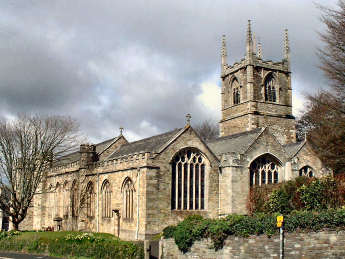
Bodmin
, St. Petroc's Church
The first Christian foundation in Bodmin was that of St. Guron around 500 AD; his well is under the little granite building by the west end. St. Petroc came from Wales in around 530 AD, founded churches in Cornwall and Brittany, took over St. Guron's cell in Bodmin and is considered father of the Cornish church. Padstow, where he founded his first settlement, is named for him - St. Petroc's holy place. The greatest treasure in Bodmin’s church is Saint Petroc's reliquary casket, made around 1170. His remains have had a chequered history; moved from Padstow in the 10th century, they were stolen by French monks but returned in the elaborate ivory and gold casket, now on display behind glass in the church. The casket was lost, rediscovered, put on display in 1957, then lost again only to turn up on a Yorkshire moor. Enter by a handsome porch, above it two priest’s rooms. Within the church are some unusual features; an impressive carved Norman font, a lantern cross, 16th century painted panels, the fine Vivian tomb and an unusual lectern, apparently made from old benchends. To the north east of the church are the ruins of the chantry chapel of St. Thomas a’Becket. Once the county town of Cornwall, now superseded by Truro, Bodmin is the terminus of the Bodmin & Wenford steam railway.
See also St.Petroc's church in Padstow - More St. Petroc's
St. Petroc's Church, East End
No parking outside but ample nearby.
More St.
More in Churches & Holy Sites
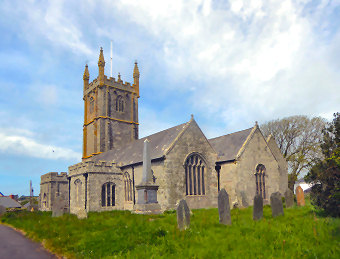
Breage and Sithney
I visited Breage, on the Marazion and Penzance road in mid-May 2017 to add to my collection of Cornish Crosses by finding one in Breage. As it turned out, the first one I found wasn't in Breage but on the Helston to Marazion road, on the corner of a lane, opposite the car park of Trevena garden centre. Having photographed the cross, I continued on to Breage where there was indeed a Cornish Cross in the churchyard, near the porch. The church, as so often in Cornwall, stands on a lann, a high mound, suggesting an older pre-Christian site. On Shute Hill, leading up to the church, there are attractive cottages; beyond the church is the Queens Arms Inn. The church itself consists of nave, two aisles and a three-stage tower. The lych gate opposite the pub lacks roof and coffin rest but does have a coffen stile. Inside, the nave is impressive and the chancel is approached beneath an elaborate rood screen, complete with rood, beyond it an elaborate reredos. On north and south walls are several wall-paintings. An inscribed "Roman" stone stands in a corner of the south aisle. A carved stone, possibly part of a headstone, inscribed in Latin, stands beneath a window. Sithney's church was closed (and in 2018) so no report yet.
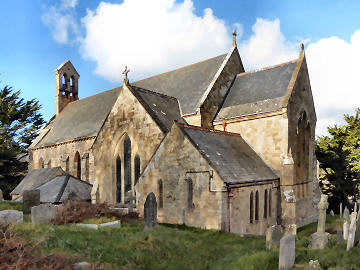
Bude's Churches
At the end of November 2017 I revisited both Bude and nearby Marhamchurch. I was in Bude primarily to look around St. Michael's Church, which stands above the Falcon Inn on the south side of the Bude Canal. While there I also took a look at the large former Methodist Chapel in Flexbury on the north side of Bude Golf Course. The dark, forbidding chapel is all boarded up and looks thoroughly abandoned. It stands forlorn on the corner of Flexbury Park and Flexbury Park Road, at the very southern end of Flexbury. St. Michael's Church, just up the hill past the Falcon Hotel is another matter entirely. It stands in a large sloping graveyard. Pevsner, in 1970, dismissed it as "unimportant" but I feel that he under-rated it badly and, indeed Peter Beacham, in the 2014 Pevsner, is quite complimentary. Designed by George Wightwick and started in 1834, it is of warm, yellow Trerice stone. Inside, the elaborately carved font in a two-bay Baptistery is on a base of Polyphant stone. Unusually there are prayer desks, decorated with biblical scenes and exhortations to prayer. A colourful rood stands high, balanced on two gilt angels. in a wall niche, St. George slays the Dragon. Outside, the path to the porch is decorated with patterns of coloured pebbles. What a contrast to the dour and forbidding former Methodist Church, now locked and shuttered.
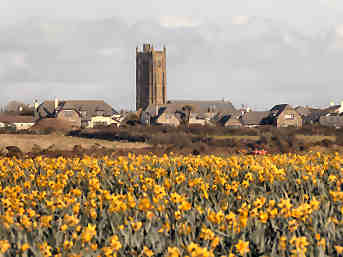
Buryan, St. Buriana
I visited Buryan in mid-February 2018 on an outing which also included St. Levan, the church high above the cliffs of Porth Chapel. Buryan is a substantial village with a store and a pub, the St. Buryan Inn, where I enjoyed a coffee on my visit. The church stands within a raised circular enclosure, usually signifying a pre-Christian site. Legends surrounding the founder of the original church on this site tell us that the 6th century saint was buried here after perishing while kidnapped by a local king, despite the attempts by St. Piran, patron saint of Cornwall's tin miners, to save her. I was there not only to look inside the church but also to photograph the two Cornish crosses, both up on substantial plinths, one inside the churchyard, one outside. A third stands at the roadside to the south of the village. On the way into the church, note the wooden porch ceiling, very typically Cornish. Unusually for Cornwall, St. Buriana's is mostly of one period, the Perpendicular Gothic. Its impressive scale is due to its origins as a collegiate church, founded by English King Athelstan in the 10th century, refounded in 1238 by Bishop Brewer of Exeter. The church is similar in plan to St. Petroc's in Bodmin, with nave, two aisles and a tower with stair turret. The interior is high, spacious and light. Roofs are Cornish wagon roofs. The superb restored elaborately carved rood screen stretches the full width of the church. Furnishing includes a fine 16th century font, a 20th century altar and reredos by E H Sedding. A litany desk is fashioned from medieval bench ends. Unusually there are misericords in the choir. A 13th century monument to Clarice de Bolleit bears an inscription in Norman French. Stained glass is by Alexander Gibbs and Ward & Hughes. A superb church, not to be missed.