Camelford, St. Thomas Church
This is not the most obvious church to spot but, once you know where it is, it is one of the easiest to visit. Entering Camelford from the south on the A39, turn left into the car park just as you begin to climb to the exit from the town. As you turn into the car park St. Thomas Church is just above you on your right. Easy access, free parking. The church is small, low and quite ordinary looking. Surprises await you inside. The north wall is nicely arcaded in grey granite. The slate floored chancel is light and airy. The nave has a fine Cornish wagon roof, the bosses all carved to individual different designs and coloured and gilded most attractively.
Unusual Ceiling Boss
St. Thomas Camelford
Elaborate Ceiling Boss
Photographs
More in Churches & Holy Sites
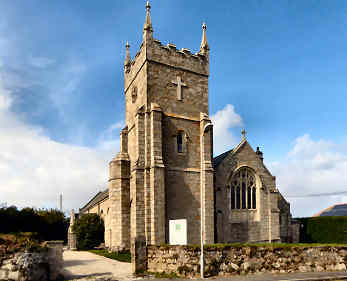
Carbis Bay, St. Anta and All Saints
Modern, of little interest, closed when I was there.
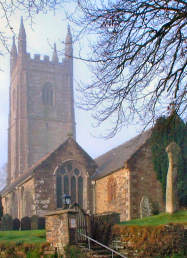
Cardinham
, St. Meubred

Charlestown, St. Pauls
I used to love Charlestown but feel that since Square Sail have owned the village and harbour things have changed for the worse: parking is expensive (�2.50 for the first hour), toilets are charged though, to be fair, they now are in most places. However, in February 2018 I was not in Charlestown to see the village, rather to take a look at St. Pauls Church, on the northern limits of the village. Unlike almost all Cornish churches, St. Pauls is not medieval but Victorian. Dating from 1851, it is the work of Christopher Eales, who was also responsible for the market halls and town halls in Truro and St. Austell. The style is Early English. It consists of nave, two aisles, north porch and a tower heightened in reconstituted stone. Inside is convincingly early Gothic. The tall nave has clerestories and the aisles are tall and narrow. A granite altar stands on a Delabole slate base. A wrought iron chancel screen is topped by a rood beam with impressive rood figures. There is some good stained glass from the latter part of the 19th century. The nave ceiling, with its curved woodin arches is quite striking. The octagonal font carries small shields, apparently un-inscribed. On a stone base, with stone steps, the wooden pulpit is nicely carved with biblical figures. On a wall, a metal plate may be of Newlyn copper. The altar carries elaborate brass candlesticks. Altogether, a very much more interesting church than I had expected.