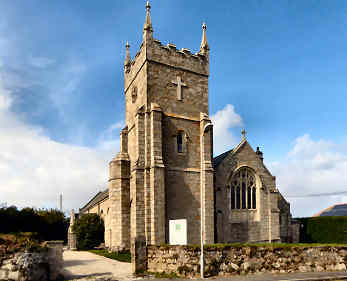
Carbis Bay, St. Anta and All Saints
Modern, of little interest, closed when I was there.
More in Churches & Holy Sites
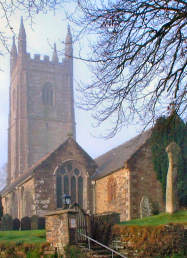
Cardinham
, St. Meubred

Charlestown, St. Pauls
I used to love Charlestown but feel that since Square Sail have owned the village and harbour things have changed for the worse: parking is expensive (�2.50 for the first hour), toilets are charged though, to be fair, they now are in most places. However, in February 2018 I was not in Charlestown to see the village, rather to take a look at St. Pauls Church, on the northern limits of the village. Unlike almost all Cornish churches, St. Pauls is not medieval but Victorian. Dating from 1851, it is the work of Christopher Eales, who was also responsible for the market halls and town halls in Truro and St. Austell. The style is Early English. It consists of nave, two aisles, north porch and a tower heightened in reconstituted stone. Inside is convincingly early Gothic. The tall nave has clerestories and the aisles are tall and narrow. A granite altar stands on a Delabole slate base. A wrought iron chancel screen is topped by a rood beam with impressive rood figures. There is some good stained glass from the latter part of the 19th century. The nave ceiling, with its curved woodin arches is quite striking. The octagonal font carries small shields, apparently un-inscribed. On a stone base, with stone steps, the wooden pulpit is nicely carved with biblical figures. On a wall, a metal plate may be of Newlyn copper. The altar carries elaborate brass candlesticks. Altogether, a very much more interesting church than I had expected.
Cleer, St. Clair's Church
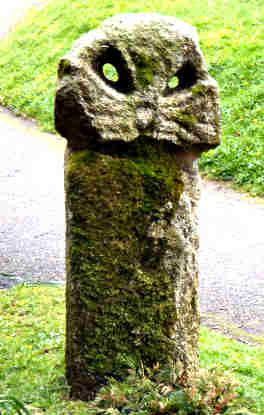
I first saw St. Cleer church in 2011 in the course of a round walk south from Minions which included Trethevy Quoit and King Doniert's Stones. I had not been back there again until I visited in mid-March 2019. I parked in the public car park (handy free toilets) to the north side of the church and entered the churchyard from the north-west corner. The three-stage tower is exceptionally fine and topped with conical pinnacles. On heading round to the south porch, the first thing I noticed was a small Cornish Cross to the left of the porch. Then, propped against the left-hand side of the porch, a slate bearing a welcome message. The porch itself has a wagon roof and a substantial double door to the body of the church. Much of the church is of the 14th and 15th centuries, though the north arcade may be late 13th century. Unusually the north arcade is of green Polyphant stone. There is a squint between the north aisle and the chancel. The fine chancel arch is of the late 19th century with a wooden arch and a wagon roof with angel corbels; this was part of an early 20th century restoration by H Fellowes Prynne. Also the result of Prynne's restoration are the altar front, reredos, rood and parclose screens, the choir stalls and bench ends. The elaborately decorated 1896 pulpit is by Harry Hems of Exeter. A large Royal Arms is dated 1708. Stained glass is mostly early 20th century, much of it by Clayton and Bell. Facing you as you enter is a fine massive slate chest tomb of Robert Langford, of 1624. There are some handsome buildings opposite the north-west corner of the churchyard, the Vicarage and a County Police Station of 1859.