
Constantine, St. Constantine's Church and Well
Constantine's Church and Well
I found St. Constantine's Well in 2004, on Trevose Golf Course, but had to wait till 2007 to find his church. Wondering about Constantine, research came up with conflicting stories, placing the saint variously in Ireland, Scotland, Wales and Cornwall, though all agreed on the 6th century. I prefer the 'Britannia Early British Kingdoms' version, supported by references in the annals of the scholar monk Gildas. Constantine, cousin of King Arthur, survived the battle of Camlaan and succeeded his father Cado as King of Dumnonia (Devon and Cornwall). Out hunting, his quarry took refuge in St. Petroc's monastery at Padstow. Impressed by the power of sanctuary Constantine became Christian. He helped found Petroc's monastery at Bodmin, founded others at Cornwall's two Constantines then joined St. David in Wales. He was killed by Irish pirates in Kintyre (Scotland) in AD 576 (or 598). His Cornwall feast day is 9th March. The well remains are nicely housed under a roof but the church is a sad affair. The well site is obvious. The church is to the north of it and a path is signed up a dune. What little remains of the church can only be seen by climbing the thorn and bramble covered dune. This must be a candidate for the care of Cornwall Heritage Trust, which does so good a job. For now, it would be nice if the golf club could maintain the site a little.
Follow the path across the golf course towards Trevose Head
The Well beneath its modern protective roof
Padstow, St.
More in Churches & Holy Sites

Cornelly, St. Cornelius Church
On the same day in late March 2018 that I looked at churches in Tregony and Kenwyn, I paid a visit to the tiny church at Cornelly, tucked away off a quiet lane near Tregony. Normally this is locked tight but information from the flower ladies in Tregony told me that St. Cornelius church would be open for Easter flower arranging. So it was and lovely the flowers were, too. Like so many churches in Cornwall, this one, high on a raised mound, is probably on a pre-Christian site. First thing you notice is the oddly small tower, partly 13th century, pinnacled and leaning away from its church. Inside, the church was beautifully decorated with Easter flower arrangements. Other than the lovely flowers, the most noticeable features were the wagon roofs and the hexagonal wooden pulpit, its panels bearing crudely painted coats-of-arms, presumably of local families including early patrons, the Gregors. The octagonal font is late medieval but surprisingly rustic for that period. The altar is unusual and seems to be constructed of Delabole slate. Notable monuments include one to Jane Reeves and another to Elizabeth Gregor. A panel on the wall portrays the church's patron saint, Cornelius. Do note the unusual altar pictured below and the pulpit panel featuring, I think, martlets.
Coverack, St. Peter's
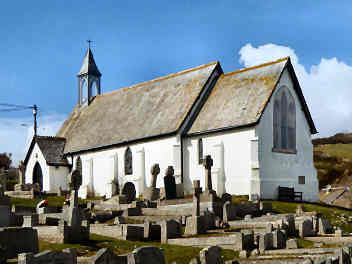
An unusual church for Cornwall, where most churches are of the late Norman or medieval periods. St. Peter's, which stands on high ground not far from the sea, is Victorian in date, being built in 1885, but really not Victorian in character, having much more of a 20th century air to it. A small lych gate leads into the sloping graveyard, from which there are lovely sea views, in one direction to Lowland Point, in the other to Coverack's little harbour. Notable in the interior are the font, lectern and pulpit, all of polished red and green serpentine from the Poltesco quarry on the Lizard. Good 20th century stained glass by Clayton & Bell. By the path up to the church I noticed a small metal teddy bear holding a vase.
Crantock, St. Carantoc Church
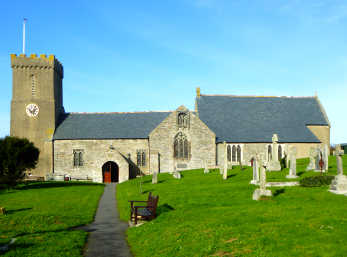
Crantock is a pleasant little village to the south of Newquay; I have described and pictured it on my Towns and Villages page. Its 14th and 15th century church, dedicated to St. Carantoc stands on an ancient holy site: this was a monastic site in Saxon times and a church stood here as early as 1086. As I approached the church, past the Old Albion Inn and Lychgate Cottage and through the lych gate into the churchyard, the first thing I noticed was a plethora of memorial crosses; to my disappointment, there was not a single old Cornish Cross among them. The next thing I noticed was a crucifixion scene set into the gable of the south transept, more usual, I would have thought, in a Catholic church than an Anglican. Inside, you would swear you were in an original medieval church; you would be paying a compliment to the skill and artistry of architect J H Sedding who restored the church at the turn of the 19th century. Most striking feature of the interior is the rood screen and rood, behind and above them the striking chancel and colourful ceiling. The seating in the quire is finely carved as is the pulpit and carved bench ends are also notable. The font is in the Norman style but probably of the 15th century. On the wall of the south transept is a painted wooden panel, probably 17th century Dutch and depicting Abraham. Most stained glass is early 20th century but in the sacristy there are fragments of medieval glass.