
Constantine, St. Constantine
This substantial church, consisting of nave, two aisles, tower and porch, stands on an eminence a couple of miles north of the Helford River, with long views to Goonhilly Downs. Little remains of the original 12th century church as it was largely rebuilt in the 15th and early 16th centuries with an additional north chapel known as the Bosahan Aisle for the local family of that name. Among the furnishings are a small section of rood screen with floral carving, a chest with some fine finely carved 16th century panels and an elaborately carved pulpit. There are some brasses, of the Gerveys and Pendarves families. A wall monument is to Jane Penticost, with another to William Nichols. In the graveyard on the south-east side is a low Cornish Cross. On the north-west side are remains of two cross shafts. A much better Cornish Cross is to be found at Trevease Farm, 2 1/2 miles to the north-west. Also on the north side of the churchyard is a Church Room of around 1700.
Rood stairs
Constantine Church
Elaborately carved pulpit
Photographs
More in Churches & Holy Sites

Constantine, St. Constantine's Church and Well
Constantine's Church and Well

Cornelly, St. Cornelius Church
On the same day in late March 2018 that I looked at churches in Tregony and Kenwyn, I paid a visit to the tiny church at Cornelly, tucked away off a quiet lane near Tregony. Normally this is locked tight but information from the flower ladies in Tregony told me that St. Cornelius church would be open for Easter flower arranging. So it was and lovely the flowers were, too. Like so many churches in Cornwall, this one, high on a raised mound, is probably on a pre-Christian site. First thing you notice is the oddly small tower, partly 13th century, pinnacled and leaning away from its church. Inside, the church was beautifully decorated with Easter flower arrangements. Other than the lovely flowers, the most noticeable features were the wagon roofs and the hexagonal wooden pulpit, its panels bearing crudely painted coats-of-arms, presumably of local families including early patrons, the Gregors. The octagonal font is late medieval but surprisingly rustic for that period. The altar is unusual and seems to be constructed of Delabole slate. Notable monuments include one to Jane Reeves and another to Elizabeth Gregor. A panel on the wall portrays the church's patron saint, Cornelius. Do note the unusual altar pictured below and the pulpit panel featuring, I think, martlets.
Coverack, St. Peter's
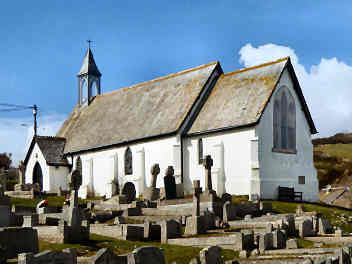
An unusual church for Cornwall, where most churches are of the late Norman or medieval periods. St. Peter's, which stands on high ground not far from the sea, is Victorian in date, being built in 1885, but really not Victorian in character, having much more of a 20th century air to it. A small lych gate leads into the sloping graveyard, from which there are lovely sea views, in one direction to Lowland Point, in the other to Coverack's little harbour. Notable in the interior are the font, lectern and pulpit, all of polished red and green serpentine from the Poltesco quarry on the Lizard. Good 20th century stained glass by Clayton & Bell. By the path up to the church I noticed a small metal teddy bear holding a vase.